This thread has been locked.

If you have a related question, please click the "Ask a related question" button in the top right corner. The newly created question will be automatically linked to this question.

PROCESSOR-SDK-AM437X: Combine QSPI and FATFS Console Project

Expert 1700 points
Part Number: PROCESSOR-SDK-AM437X
Other Parts Discussed in Thread: SYSBIOS

Hello,

I am running the "FATFS_Console_idkAM437x_armExampleProject" of the Processor SDK RTOS AM437x v5.3.0.7 version using CCS 8.3.0.9. The code is running on the AM437x IDK board.

My plan is that I write an own “QSPI flash preparation” tool, this tool should open a file located on the SD card and copy it to the QSPI flash (in my case the file would be the QSPI secondary bootloader (SBL)). Afterwards I want to remove the SD card and see that the QSPI SBL is being loaded from by the ROM bootloader (RBL) upon the next power cycle.

What that means is, I want to combine the two example projects "FATFS_Console_idkAM437x_armExampleProject" and “QSPI_BasicExample_idkAM437x_armExampleProject” with each other.

I did the following things:

Step 1

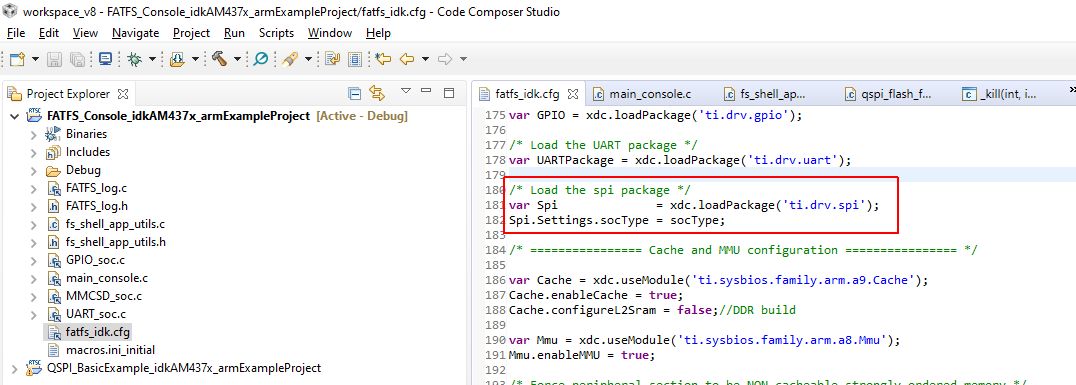
I took as a base the "FATFS_Console_idkAM437x_armExampleProject" and loaded the SPI package inside the configuration file.
Step 2

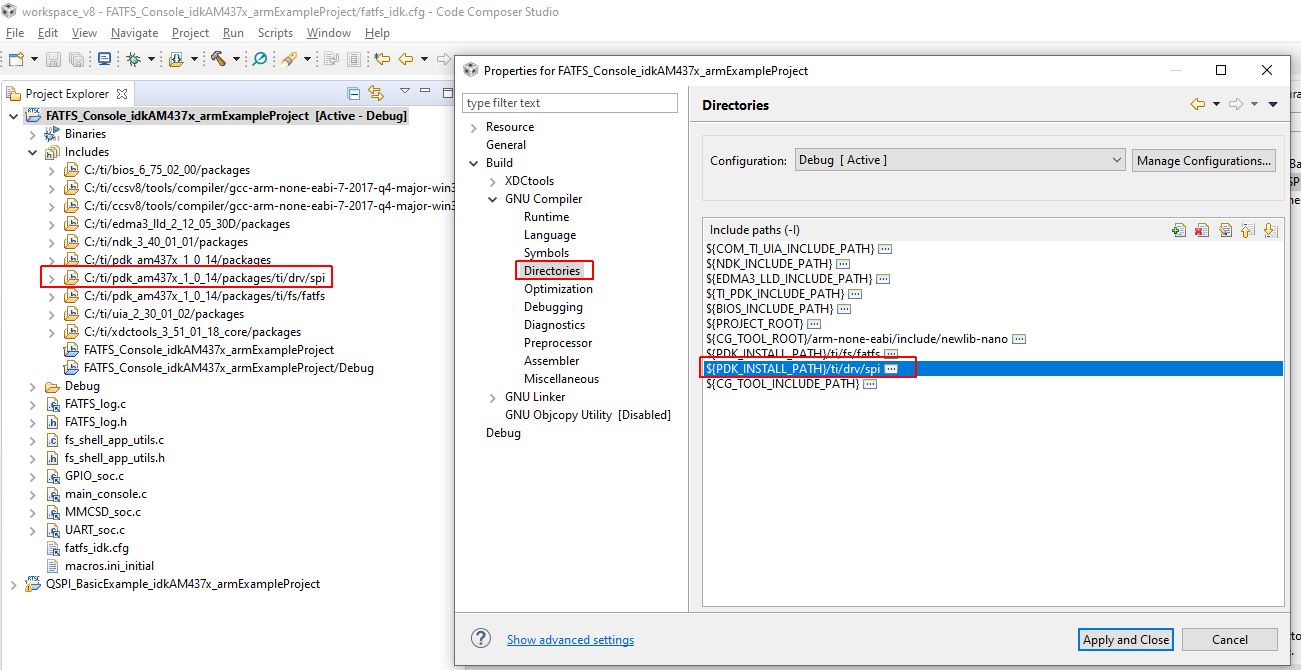
I added the “ti/drv/spi” path to the include directories like inside the “QSPI_BasicExample_idkAM437x_armExampleProject”.
Step 3

I copied some first minimalistic code from the “QSPI_BasicExample_idkAM437x_armExampleProject” to the "FATFS_Console_idkAM437x_armExampleProject".

When I now call the function SF25FL_open, I get an exception somewhere deep in the driver (I assume inside the CSL but I need to dive in a bit deeper).

I don’t see any other significant differences between the two example projects. Can you please tell me if I missed anything?

Thanks,

Inno

  • Hi Inno,

    I cannot tell exactly what could be missed. Maybe you can compare the xdc configuration files of the two projects and see if there is anything else from project  “QSPI_BasicExample_idkAM437x_armExampleProject” that needs to be added to project "FATFS_Console_idkAM437x_armExampleProject".

    Regards,

    Jianzhong

  • Hello Jianzhong,

    Thank you very much. I was able to make some progress due to your advice. As you said, there was indeed something missing in the XDC config file. Now I am able to to get access to the QSPI flash but the FAT file access functions crash with the same kind of error. Let me explain...

    At the end of the XDC configuration file for the "FATFS_Console_idkAM437x_armExampleProject" you will see the following lines:

    I identified that inside the XDC configuration file of the "QSPI_BasicExample_idkAM437x_armExampleProject", there are additional lines, which I simply copied to the FAT example project (see red rectangle in the following picture). I have to admit that I don't know the meaning of those instructions.

    Nevertheless, from now on I can access own written functions that read meaningful data out of the QSPI flash via the help of the QSPI nor flash driver from TI (I highlight them with a greed rectangle) but the software crashes now when I call file access functions such as "FSShellAppUtilsFrmtPath" (see red rectangle in the following picture). And the crash is almost identical with what I initially reported. 

    So copying the instructions from the QSPI to the FAT XDC config file repairs the QSPI flash access but breaks the FAT function calls. 

    My questions are:

    1) What is the meaning of the lines, which are placed at the bottom of the XDC configuration files (the function call Mmu.setFirstLevelDescMeta() )?
    2) How can I make it happen, that within the same project I can access the NOR flash driver functions and also in parallel the file access driver functions?

    Thanks,

    Inno

  • Hi Inno,

    Mmu.setFirstLevelDescMeta() is from the memory management unit. Please refer to <BIOS installation folder>/docs/cdoc/ti/sysbios/family/arm/a8/Mmu.html for details.

    The crash problem you had was most likely caused by conflict of MMU configurations from the two example projects. You may also want to look at this thread which has some good explanation of MMU usage: https://e2e.ti.com/support/processors/f/791/t/908657

  • Hello Jianzhong,

    I will read the E2E post and the HTML documentation inside the SDK carefully. I found the following statement inside the E2E post that you mentioned above:

    "The MMU will generate exceptions without these translation table entries when when CPU attempts R/W access to addresses in these pages."

    This is most likely what happens to me in my initial post.

    In the meanwhile it seems that I also found the cause of my second crash. This is not connected to the MMU configuration. I guess I identified a bug inside the "FATFS_Console_idkAM437x_armExampleProject" project. I basically copied certain code from the "FSShellAppUtilsCmdCat" to my own function, but I believe that even inside the "FSShellAppUtilsCmdCat" is a bug. 

    Please look at the below "FSShellAppUtilsFrmtPath" function call:

    You see above that the function "FSShellAppUtilsFrmtPath" is being called with the argument "argv[1U]" in any case. "argv[1U]" is a pointer, which points to the 2nd argument of the console command. If I type in e.g. the console command "cat readme.txt", then "argv[1U]" points to the 'r' of "readme.txt".

    But what if I call the "cat" command without any further argument? In this case "argv[1U]" may not be initialized and may point anywhere! So I managed to let the software crash even when calling the "cat" command out of the UART console.

    What I believe is missing inside the function "FSShellAppUtilsCmdCat" is code like this:

    if(argc <= 1)
    {
       FATFS_log("Too little arguments, enter filename when calling CAT !!!!\n");
       return CSL_ESYS_FAIL;
    }

    What do you think, can this be a bug?

    Another question, the program of the example projects runs on the DDR memory starting at the base address of EMIF at 0x80000000. So why do we need to add, inside the XDC configuration file, a table entry to the ARM MMU translation table for the peripheral registers, which the code accesses, but not for the DDR memory? I wonder why the following lines, taken from the "Mmu.html" file, is not part of every example project configuration file:  

    // Set the descriptor for each entry in the address range
    for (var i=0x80000000; i < 0x90000000; i = i + 0x00100000) {
        // Each 'SECTION' descriptor entry spans a 1MB address range
        Mmu.setFirstLevelDescMeta(i, i, attrs);
    }
    

    I would also expect that the ARM core creates an exception if he does not identify a "translation table hit" when accessing the DDR.

    Thanks,

    Inno 

  • inno said:
    So why do we need to add, inside the XDC configuration file, a table entry to the ARM MMU translation table for the peripheral registers, which the code accesses, but not for the DDR memory?

    I think it is because because SYS/BIOS configuration automatically adds MMU entries for the CPU memory map.

    E.g. in bios_6_73_01_01/packages/ti/sysbios/family/arm/a8/Mmu.xs there is the function module$static$init which has a loop which iterates through Program.cpu.memoryMap adding MMU table entries.

    Where the ti.sysbios.family.arm.a8.Mmu SYS/BIOS module is also used for the Cortex-A9 AM37x devices.

  • Thank you Chester. I found the following inside the map file:

    So the MMU translation table is most likely located on the DDR memory. So how can the SYS/BIOS configuration add the DDR memory sections to the MMU table, which resides on the DDR? Isn't this a conflict? At the beginning I would assume that the DDR is not accessible except the ARM core operates in a state where he does not involve any memory translation operations.

    Jianzhong, what about the issue that I had with calling "FSShellAppUtilsFrmtPath" when no argument has being used in the console when calling a command. Can this be a bug?

  • inno said:
    At the beginning I would assume that the DDR is not accessible except the ARM core operates in a state where he does not involve any memory translation operations.

    At reset the MMU is disabled. See the M bit in System Control Register from the Cortex-A9 Technical Reference Manual.

    bios_6_75_02_00/packages/ti/sysbios/family/arm/a8/Mmu.c contains the functions which setup the MMU.

  • Thank you Chester, this explains everything.

    Jianzhong, can you please check about my above question regarding the example project? Does it make sense calling "FSShellAppUtilsFrmtPath" when no further argument has being entered by the user in the console when calling a command. Can this be a bug? Afterwards I can close this E2E post.

  • Hi Inno,

    Thanks for reporting the issue in the FATFS example code. I agree with you that the code should check if a command's argument is empty and take actions accordingly. We will improve this code in future releases.

    Thank you Chester for your contribution.

    Regards,

    Jianzhong