Other Parts Discussed in Thread: TM4C1294NCPDT, TM4C129ENCPDT
Hello to everyone
While using the following code I am trying to communicate two tm4c1294ncpdt cards with can protocol, I get an "error #10234-D: unresolved symbols remain" error.
This is my code:(referenced from here: ohm.ninja/.../ )
/*
* CAN bus LED controller master firmware
* Written for TI Tiva TM4C1294NCPDT
*/
#include <stdbool.h>
#include <stdint.h>
#include <math.h>
#include "inc/hw_memmap.h"
#include "inc/hw_types.h"
#include "inc/hw_can.h"
#include "inc/hw_ints.h"
#include "driverlib/can.h"
#include "driverlib/interrupt.h"
#include "driverlib/sysctl.h"
#include "driverlib/gpio.h"
#include "driverlib/uart.h"
#include "driverlib/pin_map.h"
#include "utils/uartstdio.h"
#define PI 3.14159265359f
volatile bool errFlag = 0; // transmission error flag
unsigned int sysClock; // clockspeed in hz
void delay(unsigned int milliseconds) {
SysCtlDelay((sysClock / 3) * (milliseconds / 1000.0f));
}
// CAN interrupt handler
void CANIntHandler(void) {
unsigned long status = CANIntStatus(CAN1_BASE, CAN_INT_STS_CAUSE); // read interrupt status
if(status == CAN_INT_INTID_STATUS) { // controller status interrupt
status = CANStatusGet(CAN1_BASE, CAN_STS_CONTROL); // read back error bits, do something with them?
errFlag = 1;
} else if(status == 1) { // message object 1
CANIntClear(CAN1_BASE, 1); // clear interrupt
errFlag = 0; // clear any error flags
} else { // should never happen
UARTprintf("Unexpected CAN bus interrupt\n");
}
}
int main(void) {
tCANMsgObject msg; // the CAN message object
unsigned int msgData; // the message data is four bytes long which we can allocate as an int32
unsigned char *msgDataPtr = (unsigned char *)&msgData; // make a pointer to msgData so we can access individual bytes
// Run from the PLL at 120 MHz.
sysClock = SysCtlClockFreqSet((SYSCTL_XTAL_25MHZ | SYSCTL_OSC_MAIN | SYSCTL_USE_PLL | SYSCTL_CFG_VCO_480), 120000000);
// Set up debugging UART
SysCtlPeripheralEnable(SYSCTL_PERIPH_GPIOA); // enable UART0 GPIO peripheral
SysCtlPeripheralEnable(SYSCTL_PERIPH_UART0);
GPIOPinConfigure(GPIO_PA0_U0RX);
GPIOPinConfigure(GPIO_PA1_U0TX);
GPIOPinTypeUART(GPIO_PORTA_BASE, GPIO_PIN_0 | GPIO_PIN_1);
UARTStdioConfig(0, 115200, sysClock); // 115200 baud
// Set up CAN1
SysCtlPeripheralEnable(SYSCTL_PERIPH_GPIOB); // enable CAN1 GPIO peripheral
GPIOPinConfigure(GPIO_PB0_CAN1RX);
GPIOPinConfigure(GPIO_PB1_CAN1TX);
GPIOPinTypeCAN(GPIO_PORTB_BASE, GPIO_PIN_0 | GPIO_PIN_1);
SysCtlPeripheralEnable(SYSCTL_PERIPH_CAN1);
CANInit(CAN1_BASE);
CANBitRateSet(CAN1_BASE, sysClock, 500000);
CANIntRegister(CAN1_BASE, CANIntHandler); // use dynamic vector table allocation
CANIntEnable(CAN1_BASE, CAN_INT_MASTER | CAN_INT_ERROR | CAN_INT_STATUS);
IntEnable(INT_CAN1);
CANEnable(CAN1_BASE);
// Set up msg object
msgData = 0;
msg.ui32MsgID = 1;
msg.ui32MsgIDMask = 0;
msg.ui32Flags = MSG_OBJ_TX_INT_ENABLE;
msg.ui32MsgLen = sizeof(msgDataPtr);
msg.pui8MsgData = msgDataPtr;
unsigned int t = 0; // loop counter
float freq = 0.3; // frequency scaler
while(1) {
// set up next colour (scale sinf (0-1) to 0-255)
msgDataPtr[0] = (0.5 + 0.5*sinf(t*freq)) * 0xFF;
msgDataPtr[1] = (0.5 + 0.5*sinf(t*freq + (2*PI/3))) * 0xFF; // 120 degrees out of phase
msgDataPtr[2] = (0.5 + 0.5*sinf(t*freq + (4*PI/3))) * 0xFF; // 240 degrees out of phase
msgDataPtr[3] = 128; // 50% intensity
UARTprintf("Sending colour\tr: %d\tg: %d\tb: %d\n", msgDataPtr[0], msgDataPtr[1], msgDataPtr[2]); // write colour to UART for debugging
CANMessageSet(CAN1_BASE, 1, &msg, MSG_OBJ_TYPE_TX); // send as msg object 1
delay(100); // wait 100ms
if(errFlag) { // check for errors
UARTprintf("CAN Bus Error\n");
}
t++; // overflow is fine
}
return 0;
}
-----------------------------------------------------------------------------------------------------------------------------------------------------------------------------------------------
and error is here:

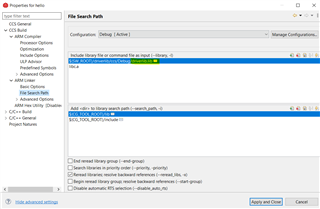
and this is include options (I have all header files in these paths, which mentioned on my code.):

Although all the required header files are available and defined, the error is never resolved. If anyone could help me that will be perfect.
Thanks.