This thread has been locked.

If you have a related question, please click the "Ask a related question" button in the top right corner. The newly created question will be automatically linked to this question.

TIDA-01606: Grid-connected sampling problem

Part Number: TIDA-01606


Hi Team,

I'm asking for my customer:

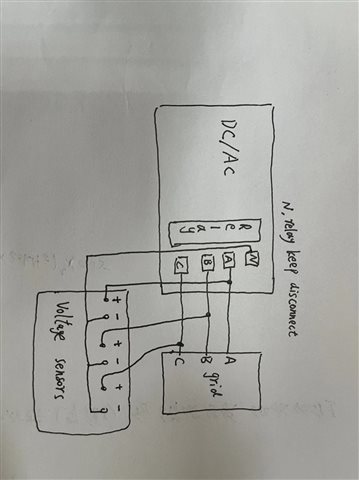
Although I could collect the grid-side voltage during the grid-connected experiment, I have always had a doubt. During the grid-connected experiment, the grid-side relay is connected to the three-phase voltage of the grid, and the N-phase relay is not connected, and the N-phase relay remains disconnected during the experiment. When collecting the grid-side phase voltage, N is still used as the negative side of the voltage. Why can I still collect voltage when collecting voltage? I checked some information. The three-phase four-wire topology uses a three-phase three-wire connection on the grid side. When the N-phase is not connected, when collecting voltage, the line voltage is usually collected, and then Line-to-phase conversion results in a line grid. I hope your company's engineers can help me explain why it is possible to directly collect phase voltages without connecting the N phases.

Best Regards,

Ben

  • Hi Ben,

    I think that you should consider the fact that a resistor is connected between the terminal of the relays.

    even if the value is around 47 this is quite small compared to MOhm values of the voltage divider at the op amp side.

    Thanks

    Best Regards

    Riccardo

  • Hi Riccardo,

    I will remove the resistor in parallel with the relay in the experiment, sampling, I changed the sampling method to use the LV25-P Hall sampling, which samples the negative terminal connected to the N-phase, the positive terminal connected to the grid three-phase A, B, C, the sampling is normal but a little bit do not understand why it can be.

    Best Regards,

    Ben

  • Hi Ben,

    i believe the reason is coming out by the fact that you are creating a virtual neutral. It is like having three branches of resistors all of the connected together in a point which will be your virtual neutral.

    Thanks

    Best Regards

    Riccardo

  • Hi Riccardo,


    Sorry for replying to your message so late. What is shown in the picture is how I have the actual hardware connected, in your reply it is N connected to a common point similar to a three phase load, but in my type of connection the grid is three phase A, B, C. Would a virtual neutral point be constructed in this case?

    Best Regards,

    Ben

  • Hi Ben,

    if the network of resistors is balance the potential between O and O1 will be zero (Millman Theorem).

    This means that you will be able to measure the single phase voltage alone.

    Thanks

    Best Regards

    Riccardo