Hello,
Is there a way to have an amplitude-modulated input source to my circuit ?
I need a 5MHz carrier signal, modulated by a 200KHz signal.
Is this possible ?
also, is it possible to add white noise ?
Thank you ..
This thread has been locked.
If you have a related question, please click the "Ask a related question" button in the top right corner. The newly created question will be automatically linked to this question.
Hello,
Is there a way to have an amplitude-modulated input source to my circuit ?
I need a 5MHz carrier signal, modulated by a 200KHz signal.
Is this possible ?
also, is it possible to add white noise ?
Thank you ..
OK, I figured it out ...
It turns out that it is not easily done in the basic-free version on Tina because the "user defined function" is disabled.
I tried a trial full version and was able to generate a modulated signal using the equation editor in the function generator:
{ Use this template to create your
own signals }
Function Signal(t);
Begin
A:=0.1;
m:=1;
fm:=200000;
fc:=5000000;
Signal := A*((1+m*cos(2*pi*fm*t))*cos(2*pi*fc*t));
End;
rfengr,
Alternatively, you can simply use two voltage sources and multiply them together (using POLY(2) VCVS for instance)
Herman
Thanks Herman,
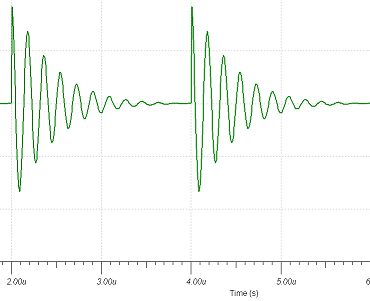
I haven't tried your way, but I really like the equation editor method. I was able to generate a ringing effect using the equation below.
By the way, what language does this equation editor use, are there any references out there on how to setup variables, functions, etc .. ?
{ Use this template to create your
own signals }
Function Signal(t);
Begin
A:=0.0005;
m:=1;
fm:=200000;
fc:=5500000;
k := 0.0000005;
mysig1:= 2/2.71828183^(t/k);
Signal := mysig1*A*((1+m*cos(2*pi*fm*t))*cos(2*pi*fc*t));
End;
I do not know the answer to your question, but I can ask around. Which full version do you use? 7.x or 8.x or 9.x?
Dear Herman,
Can you please explain further how this can be done?
Perhaps you can show the diagram.
Thanks
Mat