This thread has been locked.

If you have a related question, please click the "Ask a related question" button in the top right corner. The newly created question will be automatically linked to this question.

TIDA-060029: How to design a simple way to measurement capacitance?

Part Number: TIDA-060029

Tool/software:

Hi team,

My customer uses a high-speed comparator to measure capacitance.

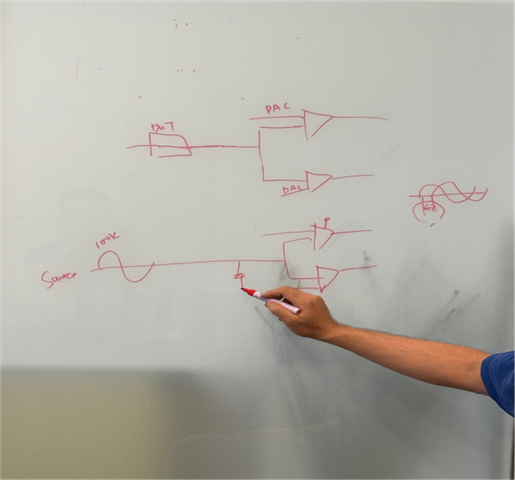
Using the output of the comparator and the output of the DUT (capacitor) to determine the angle between the two waveforms, we can use the 100kHz sin waveform to determine the angle between the two waveforms.

VCC=+-15V

However, products with fast propagation delays can't support dual power supplies. High-speed products only have a single power supply. Can a single power supply be used in this application?

How does TIDA-060029 measure?

TIDA-060029
  • Hello Jimmy,

      A single-supply high speed amplifier can be used to measure capacitance.

      I am familiar with two main methods that are used:

    1. Setting up a voltage feedback amplifier and any optional buffer in case of loading, to measure the frequency cutoff with a set RF. 
    2. Setting up a voltage feedback amplifier as a transimpedance amplifier, and have an input source to measure the output voltage change vs input voltage (this method is a bit more complicated compared to first)

      Our high speed amplifiers can not be used as a comparator most of the time if datasheet specifies a absolute max differential voltage due to internal ESD diodes between the two inputs. Some of our amplifiers might not have this diode, and can be used a comparator, but we usually recommend against it. If you decided to change your method to one of the above methods, then it would be possible to use any of our high speed amplifiers in a single-supply configuration.

      The way TIDA-060029 works is a bit more comprehensive than the needs of your pure capacitance measurement application. It is designed to show a discrete LCR meter which can measure inductance, resistance, and capacitance by measuring output voltage phase/magnitude change compared to its input. We take the output signal, and find the time delay from its input signal via cross-correlation. Similar method to the method you are using already. 

    Thank you,
    Sima