This thread has been locked.

If you have a related question, please click the "Ask a related question" button in the top right corner. The newly created question will be automatically linked to this question.

TPS2595: request for a schematic check (TPS259530).

Part Number: TPS2595

This is my first time using an eFuse, so I would like to ask a few questions.
I'm planning to prototype a board using the circuit shown below. I will attach the schematic, so please let me know if you see anything concerning.
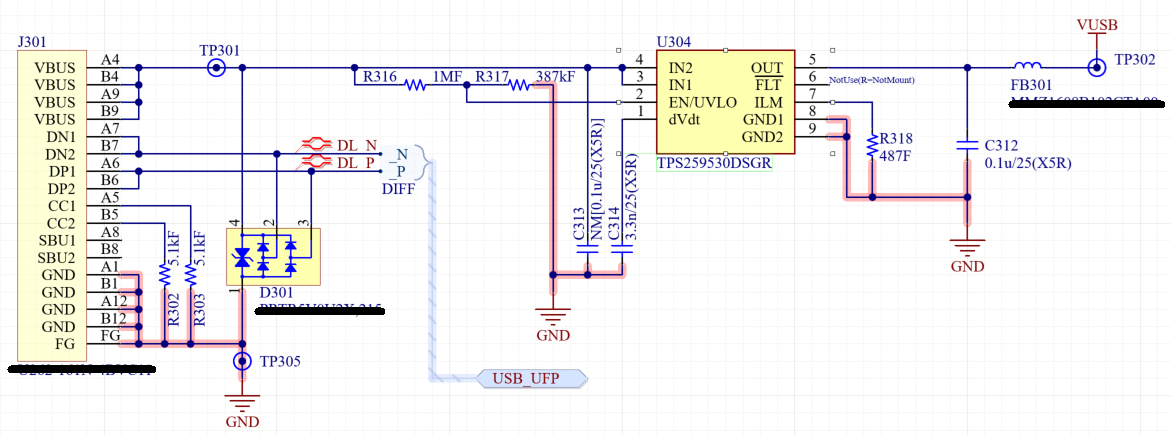
image.png

— Preconditions —
The circuit configuration is: USB Type‑C connector <-> TPS259530DSGR <-> DC‑DC / battery circuit.
The reason for using an eFuse is for CE and other certification tests. If an abnormal condition occurs in the battery circuit and the current exceeds the specified value (1 A), I want the eFuse to shut off the abnormal current.

Here are the points I'm a bit concerned about:
- Should I add a component to cut the current between the USB Type‑C connector and the eFuse?
  If the eFuse can fail in a short mode, I would like to know whether adding a current fuse or something similar is preferable.
- I think the ceramic capacitor at the IN pin of the eFuse can be set as Not Mounted, but is that acceptable?
- Since the FLT pin (pin 6) is an open‑drain output, I think it is fine to leave it unconnected if the CPU does not monitor faults. Is that correct?

  • Hi,


    - Should I add a component to cut the current between the USB Type‑C connector and the eFuse?

    If you mean adding between that phase and ground, yes you need to add capacitor and TVS diodes for transient protection. You can refer "Power supply requirement" section in datasheet. But it wont cut current but helps the device from transient protection 

      If the eFuse can fail in a short mode, I would like to know whether adding a current fuse or something similar is preferable.

    What is the requirement from your side, like how do you want the efuse to react when a short is present at the output of efuse

    - I think the ceramic capacitor at the IN pin of the eFuse can be set as Not Mounted, but is that acceptable?

    Its recommended to install if your system faces transients in voltage, it is highly recommended. lets say a short circuit is detected and efuse shuts off. Due to sudden change in current and path inductance, there is chance for the input pin to face high voltage transient that damaging the IC when the transient crosses the absolute maximum of the efuse 

    - Since the FLT pin (pin 6) is an open‑drain output, I think it is fine to leave it unconnected if the CPU does not monitor faults. Is that correct?

    Yes you can float it 

    Best Regards,

    Sailendra

  • Thank you for your response. Please see my comments below.

    - Should I add a component to cut the current between the USB Type‑C connector and the eFuse?
    - If the eFuse can fail in a short mode, I would like to know whether adding a current fuse or something similar is preferable.
    These questions were mainly because I was not sure whether I should assume an internal‑short failure mode of the eFuse itself, where the IN and OUT pins become shorted internally.
    If a short to GND occurs on the output side of the eFuse, I expect the eFuse to protect the system properly.
    However, if there is a possibility that the eFuse itself could fail in an internal‑short condition, I thought it might be better to at least provide a footprint for a current fuse or a polyfuse on either the input or output side, which is why I asked.

    - I think the ceramic capacitor at the IN pin of the eFuse can be set as Not Mounted, but is that acceptable?
    - Since the FLT pin (pin 6) is an open‑drain output, I think it is fine to leave it unconnected if the CPU does not monitor faults. Is that correct?
    Regarding these points, I am satisfied with the answers you provided. Thank you very much.

  • Hi ,

    There is no possibility for internal short happen in the IC itself with respect to design. There can be a very rare instance this happens due to fabrication uncertainties

    Best Regards,

    Sailendra