This thread has been locked.

If you have a related question, please click the "Ask a related question" button in the top right corner. The newly created question will be automatically linked to this question.

WEBENCH® Tools/LM2698: LM2698MM-ADJ

Part Number: LM2698
Other Parts Discussed in Thread: TPS61099, TPS61089

Tool/software: WEBENCH® Design Tools

Hello,

I have designed a 6.5V boost circuit by Webench tool.

Attached is the design report

Can you check the report and can we expect the efficiency mentioned by Webench design?

I have the following constraints:

Vin minimum: 3.0V , Vin maximum: 3.67V

Vout: 6.5V, Iout maximum: 50mA

Maximum allowable height is 2mm. Only 1 component can be above 2mm but that too should be below 2.8mm.

Only shielded inductors 

Only ceramic caps X7R, C0G/NP0, X5R ..... X5R to be used as last resort.

  • Hi Sahol,

    We are not able to find the attached report. Could you please attach the same again?

    Thanks & Regards,

    Praveen

  • I have attached 2 designs of LM2698MM-ADJ.

    Please confirm the design and please confirm that we would get the efficiency shown in report when we build the report?

    Also please confirm that the Webench models used are updated0447.5.5V 50mA 85C LM2698MM-ADJ.pdf

    7776.6.5V 50mA 85C LM2698MM-ADJ.pdf

  • Hi Sahol,

    Thank you for sharing the designs. We verify the same and let you know about this.

    Thanks & Regards,

    Praveen

  • Hi Sahol,

    WEBENCH efficiency algorithm generally covers several all corner conditions and are verified with the bench results for different Vins, Vouts, Iouts, Ta, diff frequencies both at full and light load , and the max eff mismatch is targeted around 3-5 percent at full load(CCM/DCM) or 5-10 percent(in case the mode of operation is PFM), for every device integrated in WEBENCH.

    However for this particular device LM2698(and especially for your current operating condition with low Iout of ~ 50 mA), we found that the WEBENCH eff calculation is not modeled completely(the switching losses, which dominate at light loads) for low currents - appears that the device was modeled quite a while back!

    We have added this model in our ToDo list for re-efficiency verification.

    For higher Iouts( where the conduction losses dominate) however for LM2698, WEBENCH eff should match with the bench with a max deviation of around 5 percent.

    The component selection looks ok for the device.

    Hence, I will recommend verifying the eff for your op condition on bench for now.

    Parallely, I had 2 questions from you -

    a. Do we have a minimum efficiency requirement value(at full load of 50 mA down to 1 mA for your design)  for your operating condition?

    b. I also realized that this part was released quite a while back and has a pricing of ~1.5$/1k, I had a question if we had some specific reason to choose this part over other parts available which can be much cheaper than this?

    Apologise for the inconvenience, let me know your views on this.

    Thanks

    Praveen

  • Thank you for your reply.

    We have been very disappointed with the results observed by building the design with LM2698.

    We observe an efficiency of around 77% for 6.5V 50mA output at an input of 3.3V. An efficiency of around 80% at an output of 5.5V 50mA with an input of 3.3V.

    We do not see any both designs have efficiencies even close to the Webench models. We have experienced this failure in meeting our expectations twice.

    Please review and suggest us if we are going wrong anywhere.

    We would like to investigate this further.

    Also does TI have any IC design which can be greater than 90% for below input and output requirements:

    1) Output voltage: 6.5V , output current(max): 50mA,  input voltage: 3V/3.3V to 3.67V

    2)Output voltage: 5.5V , output current(max): 50mA,  input voltage: 3V/3.3V to 3.67V

    I have mentioned other criterias in above messages.

    The part we selected had the least BOM count and minimum profile components in its design with expected efficiency above 90%. This is the reason we went this IC part.

  • Hi Sahol,

    Thank you for sharing your observations. We will look into this and get back to you.

    Thanks & Regards,
    Praveen

  • Hi Sahol,

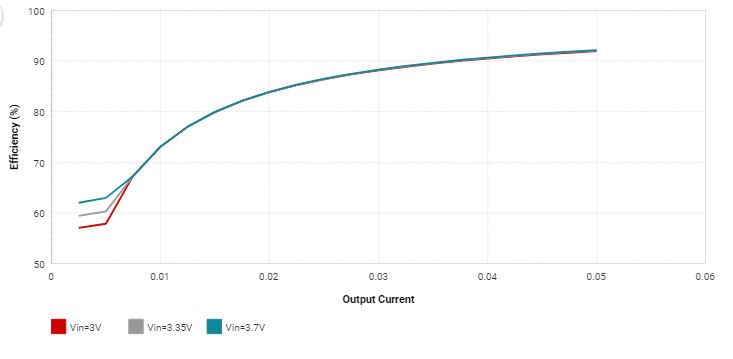
    For output 5.5V/50mA application, TPS61099 should be able to achieve >90% efficiency target. Below is the WEBENCH efficiency graph.

    The datasheet also has an efficiency graph result with 5.0V output voltage. This device's maximum output voltage is 5.5V.


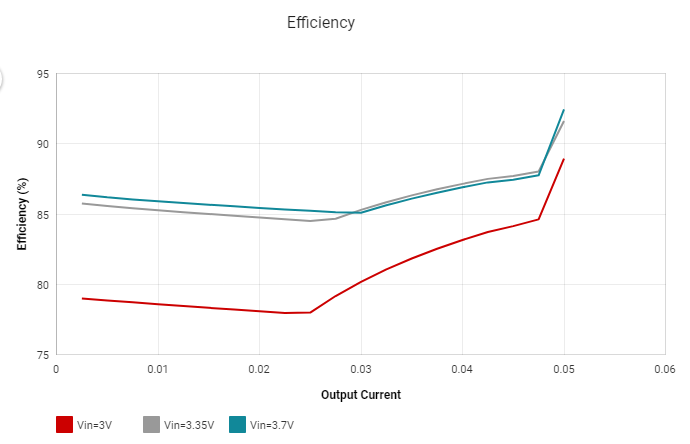
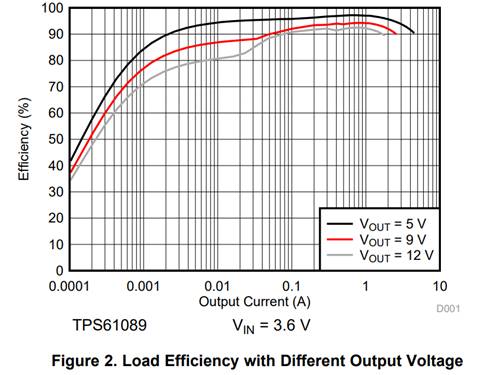
    For output 6.5V/50mA application, it’s hard to find a suitable device that meets all requirements. Especially >90% efficiency. TPS61089 should be able to achieve >90% efficiency target. Below is the WEBENCH efficiency graph.

    The datasheet also has an efficiency graph result with 5.0V output voltage

    Thanks & Regards,
    Praveen