This thread has been locked.

If you have a related question, please click the "Ask a related question" button in the top right corner. The newly created question will be automatically linked to this question.

TIDA-01081: Necessity of inductor discharging

Part Number: TIDA-01081
Other Parts Discussed in Thread: TPS92518, TPS92520-Q1, , TPS92515

Hi,

I wanted to discuss how inductor discharging is necessary, as I am considering both the TPS92520-Q1 and TPS92518 for generating short LED pulses, and thus was looking at this reference design.

Say we want ILED=1A, why isn't shunt dimming enough, without inductor discharging. I read that the inductor discharging was for shorter LED rise/fall times. I understand the point of precharging the inductor to 1A, but why would you discharge it? The next time you want to make a pulse, isn't it handy that the inductor current is already close to 1A? In fact, I would think the rise time of ILED when unshorting them would be much faster since the inductor already is biased near 1A just when the Qshort_led goes OFF.

Is this reference design intended to use with fast variating values for ILED? (Because I could understand a bit better why in this case)

From what I see, each time the inductor is discharged, it needs to be recharged, which somewhat limits further the LED switching frequency, doesn't it?

Thanks

  • Hi Yannick,

    The goal of TIDA-01081 was to demonstrate, how short LED pulses (as short as 200ns) with high pulse repetition rate (up to 10kHz, one pulse every 100us) can be generated. Much longer pulses (up to continuous light at reduced LED current) and much lower pulse repetition rates are for sure possible too. For such relaxed requirement traditional shunt dimming or even PWM dimming can do the job.

    Traditional shunt dimming is sufficient to achieve fast rise/fall times of the LED current, but has inherent deviations of the real average LED current from the set average LED current for LED pulses consisting of non-integer multiples of switching periods of the LED buck converter.

    Example: Average LED current is set to 200 mA , ripple is 200 mAp-p, instantaneous current can be somewhere between 100mA and 300 mA. A short LED pulse of 200ns is only 12% of such a single period of the 600kHz switching frequency of TPS92515 . LED current might rise from inductor valley current of 100 mA but might also decline from inductor peak current of 300 mA or might start from any value in between. Impossible to predict the real average LED current (of this ultra-short pulse) with this general approach unless the switching of the LED buck converter is synced by the start-trigger of the LED pulse as done by TIDA-01081 – any LED pulse starts (very close – see figure 27 in the user guide) from the peak value: e.g. from 300mA for a 200mA average setting, from 2.5A for a 2.4A average setting.

    This peak value of the current is controlled by the LED buck converter during state 1. It’s the first switching pulse generated after being enabled (BUCK_ON). The time for this 1st pulse can not been shorter than the minimum ON-time (tLEB) given in the datasheet of the TPS92515 . If the inductor current would start from somewhere between zero and the peak current of the former LED pulse, the minimum ON-time might be violated and the inductor current might ramp up to a higher current than targeted. Therefore the idea was to discharge the inductor current to zero after any LED pulse. This discharging needs to be done fast especially for high LED pulse repetition rates. Let say you have a 20us pulse and 10 kHz repetition rate – then the inductor needs to be discharged within the remaing 100us – 20us – 10us = 70us. The 10us in the equation is the trigger delay time of the TIDA-01081.

    The worst case discharge time of the inductor is (L x ILpk) / VL . A 100uH inductor together with a 2.5Apk inductor current and 0.25V voltage across the inductor will result in 1ms needed to discharge the inductor form the 2.5A down to 0A by using the traditional shunt method . This is simply shorting the LEDs by a FET with a (large) voltage of 0.25V across it when switched on. It is obvious, that this wouldn’t allow the high repetition rate. That’s the reason for a second FET and additional resistors and diodes in the discharge path which simply increase the voltage across the inductor, leading to a much faster discharge of the inductor.

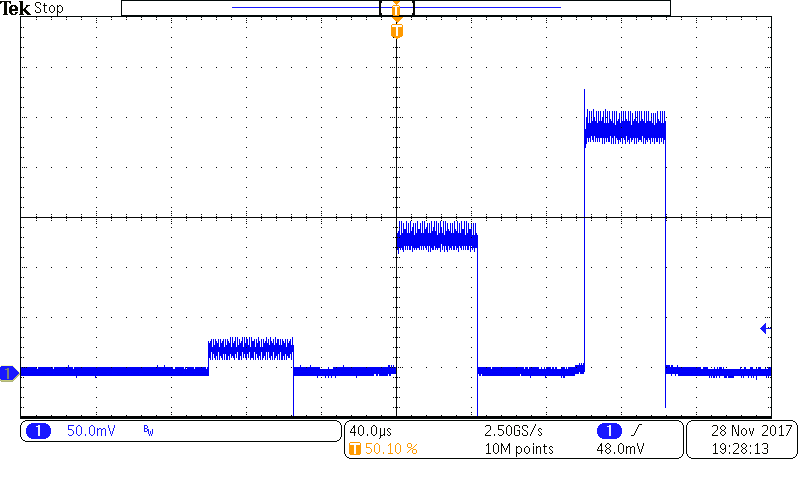
    And YES, the reference design is also able to generate consecutive LED pulses, each with a different current, see attachment.

    Best regards

    Bert

  • Thank you very much @BertW for the high quality answer, I understand better now. I would still have a few more questions for you.

    It is unclear to me how the transition from state 1 (to 2) to state 3 occurs (even after reading most of the document), basically how do you know when to enable the LEDs right after the peak current is attained at the inductor? Do you have a fixed time in the MCU to approximate this? I see a comparator (U33) at the inductor, to check for overvoltage?

    Why not triggering the LED ON on the buck transition from on to off using the SW pin as a clock (and thus triggering on the falling edge of that clock which indicates the current has attained it's peak value (afaik the buck regulates on the basis of attained peak current). This way, wouldn't the buck inductor not need to be discharged and thus could be kept in steady state (assuming a constant current requirement). Of course a flash delay would happen (not much though).

    The multiple current pulses image you linked is interesting. Do you simply send to the DAC a new current value (using the analog dimming function) at each new flash trigger? Or is there more to it?

    Sorry for asking all these questions, it just takes a lot less time asking these misc. questions directly to you. I understand the whole design is very well documented. It's more that it's a wall of text.

  • Hi Yannick,

    just to clarify: The purpose of the chosen approach is to start any LED pulse very close to the peak current – this is the begin of the 1st state 3. For that, the inductor current needs to have ramped-up to its peak current – this is the end of state 1. The ramp-up time during state 1 depends on the voltage across the buck inductor, on the desired inductor peak current and on the inductance value of the inductor (t=ILpeak x L / VL). Voltage and inductance can be considered to be constant – but with tolerances - but ILpeak can vary in this specific design from 300mA (for 200mA ILEDavg) to 2.5A (for 2.4A ILEDavg).
    Our design has a MCU controlled fixed trigger-delay time of 10us between the trigger pulse (the upper waveform in figure 27) and the start of the LED pulse (begin of the 1st state 3) to ensure, that the inductor current can ramp-up from zero to 2.5A under all tolerance conditions.
    The start time of state 1 (related to the trigger) is also provided by the MCU and equals the trigger-delay time minus the needed (tolerance based worst case max ) time for state 1 (at the specific desired ILpeak). So, this start time is very short for 2.5A ILpeak, but is long for 300mA ILpeak. Because the ramp-up time for IL is usually shorter than its tolerance based worst case max, there is some (non-controlled) time left over between the end of state 1 and the begin of the 1st state 3. This is state 2. The LEDs are still completely shortened during this state 2, the resulting voltage across the inductor (VL) equals the forward voltage of the buck converter’s free-wheeling diode and is therefore very low (some hundreds of mV). The decline of inductor current during this state 2 is very small due to this low VL and can be neglected in most cases.

    YES , U33 monitors the buck for overvoltage events on its output, which detect also a disconnected LED Board or disconnected LEDs inside the LED-string. BUCK will be immediately disabled and an error signal BUCK_VUT_OV is generated. A RESET of this signal is needed to re-start normal operation.

    Using the SW-pin of the buck as indication that IL ramped-up to its peak sounds obvious, but doesn’t easily ensure that there is always a 10us trigger delay time. This is due to the tolerances in the inductance.
    Operating the buck continuously and just using the standard way of LED-Shunt control wasn’t an option for us. It’s true, that there is almost no power dissipation in the SHUNT FET, but the targeted average current (2.4A) will still flow continuously through the inductor and alternately trough the BUCK’s internal high-side switch and its external free-wheeling diode see figure 15 of the TPS92515 datasheet.

    And yes, we simply send a new desired peak current value to the DAC (using the analog dimming function) before each new LED pulse to get the multiple current pulses image.

    .