Part Number: CC2745R10-Q1
Other Parts Discussed in Thread: UNIFLASH
Tool/software:
Hello,
I have inquiries concerning the CC2745R10-Q1 TrustZone-M and its Authentication methods.
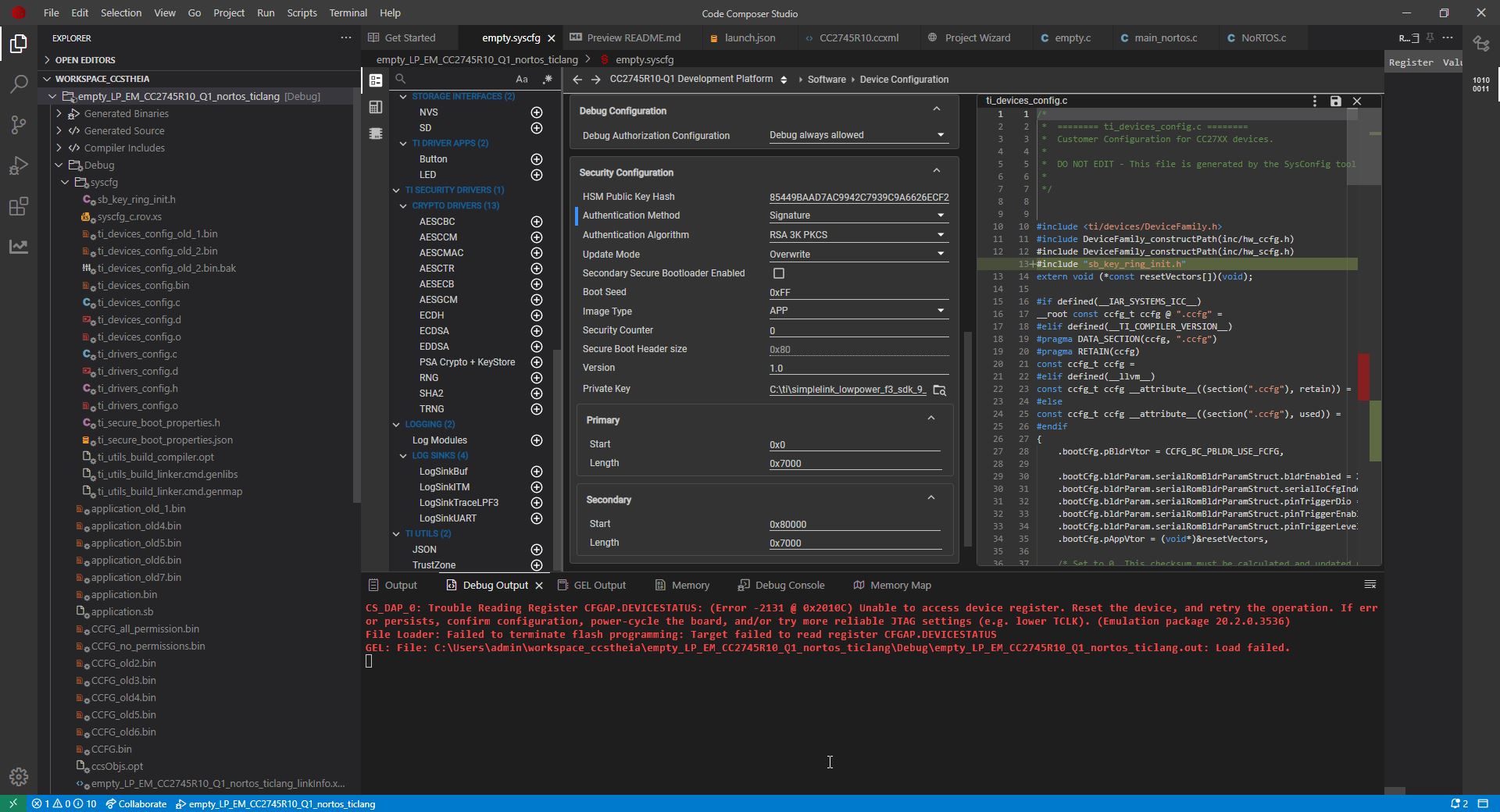
Note:I have created a sb_key_ring_init.h file and saved it in the default location: C:\Users\admin\workspace_ccstheia\empty_LP_EM_CC2745R10_Q1_nortos_ticlang\Debug\syscfg
In the CCS, when Authentication method set to "Signature" and build Project (with no errors), an attempt to Flash Project into target, displays Error -2131 @ 0x2010C Unable to access device register, as shown below

As per above settings, the generated SCFG configurations contains at offset 0x78: 0x0, at offset 0x7c:0x7000, at offset 0x88:0x80000, at offset 0x8c:0x7000 as shown below


Based on the CCS configuration above, the Update Mode is set to Overwrite, which, according to the reference manual, is regarded as the TrustZone-M disabled mode
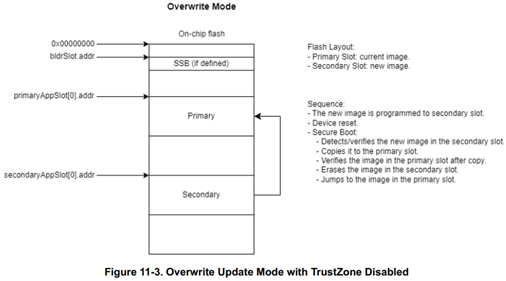
Here are my inquiries:
1. How can I resolve the error in the CCS to Flash the Project into the target?
2. According to the reference manual, TrustZone-M is in a disabled mode, correct?
3. Where does the application data will be loaded at secondary start(0x80000) or primary start(0x0)? If I wish to load the application binary file from UNIFLASH, at what address should it be loaded?
4. How can I enable or disable TrustZone-M? Is there a specific register or bit for this? By default, is TrustZone-M enabled? How can I utilize the TrustZone feature?
5. what are the effects on Flash operations via SWD if TrustZone-M is enabled, or disabled?
6. Is there any relationship between TrustZone-M with the Debug Authorization, please explain

Please reply for all the questions in details, Thanks.