CC2340R5-Q1: About Event Callback Function for UART Function

Part Number: CC2340R5-Q1

Hello,

I am using the CC2340R5-Q1 and developing software with SDK version 9.14. Currently I am developing a product for a customer and implementing/verifying UART functionality. As part of abnormal-condition checks, I intentionally input malformed data and want to decide how the software should respond when the CC2340R5-Q1 detects an error. To do that I am investigating how the CC2340R5-Q1 detects UART errors. I have observed the following behavior:

  • When receiving UART data that has no stop bit, the event callback function is not called. Instead, the read callback function is invoked.
  • In the read callback function, the status is reported as normal/OK.

My questions are:

  1. If malformed data (in this case data without a stop bit) is received, should the event callback function be called?
  2. How can I detect this condition as an error in software?


void Isr_Uart_Rx(UART2_Handle handle, void *buf, size_t count, void *userArg, int_fast16_t status)
{

    GPIO_toggle(CONFIG_GPIO_DIO13);
    uart_status = status;
    UART2_read(uart2_handle, &uart2_buf[0], (size_t)5, NULL);
}

void Isr_Uart_Event(UART2_Handle handle, uint32_t event, uint32_t data, void *userArg)
{

    GPIO_toggle(CONFIG_GPIO_DIO0);
    uart_event = event;
    uart_event_data = data;
}


void Uart_Setup(void) 
{
    UART2_Params uart2_params;

    UART2_Params_init(&uart2_params);
    uart2_params.readMode = UART2_Mode_CALLBACK;
    uart2_params.readCallback = Isr_Uart_Rx;
    uart2_params.readReturnMode = UART2_ReadReturnMode_PARTIAL;
    uart2_params.eventCallback = Isr_Uart_Event;
    uart2_params.eventMask = UART2_EVENT_FRAMING | UART2_EVENT_PARITY | UART2_EVENT_BREAK | UART2_EVENT_OVERRUN;
    uart2_params.baudRate = 500000;
    uart2_handle = UART2_open(CONFIG_UART2_0, &uart2_params);
    UART2_read(uart2_handle, &uart2_buf[0], (size_t)5, NULL);
}
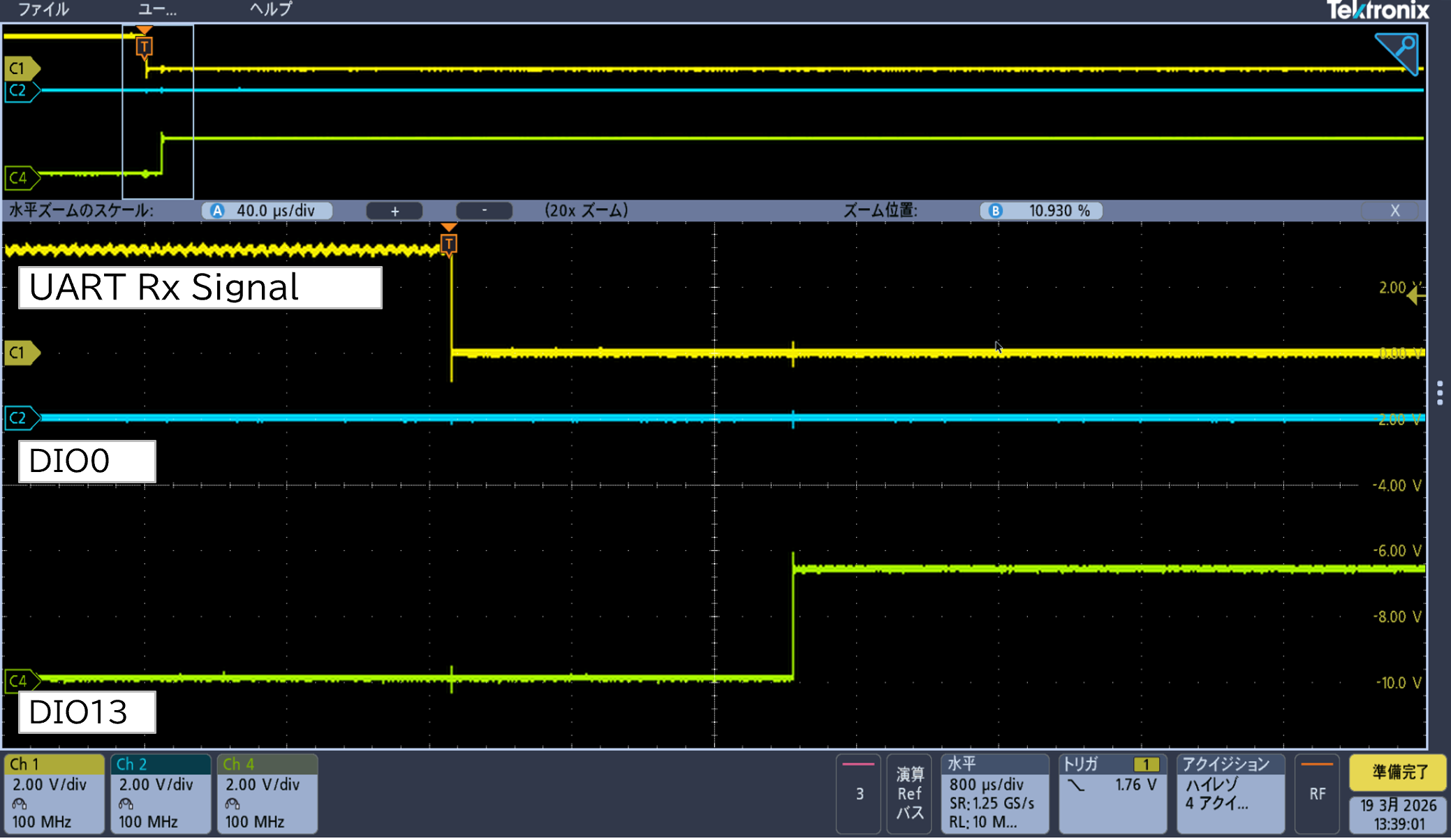
 

Fig1.png

 I will attach the code I checked and the oscilloscope waveform for your reference.Thank you for yourhelp.

  • Hello,

    I am currently looking into this and will give an answer as soon as I can.

    Thank you for your patience.

    Best,
    Josh Alderson 

  • Hello,

    Yes, the way your code is written the event callback should be called for framing error according to the API design, but due to a limitation in the UART driver that interrupt does not currently work.

    The RX callback is trigged due to an RX timeout event so yes this is expected behavior.

    To detect this error, I would suggest creating your own error checking in the RX callback.
    You can check the UART register error status using the API UARTGetRxError. This will return the error status in the UART_O_RSR_ECR register. The possible values this can return are listed in uart.h.

    doing this will allow you to handle the error as you want.

    A brief example is,
     

    #include <ti/devices/DeviceFamily.h>

    #include DeviceFamily_constructPath(driverlib/uart.h)


    UART2LPF3_HWAttrs const *hwAttrs = handle->hwAttrs;

    uint32_t errStatus;


    errStatus = UARTGetRxError(hwAttrs->baseAddr);


        if (errStatus != 0)

        {

            /* Error detected - determine type */

            if (errStatus & UART_RXERROR_FRAMING)

            {

                /* Framing error detected (missing stop bit) */

                uart_event = UART2_EVENT_FRAMING;

                GPIO_toggle(CONFIG_GPIO_DIO0);  /* Indicate error detected */

            }

            if (errStatus & UART_RXERROR_PARITY)

            {

                uart_event = UART2_EVENT_PARITY;

            }

            if (errStatus & UART_RXERROR_BREAK)

            {

                uart_event = UART2_EVENT_BREAK;

            }


            /* Clear the errors */

            UARTClearRxError(hwAttrs->baseAddr);


            /* Handle the error condition */

            /* ... your error handling code ... */

        }

    Try something like that and please let me know if it works.

    Best,
    Josh Alderson