This thread has been locked.

If you have a related question, please click the "Ask a related question" button in the top right corner. The newly created question will be automatically linked to this question.

CC2652P: 20dBm reference design questions

Part Number: CC2652P
Other Parts Discussed in Thread: SYSCONFIG

Hello!

We are designing a PCB based on the CC2652P where we want to maximise the RX sensitivity and 20dBm TX performance. We have a couple of questions regarding that:

  1. What is the difference between the CC1352PEM-XD7793-XD24-PA24 and the LAUNCHXL-CC1352P-2 reference designs? Since CC1352PEM-XD7793-XD24-PA24 is used as reference in the datasheet, I suppose it offers better performance...?
  2. We have a smaller distance between top and L2 plane on the PCB, compared to the reference design. This means we have to adjust the track widths to keep the 50Ohm impedance matching. Do we also need to adapt the passive components in the filter and balun due to that changed dielectric thickness difference?
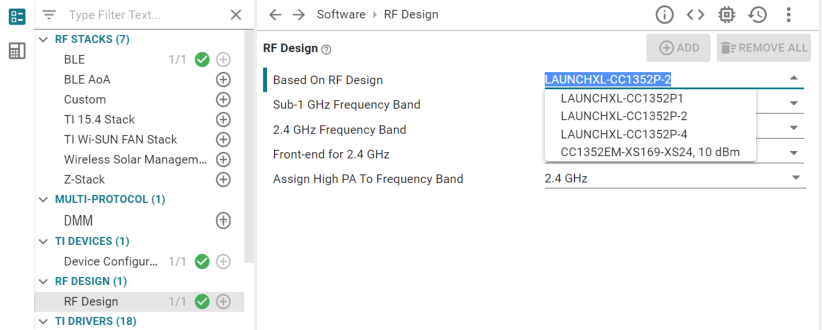
  3. For the firmware in sysconfig, we can't select CC1352PEM-XD7793-XD24-PA24 under "RF Design > Based on RF design". What should we do about that?image.png
  4. We are worried about the part-to-part TX-power variation reported here. Do you have any update on that?

Thank you very much for your help!

Best,

Raphael

  • Hi Raphael,

    1) The CC1352PEM-XD7793-XD24-PA24 and the LAUNCHXL-CC1352P-2 have no functional differences between them - it is a design that uses a form factor suitable for our validation platform. If you are interested, the design tools section of the device page contains the design files for the CC1352PEM-XD7793-XD24-PA24. The part value differences are due to the use of 0402 parts on the CC1352PEM while 0201 parts are used on the LAUNCHXL. 

    2) The differences in board stackup can affect the RF performance on both the balun and the filter. In this case, you might have to experiment and tweak these values to obtain peak performance. 

    3) Please select the LAUNCHXL-CC1352P-2

    4) Part-to-part variation is intrinsic to the fabrication process, but the operation at max power is usually less susceptible since the PA is operating close to saturation. I recommend reading section 10 of our Hardware Guidelines document (SWRA640) for details about this.  

    Hope this helps,

    Rafael