This thread has been locked.

If you have a related question, please click the "Ask a related question" button in the top right corner. The newly created question will be automatically linked to this question.

LAUNCHXL-CC2640R2: Direct Test Mode Failures?

Part Number: LAUNCHXL-CC2640R2
Other Parts Discussed in Thread: CC2640R2F

Hi,

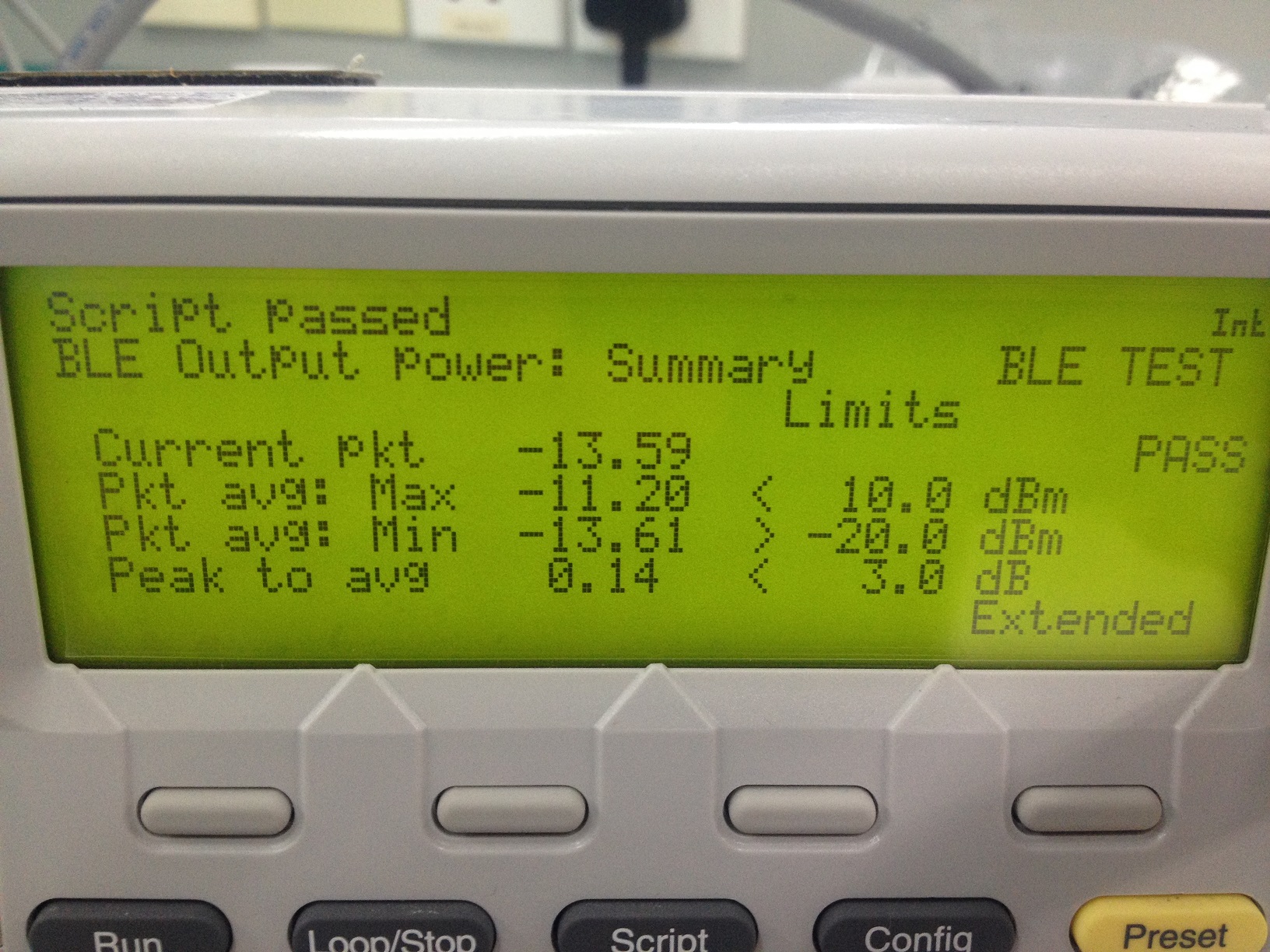
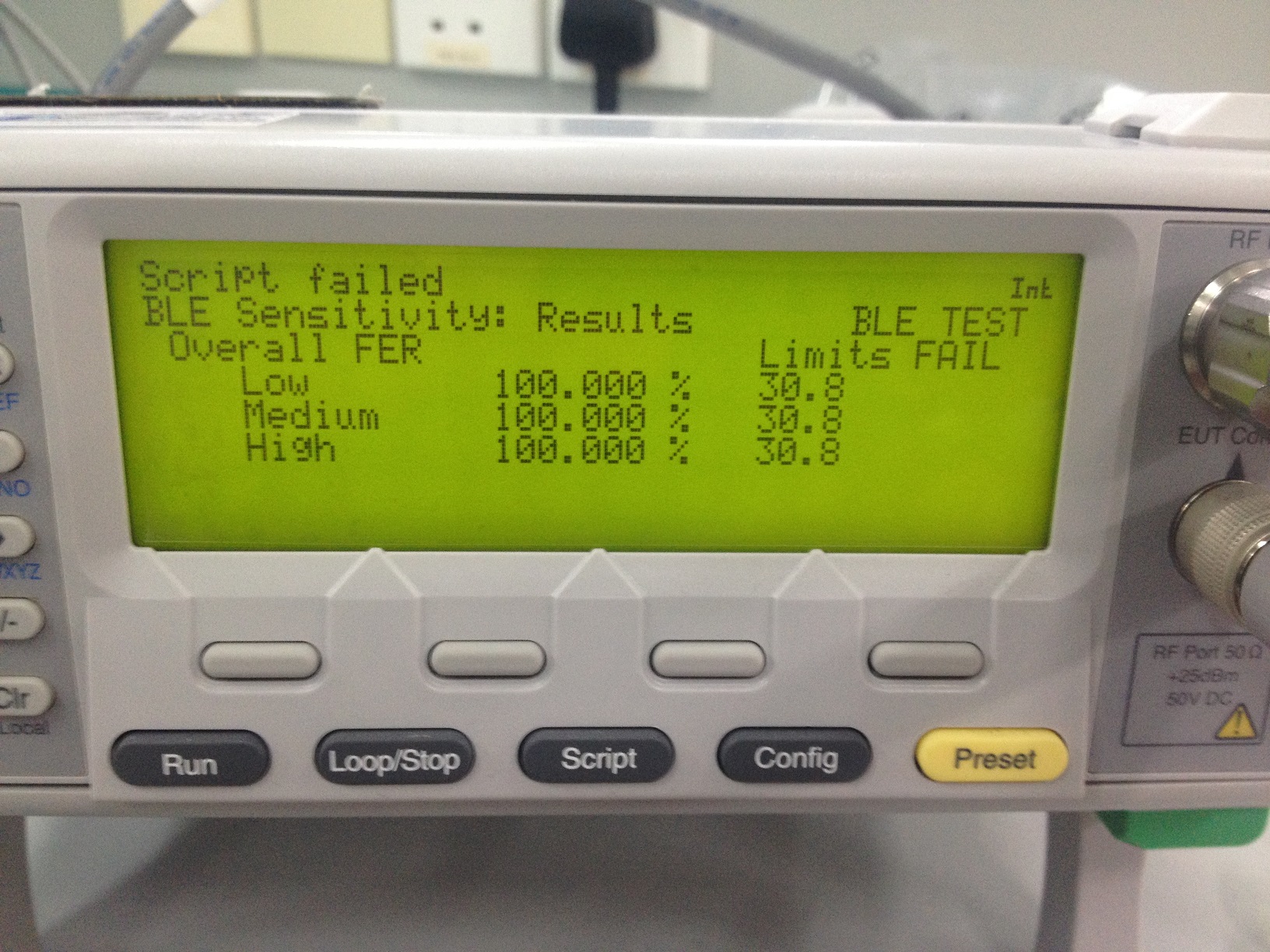
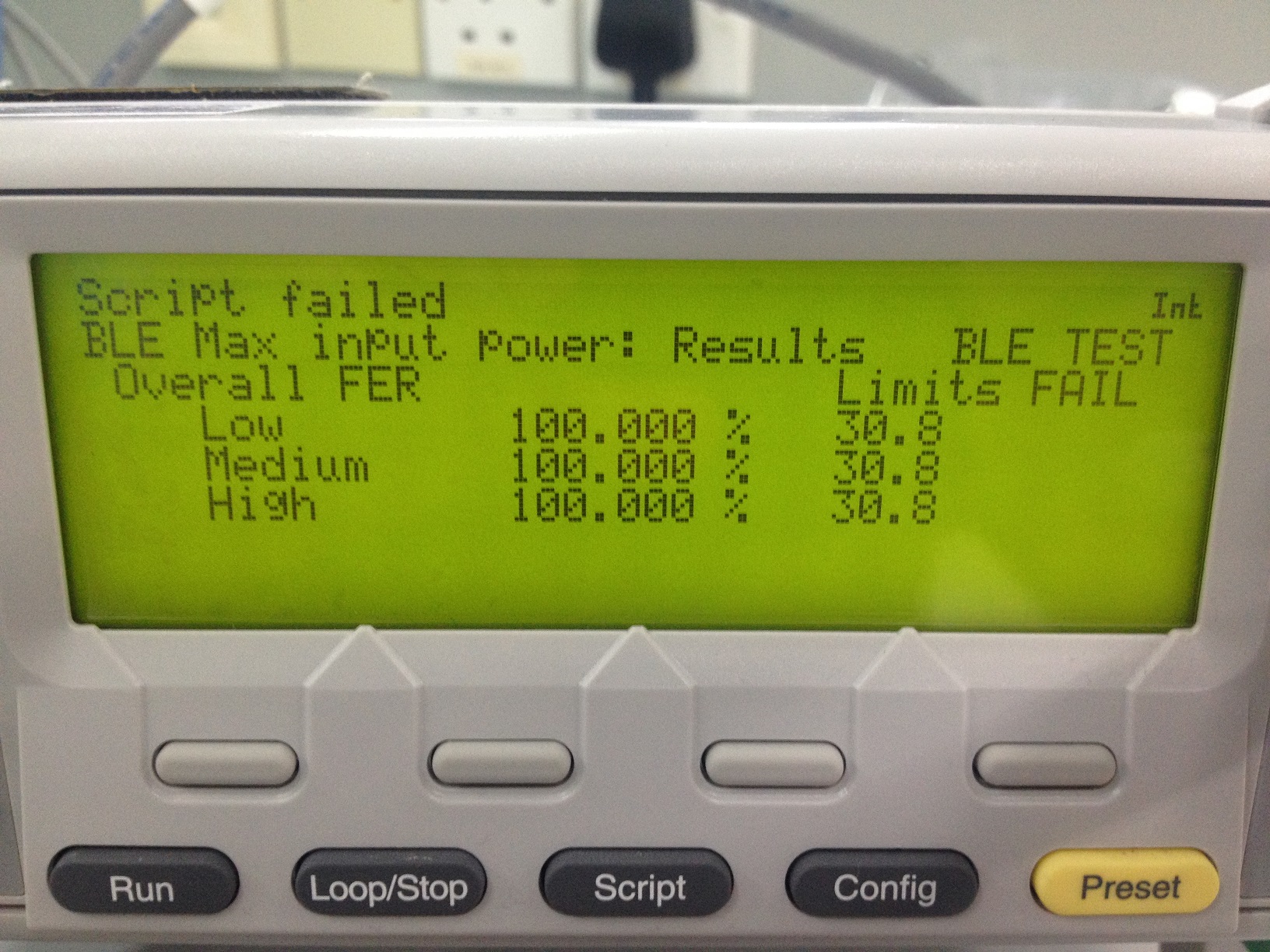
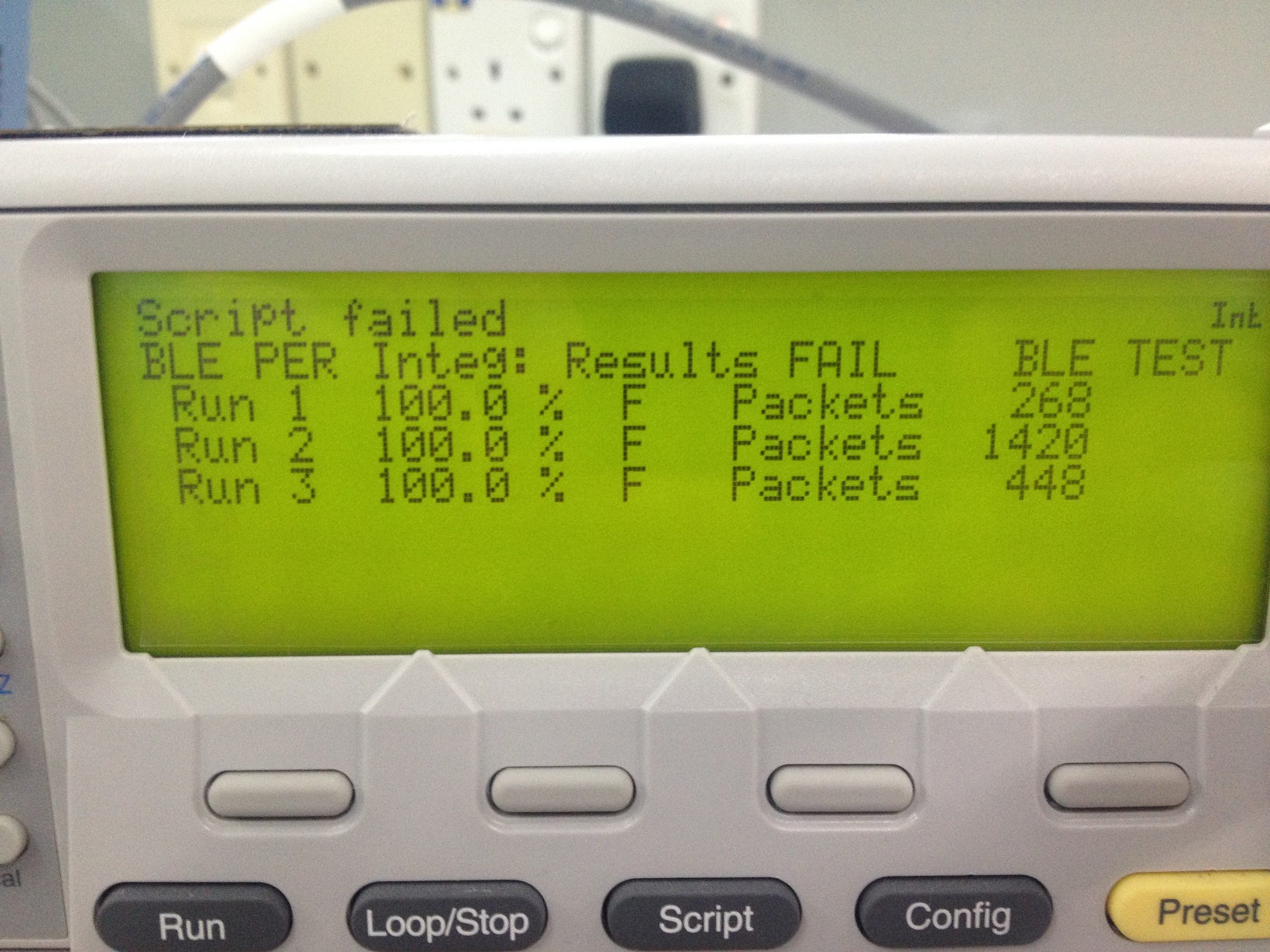
   I did Direct Test Mode using host test example program from SDK v1.30 and SDK v1.35. Both Fail a lot of the tests. Here below are the results of DTM from SDK v1.35. My colleague says the BLE Sensitivity Test Fail is a problem. I am using Anritsu BLE Tester. Are there any recommended setup or settings I need to do in order for the DTM to Pass all tests.

BLE Carrier Drift Pass
BLE Modulation Index Pass
BLE Output Power Pass
BLE Sensitivity Fail
BLE Maxi Input Power Fail
BLE Per Integrity Test Fail
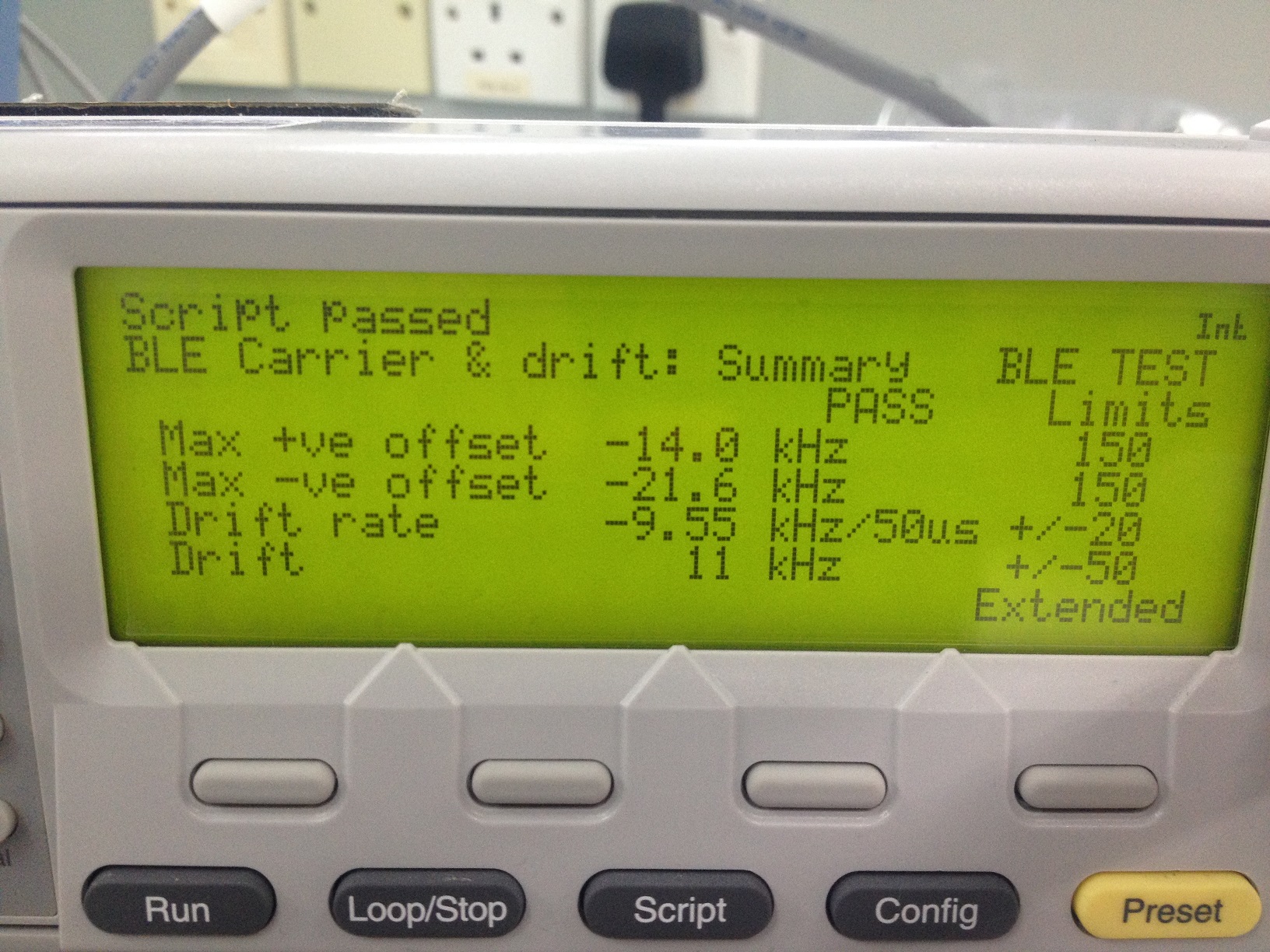
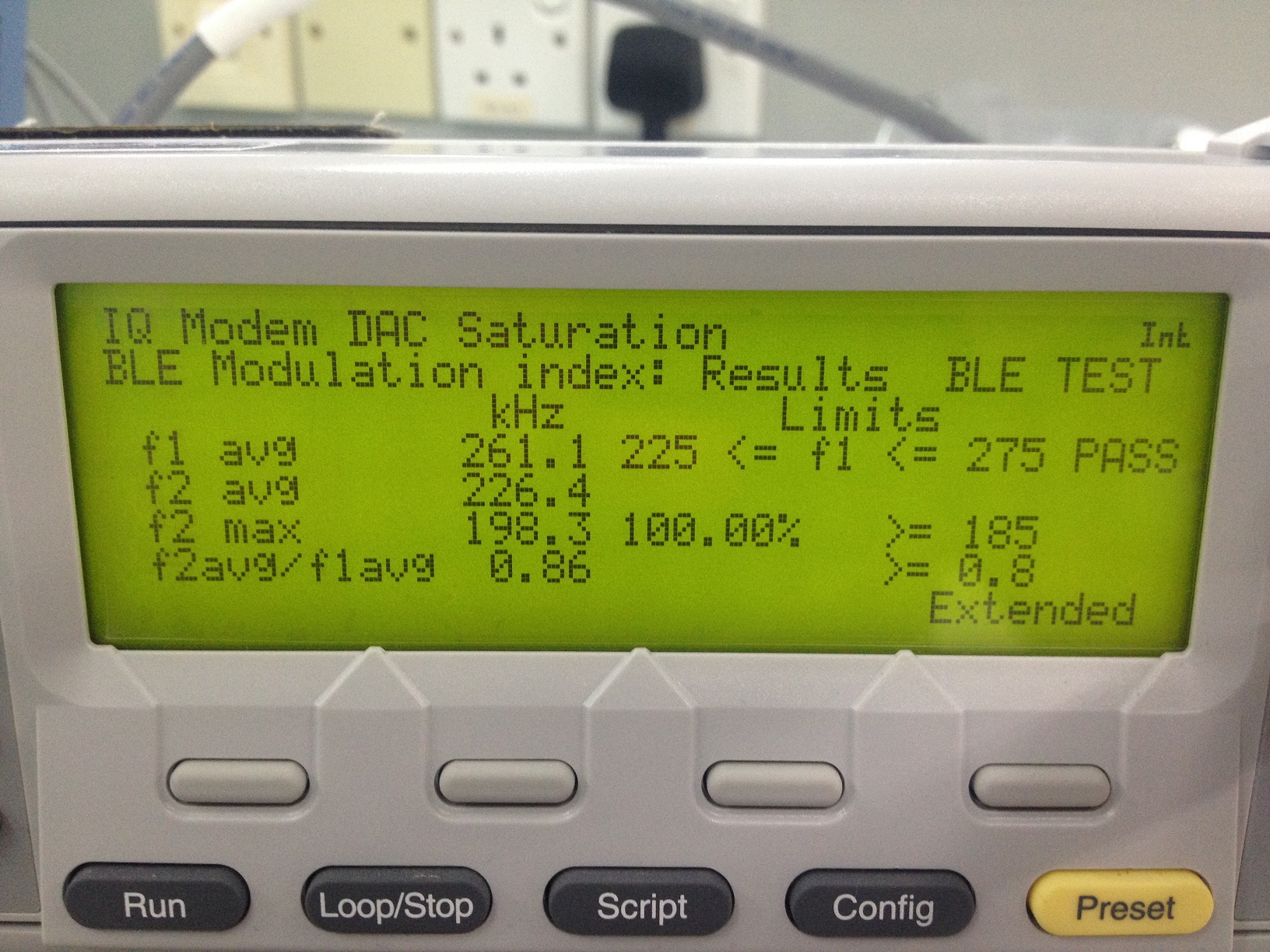
- kel

  • Hi Kel,

    The output power seems very low, how have you connected the board to the instrument? What HW are you running on?

    Regards,
    Fredrik
  • Hi Fredrik,

    My setup is CC2640R2F Launchpad with jumpers only at 3.3V and GND and powered via USB Cable connected to my laptop. The UART Pins 2 and 3 are connected to RS232 Board, which is then connected to Anritsu BLE Tester.

    - kel
  • How is the RF connected?
  • Hi Fredrik,

    There is a wired antenna connected to the Anritsu BLE Tester and then the end of the antenna I place just beside the CC2640R2F Launchpad.

    - kel
  • Kel,

    Are you accounting for the loss in the radiated coupling between the antennas? I would highly recommend connecting the instrument with a coaxial cable.

    Cheers,
    Fredrik
  • Hi Fredrik,

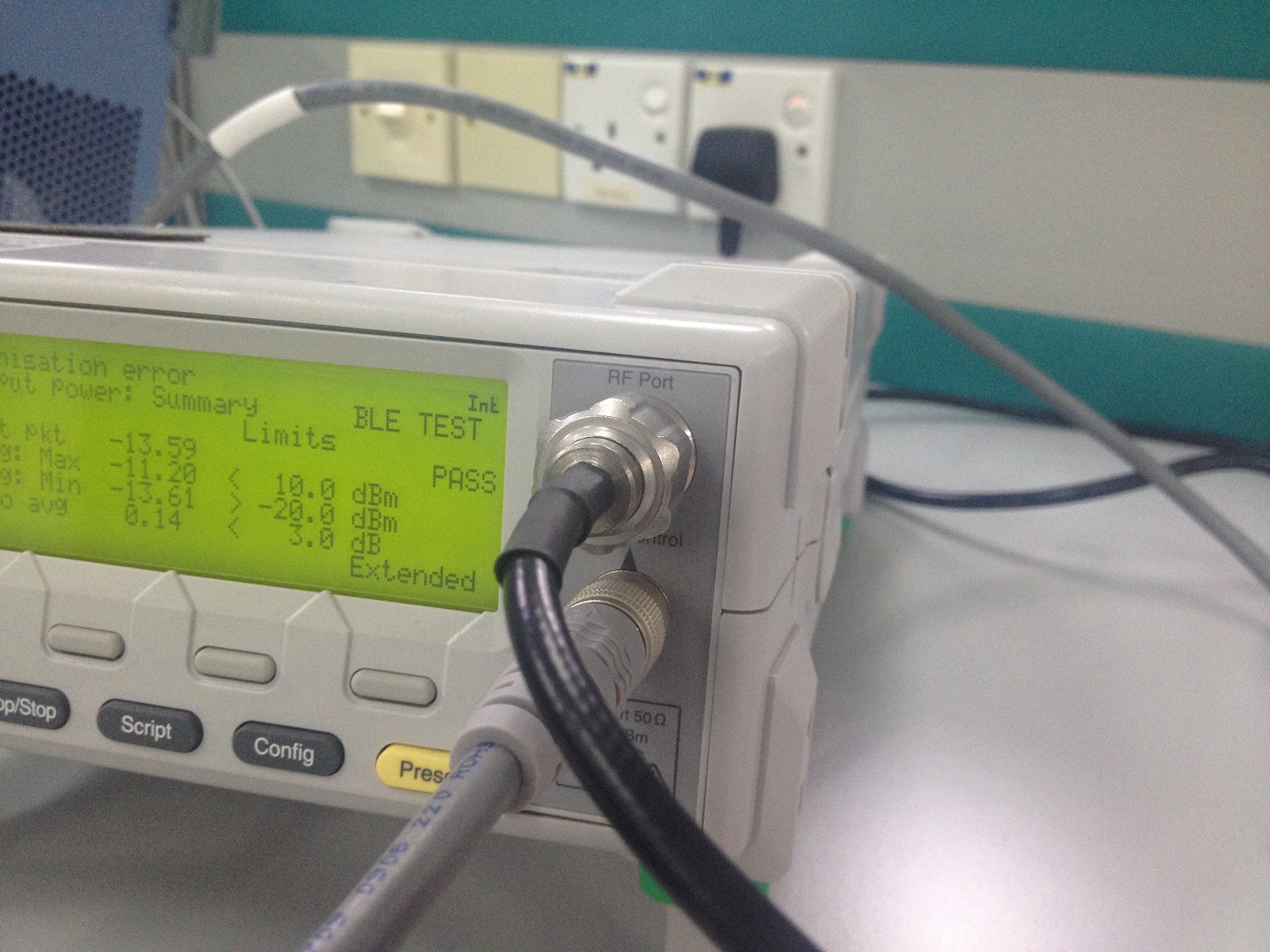
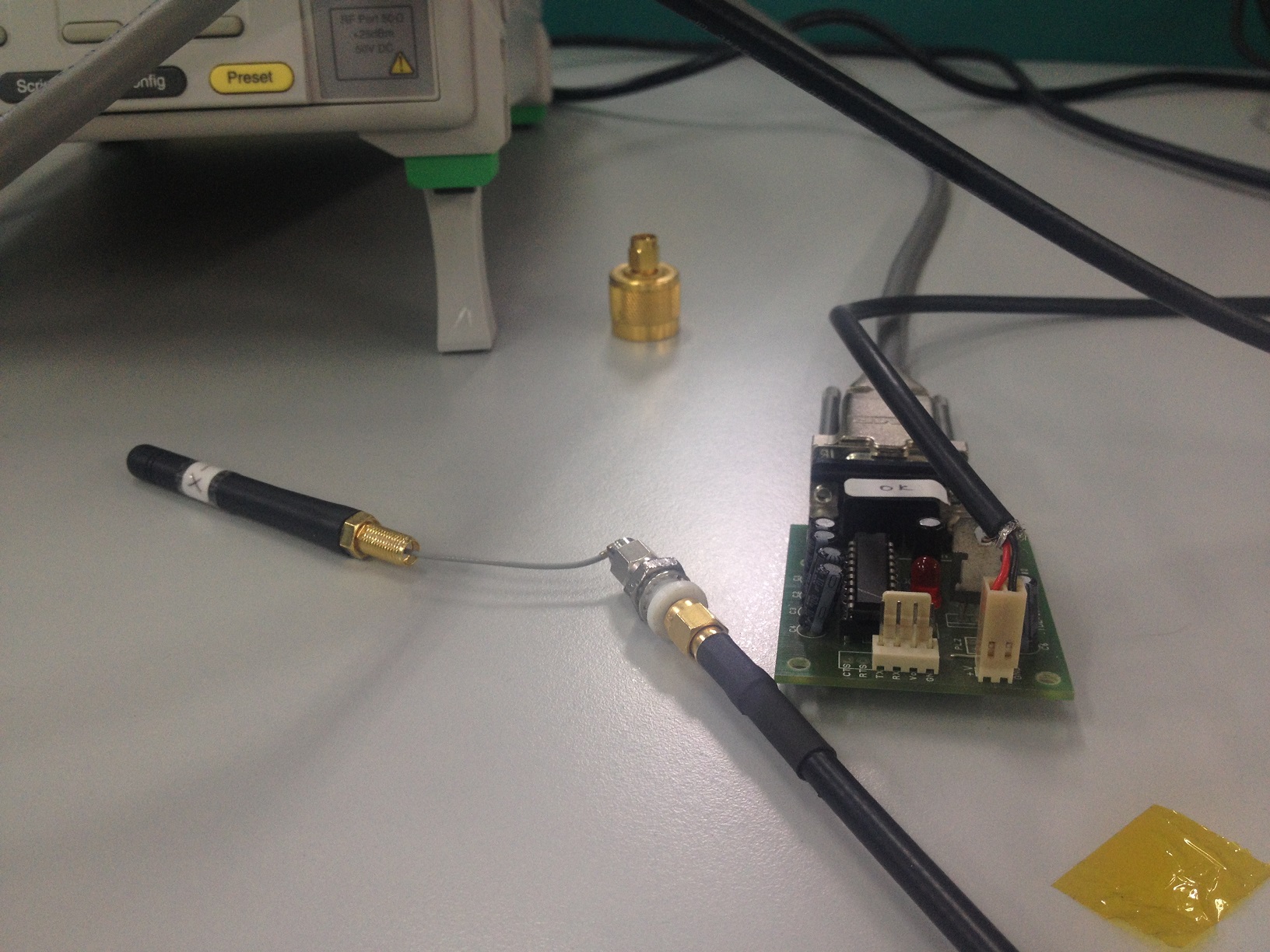
         I am using a coaxial cable connected to the Anritsu BLE Tester. See, my Anritsu BLE Tester setup below. Have TI BLE Team tested the TI CC2640R2F Launchpad with Anritsu BLE Tester? If yes, did you get better test results?

    - kel

  • Hi Kel,

    What I meant was, you should connect the coax to the RF connector on the LaunchPad. When you use an antenna as you do, there will be a significant loss in the transmission. If not properly accounted for this will of course easily affect sensitivity tests.

    We have tested the LaunchPad with multiple different R&S Bluetooth PHY testers, and the RF PHY qualification for CC2640R2F (QDID 94956) was done on the LaunchPad.

    Fredrik
  • Hi Fredrik,

    Right now I am using the CC2640R2F Launchpad to evaluate the DTM. But, later I need to do DTM to our actual CC2640R2F based product which has no RF connector.

    As you can see from Anritsu BLE Sensitivity Test, the result is 100% failure. The antenna is just beside the CC2640R2F Launchpad, at least there should be some Sensitivity.

    - kel
  • Hi Kel,

    It depends on what you have set the test limit to and what the loss is. Note that the BT PHY "Sensitivity" test does not really measure the actual sensitivity. It only checks reception at a specific level.

    Fredrik
  • Hi Fredrik,

        You are correct. I change the BLE Sensitivity Conditions Number of Packets from 1000 to 1500 and I am getting better results. We have connected the coaxial cable to RF of our boards and currently testing. I have further questions regarding this see below.

    1. Would there be any difference in BLE Test Results if I use host test example program from SDK v1.30 BLE 4.2 and SDK v.1.35 BLE 5.0?
    2. Would the Anritsu BLE Tester which supports BLE 4.2 be appropriate tool to test for example CC2640R2 Launchpad with Simple Peripheral BLE 5.0. I ask this because we are really failing the BLE Sensitivity Test using the Anritsu BLE Tester.
    3. As you have said that "BT PHY Sensitivity Test does not really measure the actual sensitivity", so what is the method or procedure to measure the actual sensitivity?

    - kel

  • You should adjust the pass/fail threshold to account for the loss in your RF connection.

    1. For any parameter related to the 4.2 specification, no.
    2. Yes, but it will not be able to test any of the BT5 PHYs.
    3. This is not defined in the BT PHY spec, so I am not sure if there is a test for this in the Anritsu. R&S has a test called "PER search" which measures the actual sensitivity.

    Fredrik
  • Hi Fredrik,

    Thanks for all your helpful replies.

    After connecting the Anritsu BLE Tester Coaxial Cable Antenna to CC2640R2F Launchpad, we got much better sensitivity results.

    For our CC2640R2F 5XD board, the sensitivity fails because we based our board design from the TI CC2640R2F Launchpad which is "RF Differential Internal Bias". However we use the 5XD board file. At 5XD board file CC2650EM_5XD is defined so setting it to "RF Differential External Bias".

    After we comment out CC2650EM_5XD define and added CC2650EM_7ID define at 5XD board, our CC2640R2F 5XD board now passes Anritsu BLE Tester Sensitivity Test.

    //#define CC2650EM_5XD
    #define CC2650EM_7ID

    - kel
  • HI Kel,

    That is good to hear.

    Our EVM names are a combined description of package and RF front-end. 5XD = 5x5, external bias, differential RF. The RF front ends are explained here: processors.wiki.ti.com/.../CC26xx_HW_training_RF_Frontends_and_Antennas.pdf

    Thus saying you have a "5XD board" with internal bias is a bit contradictory. As you have seen, enabling external bias without actually having this in the HW config will not work :-) Using the CC2650EM_7ID define is however perfectly fine as there is no dependency on the QFN package size.

    Cheers,
    Fredrik
  • Hi Fredrik

         Our CC2640R2F board is based CC2640R2F Launchpad. So, it should have RF Differential Internal Bias Support. We just replace the  CC2640R2F 7x7 with CC2640R2F 5x5.

         We started our Firmware Development using the Simple Peripheral for CC2640R2F Launchpad which uses the CC2640R2F Launchpad board file. At CC2640R2_LAUNCHXL.h this is defined below

    #define CC2650EM_7ID

    At ble_user_config.h RF_FE_MODE_AND_BIAS will be set to RF Differential Internal Bias

    #if defined( CC2650EM_7ID )
    
      #define RF_FE_MODE_AND_BIAS           ( RF_FE_DIFFERENTIAL |                 \
                                              RF_FE_INT_BIAS)

         But, since we uses CC2640R2F 5x5 I thought it would just be right to use the CC2640R2DK_5XD board files. At CC2640R2DK_5XD.h this is defined below.

    #define CC2650EM_5XD

    At ble_user_config.h RF_FE_MODE_AND_BIAS will be set to RF Differential External Bias

    #elif defined( CC2650EM_5XD ) || defined( CC2650EM_4XD ) || defined( CC2650M5A )
    
      #define RF_FE_MODE_AND_BIAS           ( RF_FE_DIFFERENTIAL |                 \
                                              RF_FE_EXT_BIAS)

          The Anritsu BLE Sensitivity Failure is caused by setting RF_FE_MODE_AND_BIAS to RF Differential External Bias when our CC2640R2F board is RF Differential Internal Bias.

          The Anritsu BLE Sensitivity Pass is caused by setting the RF_FE_MODE_AND_BIAS to RF Differential Internal Bias, when our CC2640R2F board is RF Differential Internal Bias.

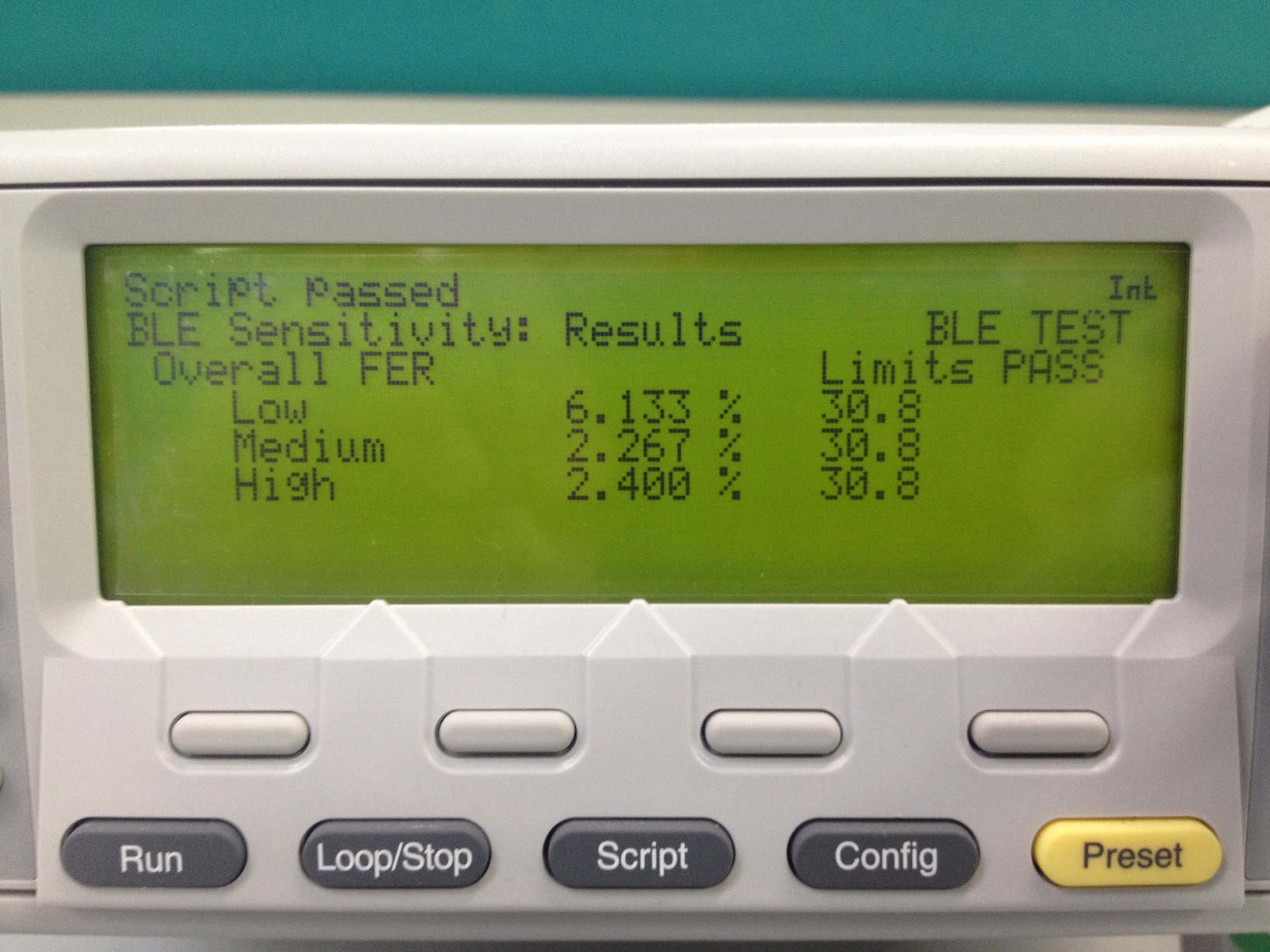
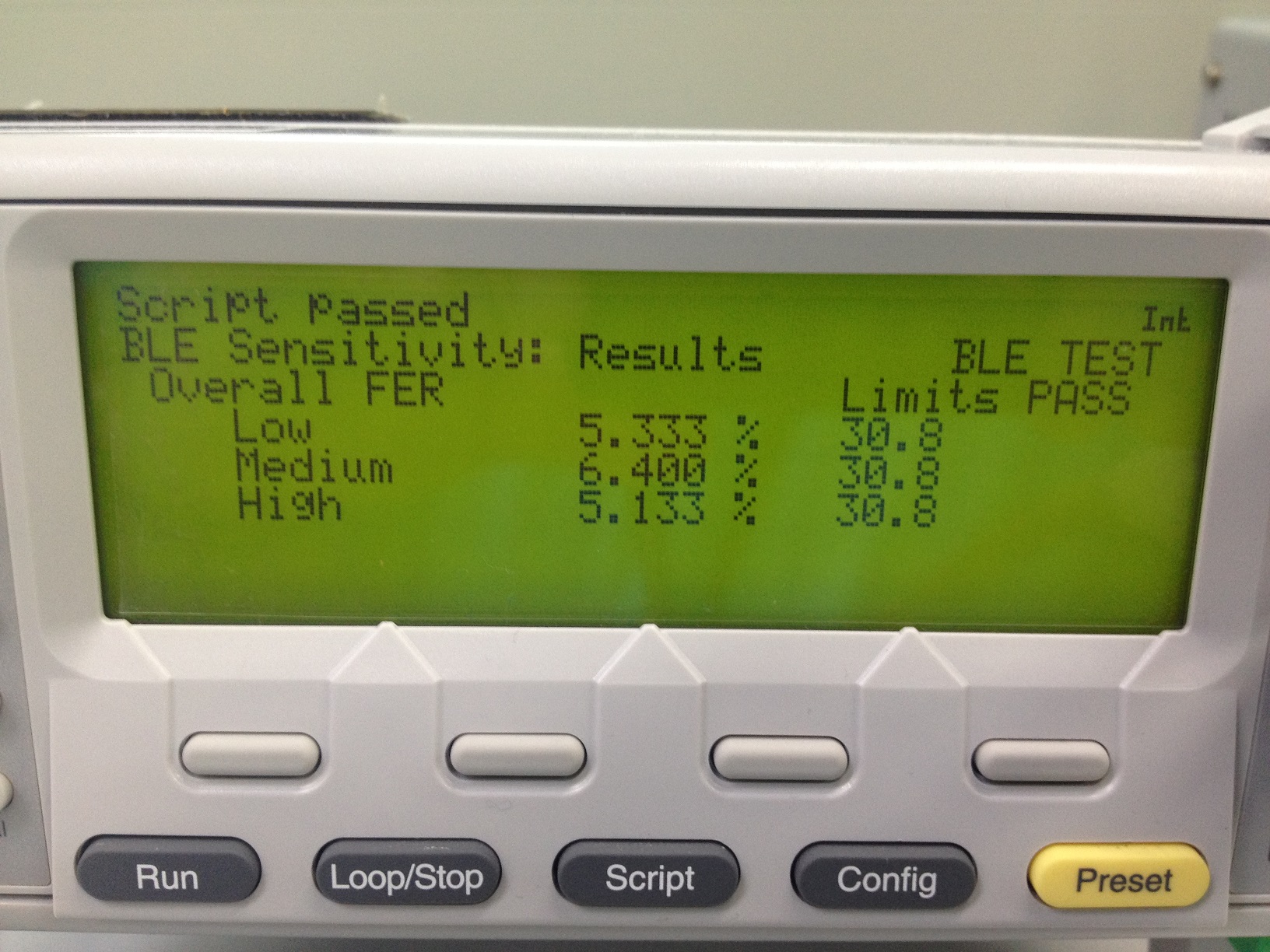
          Here below are the Anritsu BLE Sensitivity PASS results. There is difference in test results using host_test from SDK v1.30 and SDK v.1.35. The host_test from SDK V1.35 has higher error percentage. I suspect this is because the Anritsu BLE Tester does not support BLE 5.

          Anritsu BLE Sensitivity PASS results using host_test from SDK v1.30:

         Anritsu BLE Sensitivity PASS results using host_test from SDK v1.35:

    - kel