This thread has been locked.

If you have a related question, please click the "Ask a related question" button in the top right corner. The newly created question will be automatically linked to this question.

CC2640R2F: Long Range Mode - Power consumption calculator

Part Number: CC2640R2F

Hello Fredrik and Team,

I have a customer that is looking to use our CC2640R2F for their next generation device. I am familiar with the power calculator tool that is located here as well as the excel sheet for calculating theoretical range data.

What the customer needs to move further with their evaluation is an actual bench test of the CC2640R2F in the s=8 long range coded PHY modulation scheme. Our customers' asks are below and I'm posting it here in hopes that others can use this this to benefit.

"Please provide us with the power readings measured, not simulated or data sheet numbers, from the CC2640R2F silicon under the following conditions: 

Avg current during advertisments at 100ms interval, 3V supply with DCDC enabled, 23 byte payload; 
CC2640R2F @   0dBm: ____mA  (Long Range Mode)
CC2640R2F @ +5dBm: ____mA  (Long Range Mode)
 
Avg current during a peripheral connection at 100ms interval, 3V supply with DCDC enabled, 23 byte payload; 
CC2640R2F @   0dBm: ____mA  (Long Range Mode)
CC2640R2F @ +5dBm: ____mA  (Long Range Mode)"
 
 
Thanks in advance,
Omid
  • Hi Omid,

    S8 advertising will not be supported before SDK 1.50 is out.

    The current consumption for 100 ms connection interval can be estimated in the power calculator. Multiply the data payload by 8, and then add 7 (? - I have to check the spec) additional bytes to account for the longer preamble. 

    Regards,
    Fredrik

  • Hi Fredrik,

    thank you for the prompt reply. Can you elaborate on "S8 advertising will not be supported before SDK 1.50 is out"

    I found the long range S8 demo on Github located here - Are you referring to TI's support?

    The customer was looking for an actual bench test of this in the real world, is that something we would be able to provide? If not, could you let me know the % error when compared to actual testing?

    (i.e. expect a +/- 3% deviation between realistic world tests) - Do you have this data?

    Thanks in advance,

    Omid Deylami

  • Hi Fredrik,

    I located the following regarding SIG Cert. and have a better understanding of what you were communicating.

    "Please note that you cannot certify your device with Bluetooth SIG when using the LE Coded PHY evaluation configuration from this SDK. TI intends to provides updates to the BLE5-Stack at a later time which will include additional features, such as Advertising Extensions, required to support a Bluetooth 5 LE Coded PHY certification."

    I'll check with Rebel for updates on the SDK.


    I'll await further on the real world testing data. Thanks for your help,

    Omid

  • Yes, the current demo only allows you to change to coded PHY after connecting, it does not allow you to do coded advertising. 1.50 is right around the corner though, you could probably almost hold your breath. More specifically, you need to use the BLE5 stack v1.1.

    I will do some current profile measurements when the release is out.

    Regards,
    Fredrik
  • Hi Fredrik and TI Team members,

    I'd like to follow-up with another question regarding power consumption(as our application is ultra low power critical)

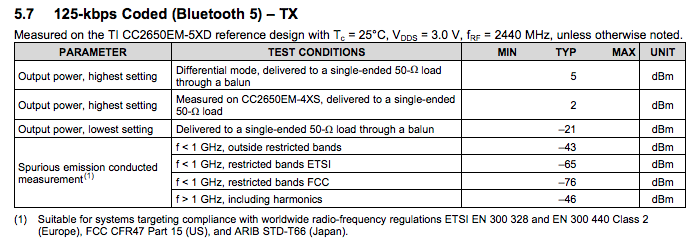
    I see the following from the datasheet:

    The above test was done at 3.0V VDDS. What we would like to understand is how the following two changes would impact the parameters above.

    The customer plans to use a singe ended RF output and is looking for the changes at the following:

    1.) VDDS @ 1.8V

    2.) VDDS @3.7V (Directly powering from Li-po)

    Thank you in advance,

    Omid Deylami

  • Hi Omid,

    Take a look at the "Typical Characteristics" section further back in the datasheet.

    Note that you cannot run directly from a LiPo as the maximum voltage of these is around 4.2 V.

    Regards,
    Fredrik