This thread has been locked.

If you have a related question, please click the "Ask a related question" button in the top right corner. The newly created question will be automatically linked to this question.

CC2640R2F: Compatibility problems with some mobile phones when running BLE5.0 stack

Part Number: CC2640R2F


Hi!

In our test, it was found that CC2640R2F had compatibility problems with some mobile phones when running BLE5 stack. When we use TI official SDK BLE5 "simple_peripheral" firmware test, this phenomenon also came out.

Our customers have reported this problem for many times during the use of the product, and we hope that TI can support us to solve this problem. The method to reappear the phenomenon is as follows:


Test conditions:

  1. Hardware: TI Launchpad ("LAUNCHXL-CC2640R2F Rev:1.0)
  2. Firmware: cc2640r2lp_simple_peripheral.hex (C:/ti/simplelink_cc2640r2_sdk_4_20_00_04/examples/rtos/CC2640R2_LAUNCHXL/ble5stack/hexfiles/cc2640r2lp_simple_peripheral.hex)
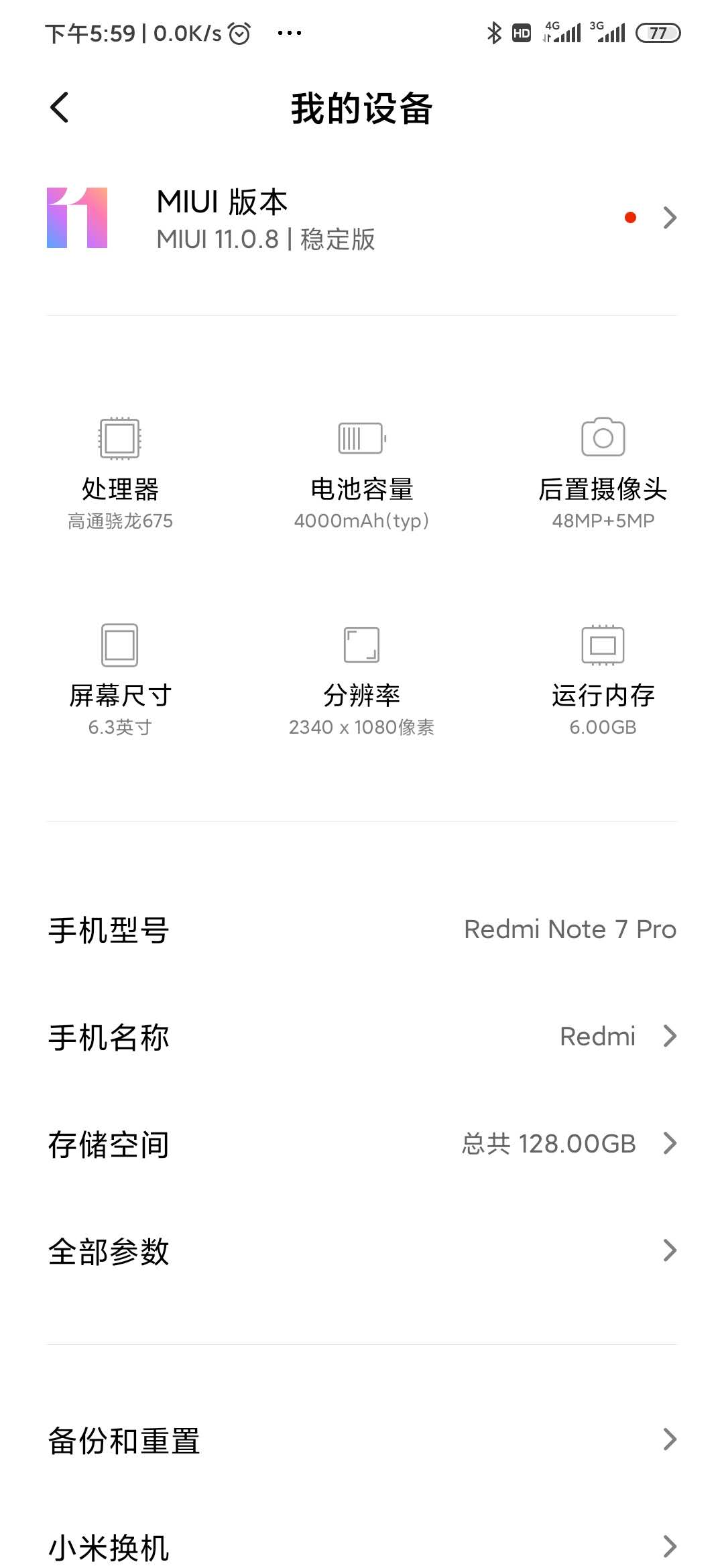
  3. Mobile phone: Redmi Note 7 Pro (MIUI 11.0.8) (The phenomenon was found more frequently in this phone).
  4. APP: nRF Connect v4.19.0


Problem phenomenon:

  1. The mobile phone uses the "nRF Connect" APP to scan broadcast packet of the development board, and then the mobile phone connects to the development board.
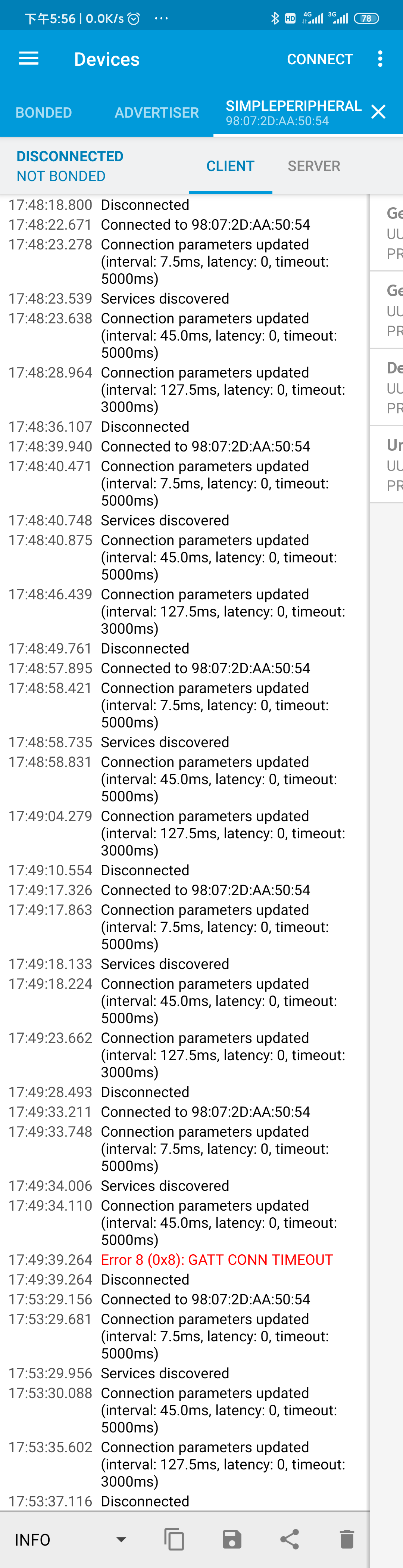
  2. The APP will initiate two link parameter updates (7.5 ms and 45 ms respectively) and service discovery to the device by default. When the APP initiates the second link parameter update of 45 ms to the device, and the APP received the successful update feedback, in a in large probability, the mobile phone may receive a timeout disconnect (GATT CONN TIMEOUT) after 5 seconds.
  3. This phenomenon occurs so frequently. Repeat operations (connecting to the development board, waiting for more than 5 seconds after completing the second link parameter update of the APP, and then disconnecting the development board), and the phenomenon approximately occurs once in 12 operations.


Measured times:

According to the above method, repeat the operation for the following times, the development board will have a timeout disconnect:

5, 15, 11, 11, 1, 18, 44, 10, 2, 7, 15, 4, 10.

Similarly, according to the above method, the operation was repeated 70 times in other manufacturers' development board, and there was no overtime disconnection. 


Attachments:

  1. "nrf-debug.png" and "nrf-info.png" are screenshots of APP log data, both of which are log information under the same operation. The "nrf-debug" log information is more detailed, while the "nrf-info" log information will be more concise, but it is clearer that the timeout disconnection occurs when the connection disconnect operation is performed.
  2. "mobile phone model.jpg" is a screenshot of the mobile phone model used in the test.

Hope we can get the feedback ASAP.

Best regards.

Sunny

  • Pls kindly refer to the following picture for the mobile phone version

  • Hi Sunny, 

    Assigning an expert to comment. 

    Thanks, 
    Elin 

  • Sunny,

    The TI devices and SDKs are tested thoroughly every release for compatibility with a large list of phones. However, it is impossible to cover all phone combinations (hw/sw).

    I recommend to use a BLE sniffer to capture the traffic in the air and study where the error comes from. TI has a packet sniffer, or you can also use a commercial sniffer. Please let me know if it would be possible for you to provide us a log.

    In any case, I will suggest to the team to add this device to our list.

    -Luis

  • Hi Luis,

    I used a third-party sniffer tool to capture the traffic packet in the air. There are two attachments, one is normal disconnect, the other is timeout disconnect.

    Test conditions:
    Hardware: TI Launchpad ("LAUNCHXL-CC2640R2F Rev:1.0)
    Firmware: cc2640r2lp_simple_peripheral.hex (C:/ti/simplelink_cc2640r2_sdk_4_20_00_04/examples/rtos/CC2640R2_LAUNCHXL/ble5stack/hexfiles/cc2640r2lp_simple_peripheral.hex)
    Mobile phone: Redmi Note 7 Pro (MIUI 11.0.8) (The phenomenon was found more frequently in this phone).
    APP: nRF Connect v4.19.0
    Sniffer analyzer:Wireshark v3.0.6

    normal disconnect:

    normal disconnect.zip

    timeout disconnect:

    timeout disconnect.zip

    Hope we can get the feedback ASAP.

    Best regards.

    Steven

  • Steven,

    I've involved the team. We're looking at this issue. 

    Is this blocking you from going to production? Can you give me an idea of your project's timeline and the severity of the issue?

    Thanks,

    luis

  • Steven,

    As I've said, I'm in the process of obtaining feedback from our team of experts.

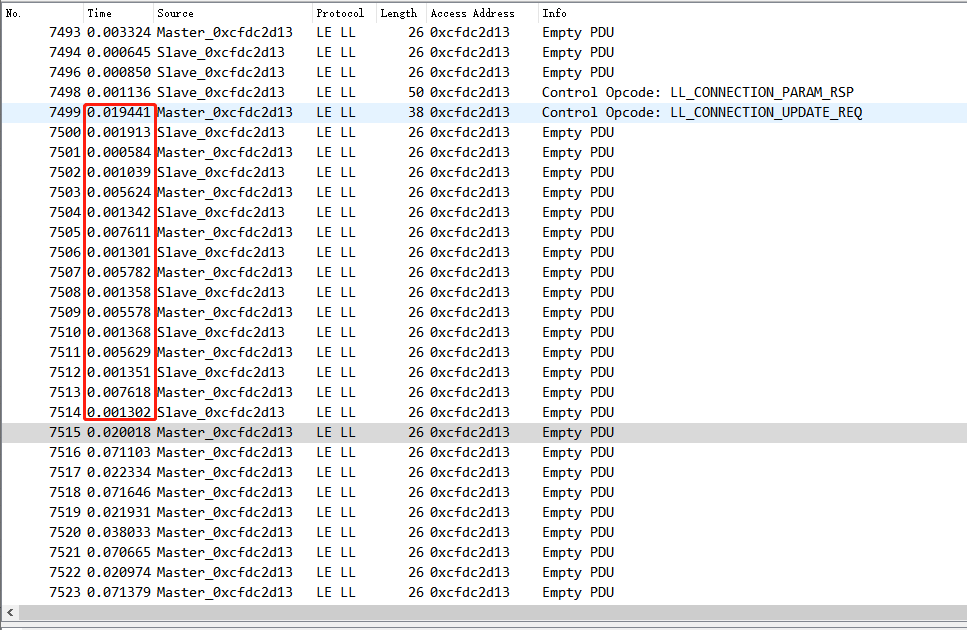
    However, on a quick look, it seems that the phone is sending connection events at intervals much more smaller than the permitted. The minimum interval between connection events is 7.5 ms, and as I'm showing in the attached image, the phone jams the TI chip with too-frequent connection events, as close as even less than 1 millisecond! (see for example message #1638 in the image below)

    Please see the image below: (I'm displaying time between packets)

    So, I believe that the cause is that, at least in part, the phone is out of spec.

    Thanks,

    Luis

  • Hi Luis,

    Steven and I are in the same team. 

    This is really blocking our production. And it is urgent, our customer and our team are dying to solve this problem ASAP. The end product will mostly use in APAC market, and the phone we listed is very popular in this area.

    This problem has prolonged the project for a month, can you help us to solve this? And we would like to move to the production in the late of this August.

    Thanks a lot.

    Sunny

  • Hi Luis,

    The following picture shows that the mobile phone communicates with the CC2640R2F chip normally, but the timeout disconnection still occurs.

    Looking forward to your reply.

    Sunny

  • Sunny,

    What are your thoughts in the likely root cause that I mentioned? It seems to me that the messages from the phone are coming at a much higher rate than permitted by the Bluetooth specification.

    Also, could you please share some logs of a "good" phone? (maybe another model that works reliably). I'm trying to analyze the communication and compare "pass" vs "fail".

    In any case, I'm involving more members on my team as you have shared the severity of this issue for your product.

    I'm hoping I can give you an update tomorrow, 8/13 by the end of the day, USA Central time.

    -Luis

  • Hi Luis,

    Pls kindly refer to our more detailed information:

    The following screenshot is of TI official firmware (SimplePeripheral of blestack, not ble5stack) interacting data with Xiaomi phones.

    Xiaomi phones also send data frequently, but there has never been a timeout disconnection. Our team think it is not entirely due to the frequent data sent by mobile phones. Xiaomi mobile phones are connected with other chips, and data is also sent frequently but this phenomenon does not occur.

    Firmware: cc2640r2lp_simple_peripheral.hex (C:\ti\simplelink_cc2640r2_sdk_4_20_00_04\examples\rtos\CC2640R2_LAUNCHXL\blestack\hexfiles)

  • Sunny,

    Our dev team is involved and now investigating the issue. Unfortunately, I can't guarantee a timeline for a possible solution.

    I have some questions for you:

    1) Could you please share some logs of a "good" phone? (maybe another model that works reliably). I'm trying to analyze the communication and compare "pass" vs "fail".

    2) Are there other phones that show the same behavior? Maybe other Xiaomi? If you give us more options, we might be able to get one here in the USA. As you probably know, the most important thing right now is being able to reproduce the issue.

    Thanks,

    Luis

  • Hi Luis,

    Good day.

    Currently, the phones which occurs the problem are the following: HUAWEI Mate30Pro(5G), HUAWEI Mate20, REDMI Note7Pro, Xiaomi 6, VIVO Iqoo Neo.

    The compressed package contains the interactive data between two mobile phones and TI CC2640R2F Launchpad (simple_peripheral) separately.

    sniffer_data.zip

    All three mobile phones tested on hand have this phenomenon, and mobile phones were  normal when interactive data.

    Looking forward to your reply.

    Sunny

  • Sunny,

    Our team is investigating the issue. I will update you periodically in this thread.

    Thanks,

    Luis