


Dear Community, Dear Colleges
I know this is surely an old and banal topic.
I'm developing one project on CC2650 with the IDE IAR. I would like to write the content of a buffer variable to a terminal (Putty, Terminal) via UART, using the driver function UART_write().
Unfortunately, this does not work. I'm not able to output/write nothing to the Putty or to the Terminal.
I need your help.
Here, I will describe the current situation.
1. First, I have the UART init function. At the end of the function I try to write a byte to the terminal using the UART_write(). This does not work.
__________________________________________________________________________________________________
#include <ti/drivers/UART.h>
#include <ti/drivers/uart/UARTCC26XX.h>
#include <xdc/runtime/System.h>
#include "board.h"
int Init_UART(void)
{
UART_Params params;
// Configure UART parameters.
UART_Params_init(¶ms);
params.baudRate = 115200;
uartParams.readMode = UART_MODE_BLOCKING;
uartParams.writeMode = UART_MODE_BLOCKING;
uartParams.writeDataMode = UART_DATA_BINARY;
uartParams.readDataMode = UART_DATA_BINARY;
uartParams.readReturnMode = UART_RETURN_FULL;
uartParams.readTimeout = ((250) * 1000) / Clock_tickPeriod;
uartParams.dataLength = UART_LEN_8;
uartParams.parityType = UART_PAR_NONE;
uartParams.stopBits = UART_STOP_ONE;
uartParams.readEcho = UART_ECHO_OFF;
// Open / power on the UART.
UART_init();
uartHandle = UART_open(Board_UART, &uartParams);
uint8_t Array_One[1] = {1};
int count = UART_write(uartHandle, Array_One, sizeof(Array_One));
return count;
}
2. Second, I have the following app.cfg file.
_________________________________________________
/* sysbios */
var useSysbiosInRom = true;

if ( useSysbiosInRom )
{
  var ROM = xdc.useModule('ti.sysbios.rom.ROM');
  ROM.romName = ROM.CC2650;
}

var Defaults = xdc.useModule('xdc.runtime.Defaults');
var Types = xdc.useModule('xdc.runtime.Types');
var Diags = xdc.useModule('xdc.runtime.Diags');
var Error = xdc.useModule('xdc.runtime.Error');
var Main = xdc.useModule('xdc.runtime.Main');
var Memory = xdc.useModule('xdc.runtime.Memory')
var SysCallback = xdc.useModule('xdc.runtime.SysCallback');
var System = xdc.useModule('xdc.runtime.System');
var Text = xdc.useModule('xdc.runtime.Text');

if ( useSysbiosInRom )
{
  var HeapMem = xdc.useModule('ti.sysbios.heaps.HeapMem');
}
else
{
  var HeapMin = xdc.useModule('xdc.runtime.HeapMin');
}
var Reset = xdc.useModule('xdc.runtime.Reset');
var BIOS = xdc.useModule('ti.sysbios.BIOS');
var Clock = xdc.useModule('ti.sysbios.knl.Clock');
var Task = xdc.useModule('ti.sysbios.knl.Task');

var Semaphore = xdc.useModule('ti.sysbios.knl.Semaphore');
var Hwi = xdc.useModule('ti.sysbios.hal.Hwi');
var M3Hwi = xdc.useModule('ti.sysbios.family.arm.m3.Hwi');
var Power = xdc.useModule('ti.sysbios.family.arm.cc26xx.Power');

/* Enable idle task (default). */
Task.enableIdleTask = true;

/* Idle CPU when threads blocked waiting for an interrupt */
Power.idle = true;
Power.policyFunc = Power.standbyPolicy;

/* Turn off RCOSC calibration */
Power.calibrateRCOSC = false;

/* compile out all Assert's */
Defaults.common$.diags_ASSERT = Diags.ALWAYS_OFF;

/* Don't load string names of modules on the target */
Defaults.common$.namedModule = false;

/* Allow Mod_create() and Mod_construct() but not delete() or destruct() */
Defaults.common$.memoryPolicy = Types.CREATE_POLICY;

/* Don't load diagnostic/descriptive text strings on the target */
Text.isLoaded = false;

/* Use the minimal user-supplied callback provider */
System.SupportProxy = SysCallback;

/* no exit handlers needed */
System.maxAtexitHandlers = 0;

/* main() and Hwi, Swi stack size */
Program.stack = 1024;

if ( useSysbiosInRom )
{
  /* no command-line arguments main(argc, argv) needed */
  Program.argSize = 0;
}

/* build a custom, optimized version of SYS/BIOS */
BIOS.libType = BIOS.LibType_Custom;

/* no logging - all compiled out */
BIOS.logsEnabled = false;

/* disable Asserts in SYS/BIOS code */
BIOS.assertsEnabled = false;

/* Reduce number of Task priority levels to save RAM */
Task.numPriorities = 6;

/* Set the default Task stack size - used if one is not specified */
Task.defaultStackSize = 512;

/* Don't check stacks for overflow - saves cycles (and power) and Flash */
Task.checkStackFlag = false;

/* Disable exception handling to save Flash - undo during active development */
M3Hwi.enableException = true;
M3Hwi.excHandlerFunc = null; /* null = default while loop function. Use e.g. "&myFxn" to use your own function. */
M3Hwi.nvicCCR.UNALIGN_TRP = 0;
M3Hwi.nvicCCR.DIV_0_TRP = 0;

/* Don't check for interrupt stack overflow during Idle loop */
Hwi.checkStackFlag = false;

/* Minimize Flash and RAM usage of Error module */
Error.raiseHook = null; /* null = default while loop function. Use e.g. "&myFxn" to your own handler function. */
Error.maxDepth = 2;

/* Set the default CPU frequency */
BIOS.cpuFreq.lo = 48000000;

/* Put reset vector at start of Flash */
M3Hwi.resetVectorAddress  = 0x0;

/* Put interrupt vector at start of RAM so interrupts can be configured at runtime */
M3Hwi.vectorTableAddress  = 0x20000000;

/* CC2650 has 50 interrupts */
M3Hwi.NUM_INTERRUPTS = 50;

if ( useSysbiosInRom )
{
  /* Create a small "alloc-only" heap */
  BIOS.heapSize = 1924;
}
else
{
  var heapMinParams = new HeapMin.Params;
  heapMinParams.size = 1924;
  var myHeapMin = HeapMin.create(heapMinParams);
  Memory.defaultHeapInstance = myHeapMin;
}

var Swi = xdc.useModule('ti.sysbios.knl.Swi');
Swi.numPriorities = 6;
BIOS.swiEnabled = true;

BIOS.includeXdcRuntime = true;

/* Tasks cannot pend based on priority */
Semaphore.supportsPriority = false;

/* Change default error function -- just spin */
Error.policyFxn = Error.policySpin;

/* true:  Allow runtime creation of e.g. semaphores
 * false: Compile out reference to Memory in BIOS */
BIOS.runtimeCreatesEnabled = true;

/* Abort and exit functions -- just spin */
System.abortFxn = System.abortSpin;
System.exitFxn = System.exitSpin;

/* CC26xx Boot module */
var Boot = xdc.useModule('ti.sysbios.family.arm.cc26xx.Boot');
Boot.driverlibVersion = 2;
Boot.customerConfig = false;
Boot.checkBackdoor = true;

/* Clock tick Period set to 10 us if not defined */
Clock.tickPeriod = 10;

/* Uart printout
System.SupportProxy = SysCallback;
var Idle = xdc.useModule('ti.sysbios.knl.Idle');
Idle.addFunc('&uartPrintf_flush');
SysCallback.putchFxn = "&uartPrintf_putch";
*/

var TIRTOS = xdc.useModule('ti.tirtos.TIRTOS');
TIRTOS.useUART = true;

/* System_printf configuration for JTAG comm with IAR */

var SysStd = xdc.useModule("xdc.runtime.SysStd");
System.SupportProxy = SysStd;

System.extendedFormats = '%$L%$S%$F%f';
3. Thirdly. The settings in IAR.
________________________________________________________________________________________
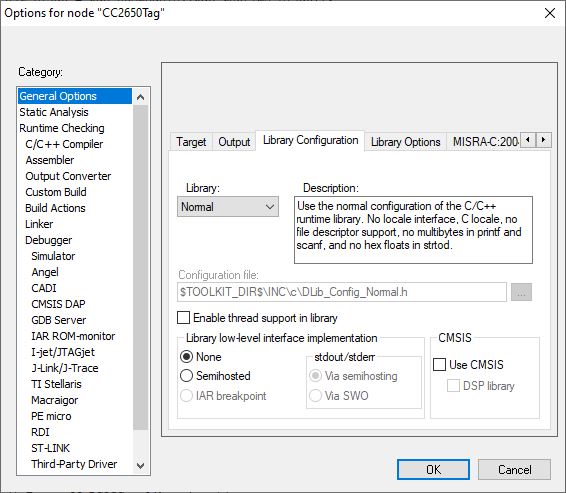
Please, can someone help me and tell me what do I wrong and what is the right way :)
Thank you in advance for your help.
Radka-Shmatka

