This thread has been locked.

If you have a related question, please click the "Ask a related question" button in the top right corner. The newly created question will be automatically linked to this question.

CC3235MODASF: CC3235SF HTTPS Server Connection Fails, HTTP Works

Part Number: CC3235MODASF
Other Parts Discussed in Thread: CC3235SF

Hi Ti,

I am trying to set up an HTTPS server on CC3235SF and cannot connect via HTTPS. Details are as follows:

Environment and Certificate Generation:

  • OpenSSL version: OpenSSL 3.6.1 27 Jan 2026

  • Commands used to generate key and certificate:


    openssl genrsa -out server-key.pem 2048

    openssl req -new -x509 ^
      -key server-key.pem ^
      -out server-cert.pem ^
      -days 365 ^
      -sha256

    openssl x509 -in server-cert.pem -out server-cert.der -outform DER
    openssl rsa -in server-key.pem -out server-key.der -outform DER

  • Placed server-cert.der and server-key.der into the project /userFile/certs/ directory.

HTTPS Server Setup in Code:

unsigned char ServerCertificateFileName[] = "/certs/http_cert.der";
unsigned char ServerKeyFileName[] = "/certs/http_key.der";
unsigned char SecurityMode[] = {0x1};
unsigned char HttpsPort[] = {0xBB, 0x01}; // 443
unsigned char SecondaryPort[] = {0x50, 0x00}; // 80
unsigned char SecondaryPortEnable[] = {0x1};

// Set certificate and private key
sl_NetAppSet(SL_NETAPP_HTTP_SERVER_ID, SL_NETAPP_HTTP_DEVICE_CERTIFICATE_FILENAME, sizeof(ServerCertificateFileName), ServerCertificateFileName);
sl_NetAppSet(SL_NETAPP_HTTP_SERVER_ID, SL_NETAPP_HTTP_PRIVATE_KEY_FILENAME, sizeof(ServerKeyFileName), ServerKeyFileName);

// Enable HTTPS on primary port
sl_NetAppSet(SL_NETAPP_HTTP_SERVER_ID, SL_NETAPP_HTTP_PRIMARY_PORT_SECURITY_MODE, sizeof(SecurityMode), SecurityMode);
sl_NetAppSet(SL_NETAPP_HTTP_SERVER_ID, SL_NETAPP_HTTP_PRIMARY_PORT_NUMBER, sizeof(HttpsPort), HttpsPort);

// Enable secondary port for HTTP redirect
sl_NetAppSet(SL_NETAPP_HTTP_SERVER_ID, SL_NETAPP_HTTP_SECONDARY_PORT_NUMBER, sizeof(SecondaryPort), SecondaryPort);
sl_NetAppSet(SL_NETAPP_HTTP_SERVER_ID, SL_NETAPP_HTTP_SECONDARY_PORT_ENABLE, sizeof(SecondaryPortEnable), SecondaryPortEnable);

// Restart HTTP server
sl_NetAppStop(SL_NETAPP_HTTP_SERVER_ID);
sl_NetAppStart(SL_NETAPP_HTTP_SERVER_ID);

Observed Behavior:

  • http://<IP> works correctly.

  • https://<IP> or https://<IP>:443 fails with ERR_CONNECTION_REFUSED in the browser.

  • All sl_NetAppSet and sl_NetAppStart calls return 0 (success), no errors.

What I Have Checked / Tried:

  • Both DER and PEM formats for certificates.

  • Confirmed the certificate and private key use RSA.

  • SecurityMode set to 0x1 (TLS enabled).

  • Secondary HTTP port enabled for redirect, still cannot connect.

  • Browser does not have the self-signed certificate installed.

Questions:

  1. Should the HTTPS server be configured before or after Wi-Fi connection?

  2. Besides sl_NetAppSet and sl_NetAppStart, are there other required steps (e.g., certificate format, permissions, file path)?

  3. Does the PC browser need to install the self-signed certificate to connect?

  4. Are there recommended ways to test or verify that the HTTPS server is actually running (e.g., port checking)?

  • Dear TI Support Team,

    I would like to clarify the current HTTPS behavior observed during testing.

    When using the SDK-provided certificates (e.g., dummy-trusted-ca-cert and dummy-trusted-ca-cert-key), the HTTPS server works correctly. The TLS handshake completes successfully, and communication is established. Although the browser shows ERR_CERT_AUTHORITY_INVALID, the connection itself functions as expected.

    However, when I generate my own certificate and private key using OpenSSL and load them into the device, the HTTPS connection consistently results in a timeout. The browser cannot establish a TLS session at all.

    This suggests that the HTTPS server configuration is correct, since it works with the SDK dummy certificates. The issue appears to be related specifically to the format or properties of the self-generated certificate and/or private key.

    Could you please advise:

    1. Are there specific requirements for certificate format (PEM/DER, PKCS#1 vs PKCS#8)?

    2. Are there mandatory extensions or key usage fields required by the NWP TLS stack?

    3. Are there known constraints on signature algorithm, key size, or encoding?

    If needed, I can provide the OpenSSL commands used to generate the certificate for further analysis.

    Thank you for your support.

  • Hi,

    Thanks for verifying it works with the dummy certificates.

    can you provide the commands you followed to create the certificates?

    Also, can you attach the server certificate itself? (it is not a secret, I do not need the matching key)

    Basically, when a browser connects to a server it gets the certificates chain and then validates the chain and eventually also validates the root certificate against its internal root CA store. But, even if it is not in the store (and probably it is not since it was not signed by an authorized root CA, like the dummy is not), it should allow you to connect if you choose to trust the certificate (and then you get a padlock with a sign to show it).

    So I assume that in your case the chain is not valid or the bottom certificate is not of CA type, etc.

    Regards,

    Shlomi

  • Dear TI Support Team,

    Thank you for your explanation regarding the certificate chain validation process.

    Below are the OpenSSL commands I used to generate the certificate and key:

    openssl genrsa -out server-key.pem 2048
    openssl req -new -x509 -key server-key.pem -out server-cert.pem -days 365 -sha256
    openssl x509 -in server-cert.pem -out server-cert.der -outform DER
    openssl rsa -in server-key.pem -out server-key.der -outform DER

    The generated certificate is self-signed and does not involve a separate Root CA or Intermediate CA.

    When this certificate is loaded into the device, the HTTPS connection consistently results in a timeout during TLS handshake. However, when using the SDK dummy certificates, HTTPS works correctly (with ERR_CERT_AUTHORITY_INVALID in the browser, as expected).

    Based on your explanation, I suspect the issue may be related to one of the following:

    • The certificate chain structure (since I am using a self-signed certificate rather than a CA-signed chain)

    • Missing required X.509 extensions (basicConstraints, keyUsage, extendedKeyUsage, etc.)

    • The bottom certificate not being marked appropriately (CA / CA)

    • Specific TLS constraints enforced by the NWP

    Could you please clarify:

    1. Does the SimpleLink HTTPS server require a CA-signed server certificate?

    2. Is a full certificate chain required to be provisioned?

    3. Are there mandatory X.509 extensions required by the NWP TLS stack?

    4. Are self-signed certificates supported, and if so, what constraints must they meet?

    I have attached the generated server certificate (PEM format) for your review.

    -----BEGIN CERTIFICATE-----
    MIIDkzCCAnugAwIBAgIUXnpFiOcp/v7URdEiyV5snYQZ+PUwDQYJKoZIhvcNAQEL
    BQAwWTELMAkGA1UEBhMCQVUxEzARBgNVBAgMClNvbWUtU3RhdGUxITAfBgNVBAoM
    GEludGVybmV0IFdpZGdpdHMgUHR5IEx0ZDESMBAGA1UEAwwJMTI3LjAuMC4xMB4X
    DTI2MDIxMTA4MjEzM1oXDTI3MDIxMTA4MjEzM1owWTELMAkGA1UEBhMCQVUxEzAR
    BgNVBAgMClNvbWUtU3RhdGUxITAfBgNVBAoMGEludGVybmV0IFdpZGdpdHMgUHR5
    IEx0ZDESMBAGA1UEAwwJMTI3LjAuMC4xMIIBIjANBgkqhkiG9w0BAQEFAAOCAQ8A
    MIIBCgKCAQEAxcV5nZpi5Ea9vpd0XeWb0VvT6uzHaj84JjkZHrY/ZsWM6DQx6ECS
    O0FttWUNOlWmeO28w7NLf0TK5cGTWf7fHcnmcGEaT6Ty76lqA3LRNIjDG8qYwX5T
    etl4S+HOBI1tJRKTjVOLCan9uwAQ8KscbsyjShIEO/00VKFdsSKJXLLdCM1Gbmwj
    1pd7E745COPpOc1y7/9SvJlT3ym/Bo4+ZyhaLxuyUk0lsFkvJHPxl7gGj2oKiqWV
    QcA3slu4tjrCsf/oGOvwsBeS5kreDRNNGQWXR0gRj/rBXsYC41yYRH7j7tj1iyvb
    uyGVj+INep/lvdf7F0XNTJukjmSlDjyeRQIDAQABo1MwUTAdBgNVHQ4EFgQUF9VQ
    MkkyvFx5CqtxBCbFPHTdY5wwHwYDVR0jBBgwFoAUF9VQMkkyvFx5CqtxBCbFPHTd
    Y5wwDwYDVR0TAQH/BAUwAwEB/zANBgkqhkiG9w0BAQsFAAOCAQEAHJnv4JFYdp9w
    dCVPF1UwTjlq4JITI5Fx0+bhtfdo0OrqYkfVJanQ4+MPbzAco2BGV68poroBv7E0
    CxP2U+DA+UF9GIxitgiulrSHZyTwyj5wnARut8l6eYY7gG3m3MqFQnSzp0GjZPfs
    s/UaoBmocuFlQxiXOVCxPtoaBZFSd5YgcXr+on2EJ59xTq+sGDI6kGD4C7ip9Qbf
    kqois65iBwUub92YBriJ9BFLrHEbkLpKdVFORMCvS2SDgz90Vebrq4UZsK7t7yLY
    Pd+oT3QO48qnE+T14OJMb9qBvY2oL/CkKzJBKGZy/58jwyj1yKS588KFLoEuHVRl
    g13HUAeWlA==
    -----END CERTIFICATE-----
    

    Thank you for your assistance.

    Best regards,
    Ryan

  • Dear TI Support Team,

    I performed additional testing regarding the certificate format.

    Using the following commands, I generated a self-signed certificate:

    openssl genrsa -out server.key 2048
    openssl req -new -x509 -key server.key -days 365 -sha256 -out server.crt

    When loading the PEM certificate (server.crt) and corresponding key into the device, HTTPS works correctly.

    However, after converting both the certificate and key to DER format:

    openssl x509 -in server.crt -out server.der -outform DER
    openssl rsa -in server.key -out server.key.der -outform DER

    and provisioning the DER files instead, the HTTPS connection consistently results in a timeout.

    This suggests that the issue is not related to certificate extensions or chain validation, but rather to how the HTTP server/NWP parses DER formatted certificates.

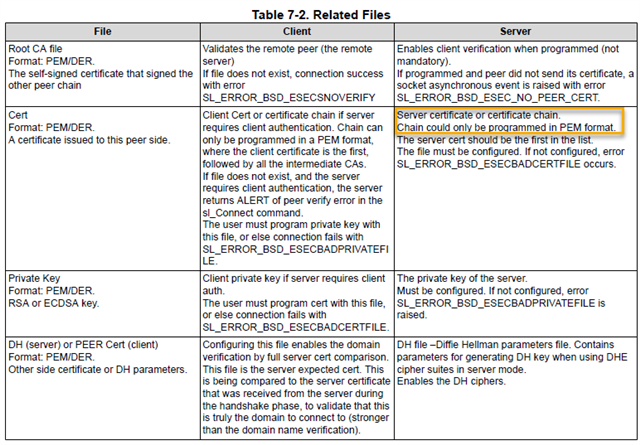
    Could you please confirm whether the SimpleLink HTTP server fully supports DER formatted certificates for SL_NETAPP_HTTP_DEVICE_CERTIFICATE_FILENAME and SL_NETAPP_HTTP_PRIVATE_KEY_FILENAME, or if PEM format is required?

    Thank you for your assistance.

    Best regards,

    Ryan

  • Hi,

    As far as I remember it can get both DER and PEM but I haven't checked it lately.

    Looking at the user guide, it does mention PEM only but without checking I cannot guarantee for sure.

    This is the table:

    Shlomi