This thread has been locked.

If you have a related question, please click the "Ask a related question" button in the top right corner. The newly created question will be automatically linked to this question.

CCS/CC3200-LAUNCHXL: CC3200 UDP socket appears unknown delay

Part Number: CC3200-LAUNCHXL
Other Parts Discussed in Thread: CC3200SDK

Tool/software: Code Composer Studio

Hi,

SDK:CC3200SDK_1.5.0

I use the udp_socket project it appears unknown delay(about 16ms), Based on this project, only modified  the following parts:

int BsdUdpServer(unsigned short usPort)
{
    SlSockAddrIn_t  sAddr;
    SlSockAddrIn_t  sLocalAddr;
    int             iCounter;
    int             iAddrSize;
    int             iSockID;
    int             iStatus;
    long           lLoopCount = 0;
    short           sTestBufLen;

    int count = 0;


    // filling the buffer
    for (iCounter=0 ; iCounter<BUF_SIZE ; iCounter++)
    {
        g_cBsdBuf[iCounter] = (char)(iCounter % 10);
    }

    sTestBufLen  = BUF_SIZE;
    //filling the UDP server socket address
    sLocalAddr.sin_family = SL_AF_INET;
    sLocalAddr.sin_port = sl_Htons((unsigned short)usPort);
    sLocalAddr.sin_addr.s_addr = 0;

    iAddrSize = sizeof(SlSockAddrIn_t);

    // creating a UDP socket
    iSockID = sl_Socket(SL_AF_INET,SL_SOCK_DGRAM, 0);
    if( iSockID < 0 )
    {
        // error
        ASSERT_ON_ERROR(SOCKET_CREATE_ERROR);
    }

    // binding the UDP socket to the UDP server address
    iStatus = sl_Bind(iSockID, (SlSockAddr_t *)&sLocalAddr, iAddrSize);
    if( iStatus < 0 )
    {
        // error
        sl_Close(iSockID);
        ASSERT_ON_ERROR(BIND_ERROR);
    }

    
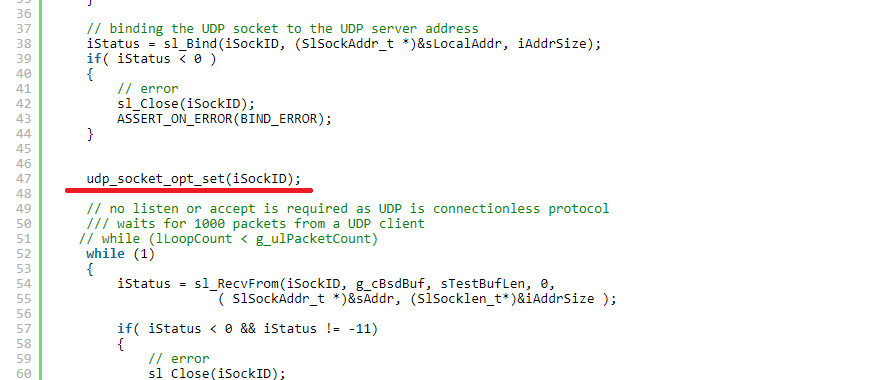
    udp_socket_opt_set(iSockID);

    // no listen or accept is required as UDP is connectionless protocol
    /// waits for 1000 packets from a UDP client
   // while (lLoopCount < g_ulPacketCount)
    while (1)
    {
        iStatus = sl_RecvFrom(iSockID, g_cBsdBuf, sTestBufLen, 0,
                     ( SlSockAddr_t *)&sAddr, (SlSocklen_t*)&iAddrSize );

        if( iStatus < 0 && iStatus != -11)
        {
            // error
            sl_Close(iSockID);
            ASSERT_ON_ERROR(RECV_ERROR);
        }

        lLoopCount++;

        //UART_PRINT("iStatus = %d\r\n",iStatus);

        UART_PRINT("0"); 
        delay_us(900);   
       
       if(iStatus>0)
        {
            UART_PRINT("11111111111111111111111111111111111111111111111111iStatus = %d\r\n",iStatus);
        }
    }

    UART_PRINT("Recieved %u packets successfully\n\r",g_ulPacketCount);

    //closing the socket after receiving 1000 packets
    sl_Close(iSockID);

    return SUCCESS;
}

/****************************************************************************
//                            MAIN FUNCTION
//****************************************************************************
void main()
{
    long lRetVal = -1;

    //
    // Board Initialization
    //
    BoardInit();

    //
    // uDMA Initialization
    //
    UDMAInit();

    //
    // Configure the pinmux settings for the peripherals exercised
    //
    PinMuxConfig();

    //
    // Configuring UART
    //
    InitTerm();

    //
    // Display banner
    //
    DisplayBanner(APPLICATION_NAME);

    InitializeAppVariables();

    //
    // Following function configure the device to default state by cleaning
    // the persistent settings stored in NVMEM (viz. connection profiles &
    // policies, power policy etc)
    //
    // Applications may choose to skip this step if the developer is sure
    // that the device is in its desired state at start of applicaton
    //
    // Note that all profiles and persistent settings that were done on the
    // device will be lost
    //
    lRetVal = ConfigureSimpleLinkToDefaultState();

    if(lRetVal < 0)
    {
        if (DEVICE_NOT_IN_STATION_MODE == lRetVal)
          UART_PRINT("Failed to configure the device in its default state \n\r");

        LOOP_FOREVER();
    }

    UART_PRINT("Device is configured in default state \n\r");

    //
    // Asumption is that the device is configured in station mode already
    // and it is in its default state
    //
    lRetVal = sl_Start(0, 0, 0);
    if (lRetVal < 0 || lRetVal != ROLE_STA)
    {
        UART_PRINT("Failed to start the device \n\r");
        LOOP_FOREVER();
    }

    UART_PRINT("Device started as STATION \n\r");

    UART_PRINT("Connecting to AP: %s ...\r\n",SSID_NAME);

    //
    //Connecting to WLAN AP
    //
    lRetVal = WlanConnect();
    if(lRetVal < 0)
    {
        UART_PRINT("Failed to establish connection w/ an AP \n\r");
        LOOP_FOREVER();
    }

    UART_PRINT("Connected to AP: %s \n\r",SSID_NAME);

    UART_PRINT("Device IP: %d.%d.%d.%d\n\r\n\r",
                SL_IPV4_BYTE(g_ulIpAddr,3),
                SL_IPV4_BYTE(g_ulIpAddr,2),
                SL_IPV4_BYTE(g_ulIpAddr,1),
                SL_IPV4_BYTE(g_ulIpAddr,0));


    lRetVal = BsdUdpServer(PORT_NUM);
    if(lRetVal < 0)
    {
        ERR_PRINT(lRetVal);
        LOOP_FOREVER();
    }


//#ifdef USER_INPUT_ENABLE
//    lRetVal = UserInput();
//    if(lRetVal < 0)
//    {
//        ERR_PRINT(lRetVal);
//        LOOP_FOREVER();
//    }
//
//#else
//    lRetVal = BsdUdpClient(PORT_NUM);
//    if(lRetVal < 0)
//    {
//        ERR_PRINT(lRetVal);
//        LOOP_FOREVER();
//    }
//
//    lRetVal = BsdUdpServer(PORT_NUM);
//    if(lRetVal < 0)
//    {
//        ERR_PRINT(lRetVal);
//        LOOP_FOREVER();
//    }
//#endif

    UART_PRINT("Exiting Application ...\n\r");

    //
    // power off the network processor
    //
    lRetVal = sl_Stop(SL_STOP_TIMEOUT);

    while (1)
    {
     _SlNonOsMainLoopTask();
    }
}

//*****************************************************************************

If I add the delay sentance"delay_us(900)" to the code, the unknown delay time will disappear.If not,it will appear about 

16ms delay time,such as the following picture.Why is it?Can you help here?

logic Analyzer log the TX pin of serial port Output waveform  :

  • Hi Kevin,

    What client are you using? Keep in mind socket APIs are blocking by default. Are you able to determine where in the loop the delay is occuring (like at sl_RecvFrom)?

    Best regards,

    Sarah

  • Hi Sarah,

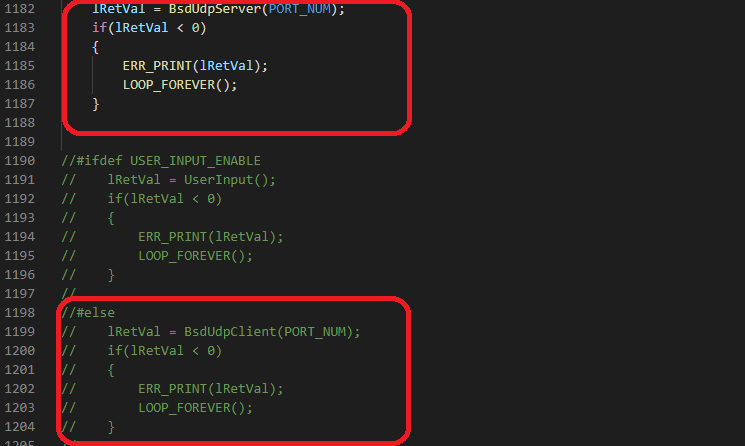
    Thank you for your reply. In fact,the client is not working,only the BsdUdpServer funtion is used. As shown below:

    The socket APIs have been set non-blocking mode,I will upload the main.c file to the attachment, please take a look. The delay is occuring  at sl_RecvFrom.
    In addtion, When I create a TCPClient and a UDPServer, both set to non-blocking, it can work normally. When the TCPClient connection is successful, in the loop of TCP, UDP scan data reception, the same 16ms unknown delay problem will occur; when deleting the TCP scan Or UDP scanning, the unknown delay will also occur; when neither scanning nor receiving, the unknown delay will not appear.
    //*****************************************************************************
    //
    // Copyright (C) 2014 Texas Instruments Incorporated - http://www.ti.com/ 
    // 
    // 
    //  Redistribution and use in source and binary forms, with or without 
    //  modification, are permitted provided that the following conditions 
    //  are met:
    //
    //    Redistributions of source code must retain the above copyright 
    //    notice, this list of conditions and the following disclaimer.
    //
    //    Redistributions in binary form must reproduce the above copyright
    //    notice, this list of conditions and the following disclaimer in the 
    //    documentation and/or other materials provided with the   
    //    distribution.
    //
    //    Neither the name of Texas Instruments Incorporated nor the names of
    //    its contributors may be used to endorse or promote products derived
    //    from this software without specific prior written permission.
    //
    //  THIS SOFTWARE IS PROVIDED BY THE COPYRIGHT HOLDERS AND CONTRIBUTORS 
    //  "AS IS" AND ANY EXPRESS OR IMPLIED WARRANTIES, INCLUDING, BUT NOT 
    //  LIMITED TO, THE IMPLIED WARRANTIES OF MERCHANTABILITY AND FITNESS FOR
    //  A PARTICULAR PURPOSE ARE DISCLAIMED. IN NO EVENT SHALL THE COPYRIGHT 
    //  OWNER OR CONTRIBUTORS BE LIABLE FOR ANY DIRECT, INDIRECT, INCIDENTAL, 
    //  SPECIAL, EXEMPLARY, OR CONSEQUENTIAL DAMAGES (INCLUDING, BUT NOT 
    //  LIMITED TO, PROCUREMENT OF SUBSTITUTE GOODS OR SERVICES; LOSS OF USE,
    //  DATA, OR PROFITS; OR BUSINESS INTERRUPTION) HOWEVER CAUSED AND ON ANY
    //  THEORY OF LIABILITY, WHETHER IN CONTRACT, STRICT LIABILITY, OR TORT 
    //  (INCLUDING NEGLIGENCE OR OTHERWISE) ARISING IN ANY WAY OUT OF THE USE 
    //  OF THIS SOFTWARE, EVEN IF ADVISED OF THE POSSIBILITY OF SUCH DAMAGE.
    //
    //*****************************************************************************
    
    
    //*****************************************************************************
    //
    // Application Name     - UDP Socket
    // Application Overview - This particular application illustrates how this
    //                        device can be used as a client or server for UDP
    //                        communication.
    //
    //*****************************************************************************
    
    
    //****************************************************************************
    //
    //! \addtogroup udp_socket
    //! @{
    //
    //****************************************************************************
    
    #include <stdlib.h>
    #include <string.h>
    
    // simplelink includes
    #include "simplelink.h"
    #include "wlan.h"
    
    // driverlib includes
    #include "hw_ints.h"
    #include "hw_types.h"
    #include "hw_memmap.h"
    #include "rom.h"
    #include "rom_map.h"
    #include "interrupt.h"
    #include "prcm.h"
    #include "utils.h"
    #include "uart.h"
    
    // common interface includes
    #include "udma_if.h"
    #include "common.h"
    #ifndef NOTERM
    #include "uart_if.h"
    #endif
    
    #include "pinmux.h"
    
    
    #define APPLICATION_NAME        "UDP Socket"
    #define APPLICATION_VERSION     "1.4.0"
    
    #define IP_ADDR            0xc0a80064 /* 192.168.0.100 */
    #define PORT_NUM           5001
    #define BUF_SIZE           1400
    #define UDP_PACKET_COUNT   1000
    
    // Application specific status/error codes
    typedef enum{
        // Choosing -0x7D0 to avoid overlap w/ host-driver's error codes
        SOCKET_CREATE_ERROR = -0x7D0,
        BIND_ERROR = SOCKET_CREATE_ERROR - 1,
        SEND_ERROR = BIND_ERROR - 1,
        RECV_ERROR = SEND_ERROR -1,
        SOCKET_CLOSE = RECV_ERROR -1,  
        DEVICE_NOT_IN_STATION_MODE = SOCKET_CLOSE - 1,
        STATUS_CODE_MAX = -0xBB8
    }e_AppStatusCodes;


    //****************************************************************************
    //                      LOCAL FUNCTION PROTOTYPES
    //****************************************************************************
    int BsdUdpClient(unsigned short usPort);
    int BsdUdpServer(unsigned short usPort);
    static long WlanConnect();
    static void DisplayBanner();
    static void BoardInit();
    static void InitializeAppVariables();
    static long ConfigureSimpleLinkToDefaultState();
    
    
    //*****************************************************************************
    //                 GLOBAL VARIABLES -- Start
    //*****************************************************************************
    volatile unsigned long  g_ulStatus = 0;//SimpleLink Status
    unsigned long  g_ulGatewayIP = 0; //Network Gateway IP address
    unsigned char  g_ucConnectionSSID[SSID_LEN_MAX+1]; //Connection SSID
    unsigned char  g_ucConnectionBSSID[BSSID_LEN_MAX]; //Connection BSSID
    unsigned long  g_ulDestinationIp = IP_ADDR;        // Client IP address
    unsigned int   g_uiPortNum = PORT_NUM;
    volatile unsigned long  g_ulPacketCount = UDP_PACKET_COUNT;
    unsigned char  g_ucSimplelinkstarted = 0;
    unsigned long  g_ulIpAddr = 0;
    char g_cBsdBuf[BUF_SIZE];
    
    #if defined(ccs) || defined(gcc)
    extern void (* const g_pfnVectors[])(void);
    #endif
    #if defined(ewarm)
    extern uVectorEntry __vector_table;
    #endif
    //*****************************************************************************
    //                 GLOBAL VARIABLES -- End
    //*****************************************************************************


    //*****************************************************************************
    // SimpleLink Asynchronous Event Handlers -- Start
    //*****************************************************************************
    
    
    //*****************************************************************************
    //
    //! \brief The Function Handles WLAN Events
    //!
    //! \param[in]  pWlanEvent - Pointer to WLAN Event Info
    //!
    //! \return None
    //!
    //*****************************************************************************
    void SimpleLinkWlanEventHandler(SlWlanEvent_t *pWlanEvent)
    {
        if(!pWlanEvent)
        {
            return;
        }
    
        switch(pWlanEvent->Event)
        {
            case SL_WLAN_CONNECT_EVENT:
            {
                SET_STATUS_BIT(g_ulStatus, STATUS_BIT_CONNECTION);
    
                //
                // Information about the connected AP (like name, MAC etc) will be
                // available in 'slWlanConnectAsyncResponse_t'-Applications
                // can use it if required
                //
                //  slWlanConnectAsyncResponse_t *pEventData = NULL;
                // pEventData = &pWlanEvent->EventData.STAandP2PModeWlanConnected;
                //
    
                // Copy new connection SSID and BSSID to global parameters
                memcpy(g_ucConnectionSSID,pWlanEvent->EventData.
                       STAandP2PModeWlanConnected.ssid_name,
                       pWlanEvent->EventData.STAandP2PModeWlanConnected.ssid_len);
                memcpy(g_ucConnectionBSSID,
                       pWlanEvent->EventData.STAandP2PModeWlanConnected.bssid,
                       SL_BSSID_LENGTH);
    
                UART_PRINT("[WLAN EVENT] STA Connected to the AP: %s , "
                    "BSSID: %x:%x:%x:%x:%x:%x\n\r",
                          g_ucConnectionSSID,g_ucConnectionBSSID[0],
                          g_ucConnectionBSSID[1],g_ucConnectionBSSID[2],
                          g_ucConnectionBSSID[3],g_ucConnectionBSSID[4],
                          g_ucConnectionBSSID[5]);
            }
            break;
    
            case SL_WLAN_DISCONNECT_EVENT:
            {
                slWlanConnectAsyncResponse_t*  pEventData = NULL;
    
                CLR_STATUS_BIT(g_ulStatus, STATUS_BIT_CONNECTION);
                CLR_STATUS_BIT(g_ulStatus, STATUS_BIT_IP_AQUIRED);
    
                pEventData = &pWlanEvent->EventData.STAandP2PModeDisconnected;
    
                // If the user has initiated 'Disconnect' request,
                //'reason_code' is SL_WLAN_DISCONNECT_USER_INITIATED_DISCONNECTION
                if(SL_WLAN_DISCONNECT_USER_INITIATED_DISCONNECTION == pEventData->reason_code)
                {
                    UART_PRINT("[WLAN EVENT]Device disconnected from the AP: %s,"
                    "BSSID: %x:%x:%x:%x:%x:%x on application's request \n\r",
                               g_ucConnectionSSID,g_ucConnectionBSSID[0],
                               g_ucConnectionBSSID[1],g_ucConnectionBSSID[2],
                               g_ucConnectionBSSID[3],g_ucConnectionBSSID[4],
                               g_ucConnectionBSSID[5]);
                }
                else
                {
                    UART_PRINT("[WLAN ERROR]Device disconnected from the AP AP: %s,"
                    "BSSID: %x:%x:%x:%x:%x:%x on an ERROR..!! \n\r",
                               g_ucConnectionSSID,g_ucConnectionBSSID[0],
                               g_ucConnectionBSSID[1],g_ucConnectionBSSID[2],
                               g_ucConnectionBSSID[3],g_ucConnectionBSSID[4],
                               g_ucConnectionBSSID[5]);
                }
                memset(g_ucConnectionSSID,0,sizeof(g_ucConnectionSSID));
                memset(g_ucConnectionBSSID,0,sizeof(g_ucConnectionBSSID));
            }
            break;
    
            default:
            {
                UART_PRINT("[WLAN EVENT] Unexpected event [0x%x]\n\r",
                           pWlanEvent->Event);
            }
            break;
        }
    }
    
    //*****************************************************************************
    //
    //! \brief This function handles network events such as IP acquisition, IP
    //!           leased, IP released etc.
    //!
    //! \param[in]  pNetAppEvent - Pointer to NetApp Event Info
    //!
    //! \return None
    //!
    //*****************************************************************************
    void SimpleLinkNetAppEventHandler(SlNetAppEvent_t *pNetAppEvent)
    {
        if(!pNetAppEvent)
        {
            return;
        }
    
        switch(pNetAppEvent->Event)
        {
            case SL_NETAPP_IPV4_IPACQUIRED_EVENT:
            {
                SlIpV4AcquiredAsync_t *pEventData = NULL;
    
                SET_STATUS_BIT(g_ulStatus, STATUS_BIT_IP_AQUIRED);
    
                //Ip Acquired Event Data
                pEventData = &pNetAppEvent->EventData.ipAcquiredV4;
    
                g_ulIpAddr = pEventData->ip;
    
                //Gateway IP address
                g_ulGatewayIP = pEventData->gateway;
    
                UART_PRINT("[NETAPP EVENT] IP Acquired: IP=%d.%d.%d.%d , "
                            "Gateway=%d.%d.%d.%d\n\r",
    
                            SL_IPV4_BYTE(g_ulIpAddr,3),
                            SL_IPV4_BYTE(g_ulIpAddr,2),
                            SL_IPV4_BYTE(g_ulIpAddr,1),
                            SL_IPV4_BYTE(g_ulIpAddr,0),
                            SL_IPV4_BYTE(g_ulGatewayIP,3),
                            SL_IPV4_BYTE(g_ulGatewayIP,2),
                            SL_IPV4_BYTE(g_ulGatewayIP,1),
                            SL_IPV4_BYTE(g_ulGatewayIP,0));
            }
            break;
    
            default:
            {
                UART_PRINT("[NETAPP EVENT] Unexpected event [0x%x] \n\r",
                           pNetAppEvent->Event);
            }
            break;
        }
    }
    
    
    //*****************************************************************************
    //
    //! \brief This function handles HTTP server events
    //!
    //! \param[in]  pServerEvent - Contains the relevant event information
    //! \param[in]    pServerResponse - Should be filled by the user with the
    //!                                      relevant response information
    //!
    //! \return None
    //!
    //****************************************************************************
    void SimpleLinkHttpServerCallback(SlHttpServerEvent_t *pHttpEvent,
                                      SlHttpServerResponse_t *pHttpResponse)
    {
        // Unused in this application
    }
    
    //*****************************************************************************
    //
    //! \brief This function handles General Events
    //!
    //! \param[in]     pDevEvent - Pointer to General Event Info
    //!
    //! \return None
    //!
    //*****************************************************************************
    void SimpleLinkGeneralEventHandler(SlDeviceEvent_t *pDevEvent)
    {
        if(!pDevEvent)
        {
            return;
        }
    
        //
        // Most of the general errors are not FATAL are are to be handled
        // appropriately by the application
        //
        UART_PRINT("[GENERAL EVENT] - ID=[%d] Sender=[%d]\n\n",
                   pDevEvent->EventData.deviceEvent.status,
                   pDevEvent->EventData.deviceEvent.sender);
    }
    
    
    //*****************************************************************************
    //
    //! This function handles socket events indication
    //!
    //! \param[in]      pSock - Pointer to Socket Event Info
    //!
    //! \return None
    //!
    //*****************************************************************************
    void SimpleLinkSockEventHandler(SlSockEvent_t *pSock)
    {
        //
        // This application doesn't work w/ socket - Events are not expected
        //
     
    }
    
    
    //*****************************************************************************
    // SimpleLink Asynchronous Event Handlers -- End
    //*****************************************************************************
    
    
    //*****************************************************************************
    //
    //! This function initializes the application variables
    //!
    //! \param[in]    None
    //!
    //! \return None
    //!
    //*****************************************************************************
    static void InitializeAppVariables()
    {
        g_ulStatus = 0;
        g_ulGatewayIP = 0;
        memset(g_ucConnectionSSID,0,sizeof(g_ucConnectionSSID));
        memset(g_ucConnectionBSSID,0,sizeof(g_ucConnectionBSSID));
        g_ulDestinationIp = IP_ADDR;
        g_uiPortNum = PORT_NUM;
        g_ulPacketCount = UDP_PACKET_COUNT;
    }
    
    //*****************************************************************************
    //! \brief This function puts the device in its default state. It:
    //!           - Set the mode to STATION
    //!           - Configures connection policy to Auto and AutoSmartConfig
    //!           - Deletes all the stored profiles
    //!           - Enables DHCP
    //!           - Disables Scan policy
    //!           - Sets Tx power to maximum
    //!           - Sets power policy to normal
    //!           - Unregister mDNS services
    //!           - Remove all filters
    //!
    //! \param   none
    //! \return  On success, zero is returned. On error, negative is returned
    //*****************************************************************************
    static long ConfigureSimpleLinkToDefaultState()
    {
        SlVersionFull   ver = {0};
        _WlanRxFilterOperationCommandBuff_t  RxFilterIdMask = {0};
    
        unsigned char ucVal = 1;
        unsigned char ucConfigOpt = 0;
        unsigned char ucConfigLen = 0;
        unsigned char ucPower = 0;
    
        long lRetVal = -1;
        long lMode = -1;
    
        lMode = sl_Start(0, 0, 0);
        ASSERT_ON_ERROR(lMode);
    
        // If the device is not in station-mode, try configuring it in station-mode 
        if (ROLE_STA != lMode)
        {
            if (ROLE_AP == lMode)
            {
                // If the device is in AP mode, we need to wait for this event 
                // before doing anything 
                while(!IS_IP_ACQUIRED(g_ulStatus))
                {
    #ifndef SL_PLATFORM_MULTI_THREADED
                  _SlNonOsMainLoopTask(); 
    #endif
                }
            }
    
            // Switch to STA role and restart 
            lRetVal = sl_WlanSetMode(ROLE_STA);
            ASSERT_ON_ERROR(lRetVal);
    
            lRetVal = sl_Stop(0xFF);
            ASSERT_ON_ERROR(lRetVal);
    
            lRetVal = sl_Start(0, 0, 0);
            ASSERT_ON_ERROR(lRetVal);
    
            // Check if the device is in station again 
            if (ROLE_STA != lRetVal)
            {
                // We don't want to proceed if the device is not coming up in STA-mode 
                return DEVICE_NOT_IN_STATION_MODE;
            }
        }
        
        // Get the device's version-information
        ucConfigOpt = SL_DEVICE_GENERAL_VERSION;
        ucConfigLen = sizeof(ver);
        lRetVal = sl_DevGet(SL_DEVICE_GENERAL_CONFIGURATION, &ucConfigOpt, 
                                    &ucConfigLen, (unsigned char *)(&ver));
        ASSERT_ON_ERROR(lRetVal);
        
        UART_PRINT("Host Driver Version: %s\n\r",SL_DRIVER_VERSION);
        UART_PRINT("Build Version %d.%d.%d.%d.31.%d.%d.%d.%d.%d.%d.%d.%d\n\r",
        ver.NwpVersion[0],ver.NwpVersion[1],ver.NwpVersion[2],ver.NwpVersion[3],
        ver.ChipFwAndPhyVersion.FwVersion[0],ver.ChipFwAndPhyVersion.FwVersion[1],
        ver.ChipFwAndPhyVersion.FwVersion[2],ver.ChipFwAndPhyVersion.FwVersion[3],
        ver.ChipFwAndPhyVersion.PhyVersion[0],ver.ChipFwAndPhyVersion.PhyVersion[1],
        ver.ChipFwAndPhyVersion.PhyVersion[2],ver.ChipFwAndPhyVersion.PhyVersion[3]);
    
        // Set connection policy to Auto + SmartConfig 
        //      (Device's default connection policy)
        lRetVal = sl_WlanPolicySet(SL_POLICY_CONNECTION, 
                                    SL_CONNECTION_POLICY(1, 0, 0, 0, 1), NULL, 0);
        ASSERT_ON_ERROR(lRetVal);
    
        // Remove all profiles
        lRetVal = sl_WlanProfileDel(0xFF);
        ASSERT_ON_ERROR(lRetVal);


        //
        // Device in station-mode. Disconnect previous connection if any
        // The function returns 0 if 'Disconnected done', negative number if already
        // disconnected Wait for 'disconnection' event if 0 is returned, Ignore 
        // other return-codes
        //
        lRetVal = sl_WlanDisconnect();
        if(0 == lRetVal)
        {
            // Wait
            while(IS_CONNECTED(g_ulStatus))
            {
    #ifndef SL_PLATFORM_MULTI_THREADED
                  _SlNonOsMainLoopTask(); 
    #endif
            }
        }
    
        // Enable DHCP client
        lRetVal = sl_NetCfgSet(SL_IPV4_STA_P2P_CL_DHCP_ENABLE,1,1,&ucVal);
        ASSERT_ON_ERROR(lRetVal);
    
        // Disable scan
        ucConfigOpt = SL_SCAN_POLICY(0);
        lRetVal = sl_WlanPolicySet(SL_POLICY_SCAN , ucConfigOpt, NULL, 0);
        ASSERT_ON_ERROR(lRetVal);
    
        // Set Tx power level for station mode
        // Number between 0-15, as dB offset from max power - 0 will set max power
        ucPower = 0;
        lRetVal = sl_WlanSet(SL_WLAN_CFG_GENERAL_PARAM_ID, 
                WLAN_GENERAL_PARAM_OPT_STA_TX_POWER, 1, (unsigned char *)&ucPower);
        ASSERT_ON_ERROR(lRetVal);
    
        // Set PM policy to normal
        lRetVal = sl_WlanPolicySet(SL_POLICY_PM , SL_NORMAL_POLICY, NULL, 0);
        ASSERT_ON_ERROR(lRetVal);
    
        // Unregister mDNS services
        lRetVal = sl_NetAppMDNSUnRegisterService(0, 0);
        ASSERT_ON_ERROR(lRetVal);
    
        // Remove  all 64 filters (8*8)
        memset(RxFilterIdMask.FilterIdMask, 0xFF, 8);
        lRetVal = sl_WlanRxFilterSet(SL_REMOVE_RX_FILTER, (_u8 *)&RxFilterIdMask,
                           sizeof(_WlanRxFilterOperationCommandBuff_t));
        ASSERT_ON_ERROR(lRetVal);
    
        lRetVal = sl_Stop(SL_STOP_TIMEOUT);
        ASSERT_ON_ERROR(lRetVal);
    
        InitializeAppVariables();
        
        return lRetVal; // Success
    }
    
    
    //****************************************************************************
    //
    //!    \brief Parse the input IP address from the user
    //!
    //!    \param[in]                     ucCMD (char pointer to input string)
    //!
    //!    \return                        0 : if correct IP, -1 : incorrect IP
    //
    //****************************************************************************
    int IpAddressParser(char *ucCMD)
    {
        int i=0;
        unsigned int uiUserInputData;
        unsigned long ulUserIpAddress = 0;
        char *ucInpString;
        ucInpString = strtok(ucCMD, ".");
        uiUserInputData = (int)strtoul(ucInpString,0,10);
        while(i<4)
        {
            //
           // Check Whether IP is valid
           //
           if((ucInpString != NULL) && (uiUserInputData < 256))
           {
               ulUserIpAddress |= uiUserInputData;
               if(i < 3)
                   ulUserIpAddress = ulUserIpAddress << 8;
               ucInpString=strtok(NULL,".");
               uiUserInputData = (int)strtoul(ucInpString,0,10);
               i++;
           }
           else
           {
               return -1;
           }
        }
        g_ulDestinationIp = ulUserIpAddress;
        return SUCCESS;
    }
    
    //*****************************************************************************
    //
    //! UserInput
    //!
    //! This function
    //!        1. Function for reading the user input for UDP RX/TX
    //!
    //! \return none
    //
    //*****************************************************************************
    long UserInput()
    {
        int iInput = 0;
        char acCmdStore[50];
        int lRetVal;
        int iRightInput = 0;
        unsigned long ulUserInputData = 0;
    
        UART_PRINT("Default settings: SSID Name: %s, PORT = %d, Packet Count = %d, "
                      "Destination IP: %d.%d.%d.%d\n\r",
                SSID_NAME, g_uiPortNum, g_ulPacketCount,
                SL_IPV4_BYTE(g_ulDestinationIp,3),
                SL_IPV4_BYTE(g_ulDestinationIp,2),
                SL_IPV4_BYTE(g_ulDestinationIp,1),
                SL_IPV4_BYTE(g_ulDestinationIp,0));
    
        do
        {
            UART_PRINT("\r\nOptions:\r\n1. Send UDP packets.\r\n2. Receive UDP "
                        "packets.\r\n3. Settings.\r\n4. Exit\r\n");
            UART_PRINT("Enter the option to use: ");
            lRetVal = GetCmd(acCmdStore, sizeof(acCmdStore));
            if(lRetVal == 0)
            {
              //
              // No input. Just an enter pressed probably. Display a prompt.
              //
              UART_PRINT("\n\n\rEnter Valid Input.");
            }
            else
            {
                iInput  = (int)strtoul(acCmdStore,0,10);
                if(iInput  == 1)
                {
                    UART_PRINT("Run iperf command \"iperf.exe -u -s -i 1\" and "
                                "press Enter\n\r");
                    //
                    // Wait to receive a character over UART
                    //
                    MAP_UARTCharGet(CONSOLE);
                    UART_PRINT("Sending UDP packets...\n\r");
    
                    // Before proceeding, please make sure to have a server 
                    // waiting on PORT_NUM
                    lRetVal = BsdUdpClient(g_uiPortNum);
                    ASSERT_ON_ERROR(lRetVal);
                }
                else if(iInput  == 2)
                {
                    UART_PRINT("Run iperf command \"iperf.exe -u -c %d.%d.%d.%d -i 1 "
                                "-t 100000\" and press Enter\n\r",
                              SL_IPV4_BYTE(g_ulIpAddr,3), SL_IPV4_BYTE(g_ulIpAddr,2),
                              SL_IPV4_BYTE(g_ulIpAddr,1), SL_IPV4_BYTE(g_ulIpAddr,0));
                    
                    //
                    // Wait to receive a character over UART
                    //
                    MAP_UARTCharGet(CONSOLE);
                    UART_PRINT("Receiving UDP packets...\n\r");
                    
                    // After calling this function, you can start sending data 
                    // to CC3200 IP address on PORT_NUM
                    lRetVal = BsdUdpServer(g_uiPortNum);
                    ASSERT_ON_ERROR(lRetVal);
                }
                else if(iInput  == 3)
                {
                  iRightInput = 0;
                    do
                    {
                        UART_PRINT("\n\rSetting Options:\n\r1. PORT\n\r2. Packet "
                                   "Count\n\r3. Destination IP\n\r4. Main Menu\r\n");
                        UART_PRINT("Enter the option to use: ");
                        lRetVal = GetCmd(acCmdStore, sizeof(acCmdStore));
                        if(lRetVal == 0)
                        {
                            //
                            // No input. Just an enter pressed probably. Display prompt.
                            //
                            UART_PRINT("\n\n\rEnter Valid Input.");
                        }
                        else
                        {
    
                            iInput  = (int)strtoul(acCmdStore,0,10);
                            //SettingInput(iInput);
                            switch(iInput)
                            {
                                case 1:
                                do
                                {
                                    UART_PRINT("Enter new Port: ");
                                    lRetVal = GetCmd(acCmdStore, sizeof(acCmdStore));
                                    if(lRetVal == 0)
                                    {
                                      //
                                      // No input. Just an enter pressed probably. 
                                      // Display a prompt.
                                      //
                                      UART_PRINT("\n\rEnter Valid Input.");
                                      iRightInput = 0;
                                    }
                                    else
                                    {
                                      ulUserInputData = (int)strtoul(acCmdStore,0,10);
                                      if(ulUserInputData <= 0 || ulUserInputData > 65535)
                                      {
                                        UART_PRINT("\n\rWrong Input");
                                        iRightInput = 0;
                                      }
                                      else
                                      {
                                        g_uiPortNum = ulUserInputData;
                                        iRightInput = 1;
                                      }
                                    }
    
                                    UART_PRINT("\r\n");
                                }while(!iRightInput);
    
                                iRightInput = 0;
                                break;
                            case 2:
                                do
                                {
                                    UART_PRINT("Enter Packet Count: ");
                                    lRetVal = GetCmd(acCmdStore, sizeof(acCmdStore));
                                    if(lRetVal == 0)
                                    {
                                      //
                                      // No input. Just an enter pressed probably.
                                      // Display a prompt.
                                      //
                                      UART_PRINT("\n\rEnter Valid Input.");
                                      iRightInput = 0;
                                    }
                                    else
                                    {
                                        ulUserInputData = (int)strtoul(acCmdStore,0,10);
                                      if(ulUserInputData <= 0 || ulUserInputData > 9999999)
                                      {
                                        UART_PRINT("\n\rWrong Input");
                                        iRightInput = 0;
                                      }
                                      else
                                      {
                                          g_ulPacketCount = ulUserInputData;
                                        iRightInput = 1;
                                      }
                                    }
    
                                    UART_PRINT("\r\n");
                                }while(!iRightInput);
                                iRightInput = 0;
                                break;
                            case 3:
                                do
                                {
                                    UART_PRINT("Enter Destination IP: ");
                                    lRetVal = GetCmd(acCmdStore, sizeof(acCmdStore));
                                    if(lRetVal == 0)
                                    {
                                      //
                                      // No input. Just an enter pressed probably. 
                                      // Display a prompt.
                                      //
                                      UART_PRINT("\n\rEnter Valid Input.");
                                      iRightInput = 0;
                                    }
                                    else
                                    {
                                    if(IpAddressParser(acCmdStore) < 0)
                                      {
                                        UART_PRINT("\n\rWrong Input");
                                        iRightInput = 0;
                                      }
                                      else
                                      {
                                        iRightInput = 1;
                                      }
                                    }
    
                                    UART_PRINT("\r\n");
                                }while(!iRightInput);
                                iRightInput = 0;
                                break;
                            case 4:
                                iRightInput = 1;
                                break;
                                
                            default:
                                break;
    
                            }
    
                        }
                    }while(!iRightInput);
    
                }
                else if(iInput == 4)
                {
                  break;
                }
                else
                {
                  UART_PRINT("\n\n\rWrong Input");
                }
            }
            UART_PRINT("\n\r");
        }while(1);
    
        return 0 ;
    
    }
    
    //****************************************************************************
    //
    //! \brief Opening a UDP client side socket and sending data
    //!
    //! This function opens a UDP socket and tries to connect to a Server IP_ADDR
    //!    waiting on port PORT_NUM.
    //!    Then the function will send 1000 UDP packets to the server.
    //!
    //! \param[in]  port number on which the server will be listening on
    //!
    //! \return    0 on success, -1 on Error.
    //
    //****************************************************************************
    int BsdUdpClient(unsigned short usPort)
    {
        int             iCounter;
        short           sTestBufLen;
        SlSockAddrIn_t  sAddr;
        int             iAddrSize;
        int             iSockID;
        int             iStatus;
        unsigned long   lLoopCount = 0;
    
        // filling the buffer
        for (iCounter=0 ; iCounter<BUF_SIZE ; iCounter++)
        {
            g_cBsdBuf[iCounter] = (char)(iCounter % 10);
        }
    
        sTestBufLen  = BUF_SIZE;
    
        //filling the UDP server socket address
        sAddr.sin_family = SL_AF_INET;
        sAddr.sin_port = sl_Htons((unsigned short)usPort);
        sAddr.sin_addr.s_addr = sl_Htonl((unsigned int)g_ulDestinationIp);
    
        iAddrSize = sizeof(SlSockAddrIn_t);
    
        // creating a UDP socket
        iSockID = sl_Socket(SL_AF_INET,SL_SOCK_DGRAM, 0);
        if( iSockID < 0 )
        {
            // error
            ASSERT_ON_ERROR(SOCKET_CREATE_ERROR);
        }
    
        // for a UDP connection connect is not required
        // sending 1000 packets to the UDP server
        while (lLoopCount < g_ulPacketCount)
        {
            g_cBsdBuf[0] = lLoopCount >> 24  & 0xFF;
            g_cBsdBuf[1] = lLoopCount >> 16  & 0xFF;
            g_cBsdBuf[2] = lLoopCount >> 8  & 0xFF;
            g_cBsdBuf[3] = lLoopCount & 0xFF;
            
    		// sending packet
            iStatus = sl_SendTo(iSockID, g_cBsdBuf, sTestBufLen, 0,
                                    (SlSockAddr_t *)&sAddr, iAddrSize);
            if( iStatus <= 0 )
            {
                // error
                sl_Close(iSockID);
                ASSERT_ON_ERROR(SEND_ERROR);
            }
            lLoopCount++;
        }
    
        UART_PRINT("Sent %u packets successfully\n\r",g_ulPacketCount);
    
        //closing the socket after sending 1000 packets
        sl_Close(iSockID);
    
        return SUCCESS;
    }
    
    void udp_socket_opt_set(int iSockID)
    {
        SlSockNonblocking_t enableOption;
    
        enableOption.NonblockingEnabled = 1;
        sl_SetSockOpt(iSockID,SL_SOL_SOCKET,SL_SO_NONBLOCKING, (char *)&enableOption,sizeof(enableOption)); // ʹ��/��ֹ������ģʽ��Ĭ������ģʽ
    }
    
    /*******************************************************************************
    // ��������delay_ms
    // ��  ��: �����ʱ
    // ��  ����ms ����
    // ����ֵ����
    *******************************************************************************/
    void delay_ms(int ms)
    {
        UtilsDelay((ms*80000)/6);
    }
    
    /*******************************************************************************
    // ��������delay_us
    // ��  ��: �����ʱ
    // ��  ����us΢��
    // ����ֵ����
    *******************************************************************************/
    void delay_us(int us)
    {
        //UtilsDelay((us*80)/6);
        UtilsDelay((us*80)/6);
    }
    
    //****************************************************************************
    //
    //! \brief Opening a UDP server side socket and receiving data
    //!
    //! This function opens a UDP socket in Listen mode and waits for an incoming
    //! UDP connection.
    //!    If a socket connection is established then the function will try to
    //!    read 1000 UDP packets from the connected client.
    //!
    //! \param[in]          port number on which the server will be listening on
    //!
    //! \return             0 on success, Negative value on Error.
    //
    //****************************************************************************
    int BsdUdpServer(unsigned short usPort)
    {
        SlSockAddrIn_t  sAddr;
        SlSockAddrIn_t  sLocalAddr;
        int             iCounter;
        int             iAddrSize;
        int             iSockID;
        int             iStatus;
        long            lLoopCount = 0;
        short           sTestBufLen;
    
        int count = 0;
    
    
        // filling the buffer
        for (iCounter=0 ; iCounter<BUF_SIZE ; iCounter++)
        {
            g_cBsdBuf[iCounter] = (char)(iCounter % 10);
        }
    
        sTestBufLen  = BUF_SIZE;
        //filling the UDP server socket address
        sLocalAddr.sin_family = SL_AF_INET;
        sLocalAddr.sin_port = sl_Htons((unsigned short)usPort);
        sLocalAddr.sin_addr.s_addr = 0;
    
        iAddrSize = sizeof(SlSockAddrIn_t);
    
        // creating a UDP socket
        iSockID = sl_Socket(SL_AF_INET,SL_SOCK_DGRAM, 0);
        if( iSockID < 0 )
        {
            // error
            ASSERT_ON_ERROR(SOCKET_CREATE_ERROR);
        }
    
        // binding the UDP socket to the UDP server address
        iStatus = sl_Bind(iSockID, (SlSockAddr_t *)&sLocalAddr, iAddrSize);
        if( iStatus < 0 )
        {
            // error
            sl_Close(iSockID);
            ASSERT_ON_ERROR(BIND_ERROR);
        }
    
        //���÷�����
        udp_socket_opt_set(iSockID);
    
        // no listen or accept is required as UDP is connectionless protocol
        /// waits for 1000 packets from a UDP client
       // while (lLoopCount < g_ulPacketCount)
        while (1)
        {
            iStatus = sl_RecvFrom(iSockID, g_cBsdBuf, sTestBufLen, 0,
                         ( SlSockAddr_t *)&sAddr, (SlSocklen_t*)&iAddrSize );
    
            if( iStatus < 0 && iStatus != -11)
            {
                // error
                sl_Close(iSockID);
                ASSERT_ON_ERROR(RECV_ERROR);
            }
    
            lLoopCount++;
    
            //UART_PRINT("iStatus = %d\r\n",iStatus);
    
            UART_PRINT("0"); //ʹ���߼������Dz鿴
            delay_us(900);   //�������900us �ɽ��δ֪��ʱ���⣨���˷������ʱ�䣬������ʵ��ʹ��Ҫ��
    
            if(iStatus>0)
            {
                UART_PRINT("11111111111111111111111111111111111111111111111111iStatus = %d\r\n",iStatus);
            }
        }
    
        UART_PRINT("Recieved %u packets successfully\n\r",g_ulPacketCount);
    
        //closing the socket after receiving 1000 packets
        sl_Close(iSockID);
    
        return SUCCESS;
    }
    
    //****************************************************************************
    //
    //!  \brief Connecting to a WLAN Accesspoint
    //!
    //!   This function connects to the required AP (SSID_NAME) with Security
    //!   parameters specified in te form of macros at the top of this file
    //!
    //!   \param[in]              None
    //!
    //!   \return       status value
    //!
    //!   \warning    If the WLAN connection fails or we don't aquire an IP
    //!            address, It will be stuck in this function forever.
    //
    //****************************************************************************
    static long WlanConnect()
    {
        SlSecParams_t secParams = {0};
        long lRetVal = 0;
    
        secParams.Key = (signed char*)SECURITY_KEY;
        secParams.KeyLen = strlen(SECURITY_KEY);
        secParams.Type = SECURITY_TYPE;
    
        lRetVal = sl_WlanConnect((signed char*)SSID_NAME, strlen(SSID_NAME), 0, \
                                        &secParams, 0);
        ASSERT_ON_ERROR(lRetVal);
    
        while((!IS_CONNECTED(g_ulStatus)) || (!IS_IP_ACQUIRED(g_ulStatus)))
        {
            // Wait for WLAN Event
    #ifndef SL_PLATFORM_MULTI_THREADED
            _SlNonOsMainLoopTask();
    #endif
          
        }
    
        return SUCCESS;
    }
    
    //*****************************************************************************
    //
    //! Application startup display on UART
    //!
    //! \param  none
    //!
    //! \return none
    //!
    //*****************************************************************************
    static void
    DisplayBanner(char * AppName)
    {
        UART_PRINT("\n\n\n\r");
        UART_PRINT("\t\t *************************************************\n\r");
        UART_PRINT("\t\t      CC3200 %s Application       \n\r", AppName);
        UART_PRINT("\t\t *************************************************\n\r");
        UART_PRINT("\n\n\n\r");
    }
    
    
    //*****************************************************************************
    //
    //! Board Initialization & Configuration
    //!
    //! \param  None
    //!
    //! \return None
    //
    //*****************************************************************************
    static void
    BoardInit(void)
    {
    /* In case of TI-RTOS vector table is initialize by OS itself */
    #ifndef USE_TIRTOS
      //
      // Set vector table base
      //
    #if defined(ccs) || defined(gcc)
        MAP_IntVTableBaseSet((unsigned long)&g_pfnVectors[0]);
    #endif
    #if defined(ewarm)
        MAP_IntVTableBaseSet((unsigned long)&__vector_table);
    #endif
    #endif
        //
        // Enable Processor
        //
        MAP_IntMasterEnable();
        MAP_IntEnable(FAULT_SYSTICK);
    
        PRCMCC3200MCUInit();
    }
    
    //****************************************************************************
    //                            MAIN FUNCTION
    //****************************************************************************
    void main()
    {
        long lRetVal = -1;
    
        //
        // Board Initialization
        //
        BoardInit();
    
        //
        // uDMA Initialization
        //
        UDMAInit();
    
        //
        // Configure the pinmux settings for the peripherals exercised
        //
        PinMuxConfig();
    
        //
        // Configuring UART
        //
        InitTerm();
    
        //
        // Display banner
        //
        DisplayBanner(APPLICATION_NAME);
    
        InitializeAppVariables();
    
        //
        // Following function configure the device to default state by cleaning
        // the persistent settings stored in NVMEM (viz. connection profiles &
        // policies, power policy etc)
        //
        // Applications may choose to skip this step if the developer is sure
        // that the device is in its desired state at start of applicaton
        //
        // Note that all profiles and persistent settings that were done on the
        // device will be lost
        //
        lRetVal = ConfigureSimpleLinkToDefaultState();
    
        if(lRetVal < 0)
        {
            if (DEVICE_NOT_IN_STATION_MODE == lRetVal)
              UART_PRINT("Failed to configure the device in its default state \n\r");
    
            LOOP_FOREVER();
        }
    
        UART_PRINT("Device is configured in default state \n\r");
    
        //
        // Asumption is that the device is configured in station mode already
        // and it is in its default state
        //
        lRetVal = sl_Start(0, 0, 0);
        if (lRetVal < 0 || lRetVal != ROLE_STA)
        {
            UART_PRINT("Failed to start the device \n\r");
            LOOP_FOREVER();
        }
    
        UART_PRINT("Device started as STATION \n\r");
    
        UART_PRINT("Connecting to AP: %s ...\r\n",SSID_NAME);
    
        //
        //Connecting to WLAN AP
        //
        lRetVal = WlanConnect();
        if(lRetVal < 0)
        {
            UART_PRINT("Failed to establish connection w/ an AP \n\r");
            LOOP_FOREVER();
        }
    
        UART_PRINT("Connected to AP: %s \n\r",SSID_NAME);
    
        UART_PRINT("Device IP: %d.%d.%d.%d\n\r\n\r",
                    SL_IPV4_BYTE(g_ulIpAddr,3),
                    SL_IPV4_BYTE(g_ulIpAddr,2),
                    SL_IPV4_BYTE(g_ulIpAddr,1),
                    SL_IPV4_BYTE(g_ulIpAddr,0));
    
    
        lRetVal = BsdUdpServer(PORT_NUM);
        if(lRetVal < 0)
        {
            ERR_PRINT(lRetVal);
            LOOP_FOREVER();
        }
    
    
    //#ifdef USER_INPUT_ENABLE
    //    lRetVal = UserInput();
    //    if(lRetVal < 0)
    //    {
    //        ERR_PRINT(lRetVal);
    //        LOOP_FOREVER();
    //    }
    //
    //#else
    //    lRetVal = BsdUdpClient(PORT_NUM);
    //    if(lRetVal < 0)
    //    {
    //        ERR_PRINT(lRetVal);
    //        LOOP_FOREVER();
    //    }
    //
    //    lRetVal = BsdUdpServer(PORT_NUM);
    //    if(lRetVal < 0)
    //    {
    //        ERR_PRINT(lRetVal);
    //        LOOP_FOREVER();
    //    }
    //#endif
    
        UART_PRINT("Exiting Application ...\n\r");
    
        //
        // power off the network processor
        //
        lRetVal = sl_Stop(SL_STOP_TIMEOUT);
    
        while (1)
        {
         _SlNonOsMainLoopTask();
        }
    }
    
    //*****************************************************************************
    //
    // Close the Doxygen group.
    //! @}
    //
    //*****************************************************************************
    
  • Hi,

    Can you give some ways here?

    Regards,

    Kevin

  • Hi Kevin,

    You may be running only the server in this example, but my question was about what client are you using to connect to this server?

    I'm having trouble understanding what you have debugged already.

    1. "When I create a TCPClient and a UDPServer, both set to non-blocking, it can work normally."
      1. Why are you using a UDP server and TCP client? They should both be the same protocol. TCP has error checking and requires a response back from the sender. UDP does not have error checking.

    2. "When the TCPClient connection is successful, in the loop of TCP, UDP scan data reception, the same 16ms unknown delay problem will occur"
      1. What do you mean by UDP scan data reception?

    Best regards,

    Sarah

  • Hi Sarah,

    Sorry,it may be that the customer's description is not clear.His problem is the same as the following:

    https://e2e.ti.com/support/wireless-connectivity/wifi/f/968/p/694038/2569135?tisearch=e2e-sitesearch&keymatch=CC3200%252525252525252520udp#2569135

    He used the same method,but  the problem is still not solved.

    Regards,

    Kevin

  • Hi Kevin,

    As the thread states, please verify the customer has:

    1. Flashed the latest CC3200 servicepack, currently 1.0.1.14-2.12.2.8.
    2. If power consumption is not a concern, set the NWP power policy to always on.
    3. If decreased Rx throughput is acceptable, disable Rx packet aggregation.
    4. Tested using UDP on both the server and client. Do not mix the UDP and TCP protocols on the same socket.

    As the thread states, latency variance is normal. Is the latency the concern, or is the concern data throughput?

    Best regards,
    Sarah