This thread has been locked.

If you have a related question, please click the "Ask a related question" button in the top right corner. The newly created question will be automatically linked to this question.

CC2651P3: +10dBm PA configuration with VDDR bias

Part Number: CC2651P3
Other Parts Discussed in Thread: SYSCONFIG, Z-STACK

We have a design based on CC2651P3, using the RKP package and +10dBm output level. This design was reviewed by TI from a hardware perspective

We are measuring the TX power from the PA. We are using the following PA table entry:

{10, RF_TxPowerTable_HIGH_PA_ENTRY(38, 1, 1, 39, 16) }, // 0x104F66

Using this entry, the actual PA output is around +3dBm (expected is +10dBm).

Note that in the CC2651P3 datasheet (and launchpad schematic), it shows that the PA path should be biased by VDDR when using +10dBm. And when using +20dBm, it is biased by VDDS. The launchpad by default is biased by VDDS, but it has an option to be biased by VDDR by moving R6 to position R7. Our design is biased by VDDR, because we are using +10dBm.

As a test, I checked to see how the launchpad would behave when its bias is changed from VDDS to VDDR. I used the +10dBm PA table entry shown above. When biased by VDDS the measured output power is +10dBm. When biased by VDDR the measured power is around +3dBm. So, I was able to reproduce the low TX power issue on launchpad.

It seems that when the PA is biased by VDDR it needs to be configured differently to work properly. However I have not been able to find any documentation on this. Please advise.

Regards,
Andy

  • Hi Andy,

    I will test this in the lab and get back to you.

    regards

  • Hello,

    Do you have any updates on this?

    Thanks,
    Andy

  • Hi Andy,

    Can you check the hardware with SmartRF studio ( at least 7.27.0)and see what power you get.

    I just tested a LP and am seeing 8.5dBm when setting at +10dBm. I am trying to figure out is causing 1.5dB drop.

    Regards

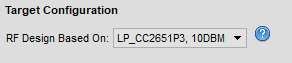
  • With SmartRF studio and (LP_CC2651P3, 10DBM), the power is higher (+7.6dB). How can I achieve this configuration in firmware (currently using the rfDiagnostics example)?

  • Hi Andy,

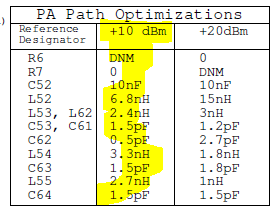
    You have to change the components on the LP as well for 10dBm option. The following is from the schematic.

    regards,

  • Those are the component values we used. The main problem right now is we can only achieve a reasonable power level using SmartRF studio (JTAG connection). For actual operation, we need to control the radio in firmware, not via JTAG.

    I'll repeat my previous question here:

    ---

    With SmartRF studio and (LP_CC2651P3, 10DBM), the power is higher (+7.6dB). How can I achieve this configuration in firmware (currently using the rfDiagnostics example)?

    ---

    If you would be able to answer the above question, that would at least allow us to make some progress.

    Regards,
    Andy

  • Hi Andy,

    Inside of the rfDiagnostics SysConfig did you select "RF Design" -> "Based on RF Design" to "LP_CC2651P3, 10DBM", go to "Show Board View" -> "Use Custom Board", and change the "Custom" -> "IEEE" -> "TX Power" to 10 dBm?

    SmartRF Studio is capable of exporting the radio settings that it uses.  If you are having poor results with the ti_radio_config.c settings which are generated by the rfDiagnostics project then you should exclude this file from building and try using the SmartRF Studio version instead.  I've noticed small changes to the override tables at 10 dBm as compared to Sysconfig which may make a difference in your evaluation.

    Regards,
    Ryan

  • Hi Ryan,

    On October 17, in the thread "CC2651P3: DIO_21" you stated the following:

    ---

    You should not use the LP_CC2651P3_10DBM RF Design selection, please keep the default LP_CC2651P3  version.  Attached are the ti_radio_config changes I believe are necessary to generate 6-10 dBm PA tables. 

    ---

    So no, I did NOT select LP_CC2651P3, 10DBM because you stated that "You should not use the LP_CC2651P3_10DBM RF Design selection".

    Regards,
    Andy

  • Hi Andy,

    That is definitely what I said on a prior E2E thread and I should have clarified what has changed since then.  I was thinking specifically about Z-Stack application examples in the previous E2E thread which do not have the same SysConfig options as rfDiagnostics.  I was also thinking only about the PA tables but not considering the overrides.  Furthermore, SIMPLELINK-CC13XX-CC26XX-SDK v6.30 released on October 28 and includes some improvements to the CC2651P3 software design.  As such, can you please evaluate rfDiagnostics on the v6.30 SDK and let me know whether using the LP_CC2651P3, 10DBM design improves your TX output behavior?  If not then please change ti_drivers_config.c to match the SmartRF settings.  I apologize for the confusion or lost development time I may have caused.

    Regards,
    Ryan

  • Hi Ryan,

    I imported the rfDiagnostics project into SDK 6.30 and that seems to have mostly corrected the low power issue. The power level is still 3dB too low however.

    Can you please explain the reason for using different bias level (VDDR vs VDDS), and different RF component values, when using +10dBm? When I use the launchpad configured for VDDS bias, and set it at the +10dBm setting, I get +10dBm output. So far I have not seen +10dBm coming out of the launchpad when biased at VDDR.

    The launchpad schematic specifies to use VDDR bias and specific component values for +10dBm. However, I cannot buy a launchpad in that configuration. And it is not easy to change out all those 0201 components to create a launchpad in that configuration. And, it is hard to "trust" that those values are correct, especially since on our board we have those values and are seeing 3dB reduced power (+7dBm).

    So, it seems that the simplest thing to do in our design is to bias at VDDS and use the +20dBm component values from the launchpad, and just set our output power at +10dBm. Because we can see that that works. There must be some reason TI recommends to not do that?

    Regards,
    Andy

  • Hi Ryan,

    Just wondering if you will be able to provide any response on this?

    Thanks,
    Andy

  • Hi Andy,

    Did we review your design by any chance?

    Thanks,

  • I'll send over the review files internally.

    Darren

  • Hi FI and Darren - do you have any update on this?

    Thanks,
    Andy

  • Hi Ryan,

    I am now moving on to getting the Z-Stack running on this device. I'm using SDK 6.4 and zc_sampleapp. I have selected "LP_CC2651P3, 10DBM" in "RF Design", but in "Z-Stack" I get an error because there is no "LP_CC2651P3, 10DBM" option in "Based on RF Design" (only "LP_CC2651P3"). 

    Is this expected?

    Thanks,
    Andy

  • Hi Andy,

    This is expected, since Z-Stack does not currently support the "LP_CC2651P3, 10DBM" option as compared to Prop RF examples.  Therefore you will need to use custom ti_radio_config.c/h files and exclude these files from building in SysConfig as we've previously discussed.

    Regards,
    Ryan