This thread has been locked.

If you have a related question, please click the "Ask a related question" button in the top right corner. The newly created question will be automatically linked to this question.

CC2592EMK-RD: Transmission lines impedance of CC2592

Part Number: CC2592EMK-RD
Other Parts Discussed in Thread: CC2592, CC2520

Hello

I have two questions about CC2592 application.

1. My project needs to use CC2520+CC2592. When I refer to the reference design of CC2538-CC2592EM and CC2592EM, I find that

the transmission lines from CC2592 output pin seem not to be 50 ohm. I wonder why the transmission lines are not 50 ohm.

2. My project will use a 6 layers stack-up. The prepreg thickness between layer1 and layer2 will be different with the reference design.

How should I design the impedance of transmission line from CC2592 output pin to antenna? 

Thanks.

  • Hi,

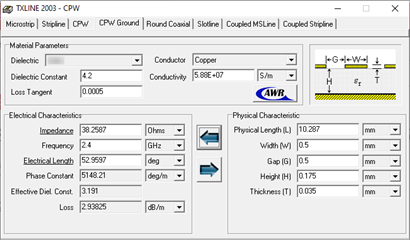
    1. Indeed you are correct. The CPSW impedance with FR4 is 38Ω. This seems to have been overlooked during design, since the calculations are a match for Duroid (ϵr = 2.8) and not FR4 (ϵr = 4.2).


    2. In your case, perform the calculations that account for 50Ω for the transmission line.

    Please apologize for the inconvenience,

    Rafael

  • Hi Rafael,

    Thanks for you reply. I still have three questions about this problem.

    1.  Both CC2538-CC2592EM and CC2592EM stack-up design files show the PCB material is FR-4. Could you tell me more details about why using a Duroid (ϵr = 2.8) calculations on a FR4 PCB design? Because it seems to be not reasonable.

    2. Can RF testing results of CC2538-CC2592EM conform to the statements of datasheet?

    3.  Could you share the Duroid (ϵr = 2.8) calculations with me?

  • Gavin,

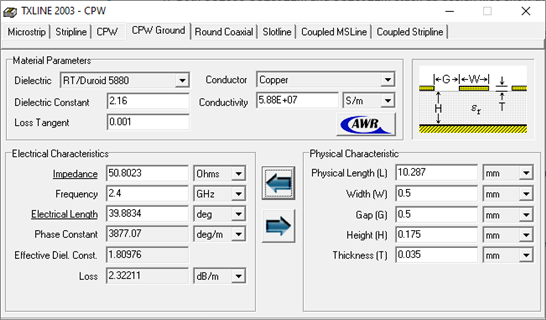
    1. The calculations were probably done incorrectly with the Duroid material during the board design. This is the default material of the trace impedance calculator TxLine and was probably missed in design reviews. This is an artifact that was fully corrected in more modern designs.

    2. The datasheet indicates the device was characterized by the CC2592EMK-RD, which has a slight narrower gap (0.4mm instead of 0.5mm) when compared to the kit you mentioned above but it is still off for FR-4 (about 38Ω as well). Despite the mismatch, the device still meets a satisfactory performance.

    3. The Duroid results for the kit are similar. The calculations are shown below:

    Regards,

    Rafael