A related question is a question created from another question. When the related question is created, it will be automatically linked to the original question.
If you have a related question, please click the "Ask a related question" button in the top right corner. The newly created question will be automatically linked to this question.
CC2652R: maximum poll failure in ZED before triggering rejoin.
1. We want to delay the rejoin after poll fail to get the ACK. For this we want to increase the poll data request fo multiple times and to increase the interval between poll data request when there is no ACK from the coordinator.
2. The main issue we observe is the device keeps rejoining continuously and we are unable to control the device during the rejoin process. We want to make sure that the rejoin process takes place only when the device is sure offline and not just because of some ACK packet lost.
Data requests (of the same MAC sequence number) that don't receive a MAC ack are retried soon afterwards (the MAC attempts the data request again, up to MAX_POLL_FAILURE_RETRIES).
Then after POLL_RATE ms, Z-Stack will try another set of (up to) MAX_POLL_FAILURE_RETRIES data requests; it will retry this up to APSC_MAX_FRAME_RETRIES. If it is still unsuccessful, then the device detects that it has lost its parent, and will try to rejoin after SAMPLEAPP_END_DEVICE_REJOIN_DELAY ms.
As an example, let's say we have: - MAX_POLL_FAILURE_RETRIES == 2 - APSC_MAX_FRAME_RETRIES == 1 - POLL_RATE == 3000 - SAMPLEAPP_END_DEVICE_REJOIN_DELAY == 10000
Assuming the parent is offline, the ZED will perform the following sequence:
ZED polls, but doesn't receive ack (MAC seq == 11).
ZED waits 10000 ms, then sends a Beacon Request to find a parent. It repeats this until it finds a parent.
Please modify the above values to meet your needs for how soon the ZED determines when it has lost its parent.
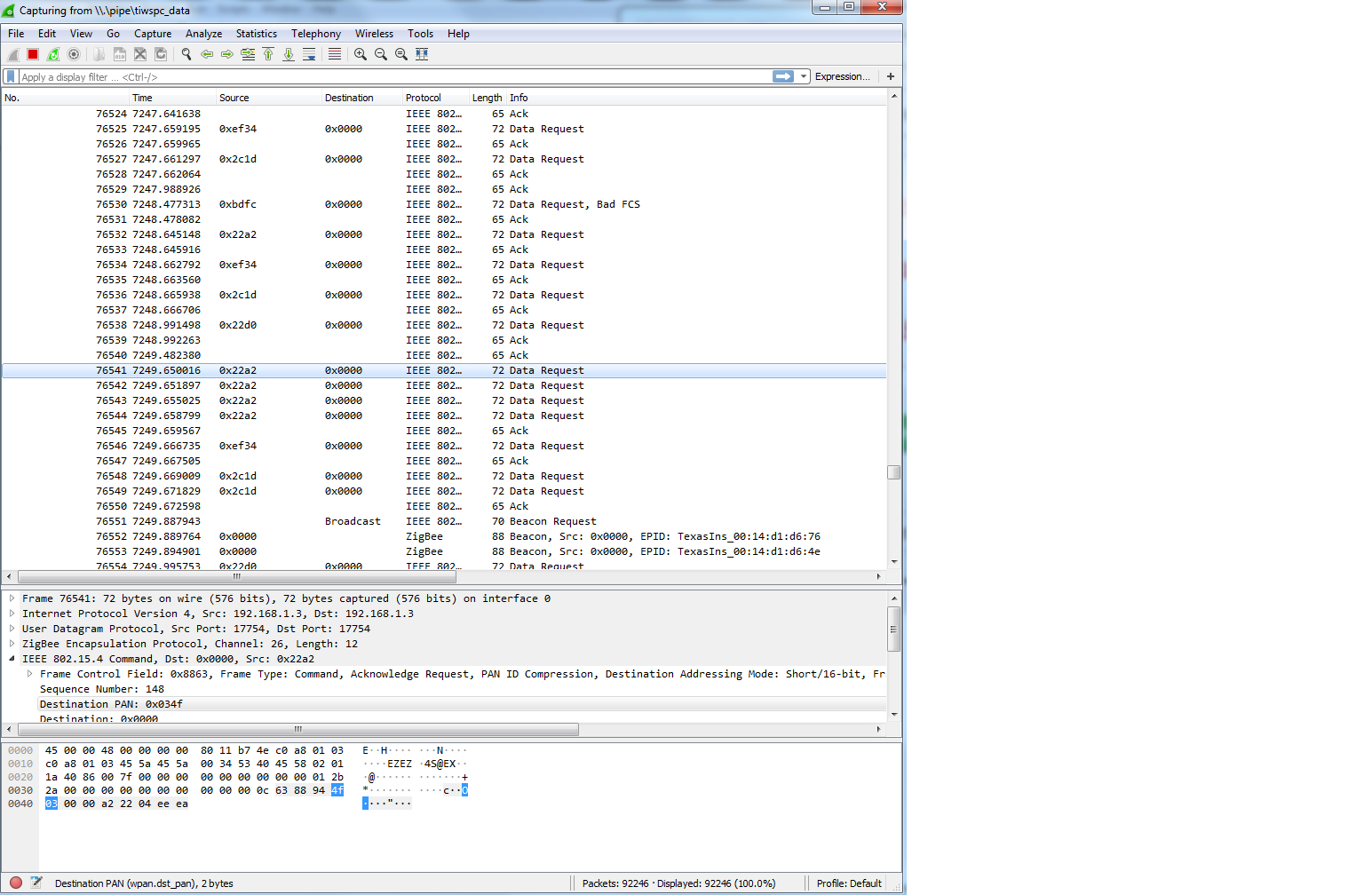
For your points: 1. It seems that you may want to consider increasing APSC_MAX_FRAME_RETRIES and/or POLL_RATE. 2. Based on your log, it seems that 0x22A2 is sending Data Requests at a reasonable rate (every 1 second). I'm not sure what you mean that you are not able to control it.
If your battery powered device with poll rate zero send a message, it might do an extra polling to get APS ack or to check if there is message on its parent node for it.