This thread has been locked.

If you have a related question, please click the "Ask a related question" button in the top right corner. The newly created question will be automatically linked to this question.

CC2652P: CC2652P RF Microstrip query

Part Number: CC2652P

Hi,

I'm developing a new realese for one product that includes a CC2652P Zigbee Transceiver. We have been working ok with the CC2652P transceiver for over 6 months. In our actual PCB Layout we fulfill all the PCB design recommendation, and that worked fine for us. 

Now, that we are working on a new release with a lot of new features, we don't have a lot of space on the PCB to place all the components as before. One of the possibilities we are working on is changing the topology of the transceiver component arrangement. Below I add a picture of the possibility we are contemplating.
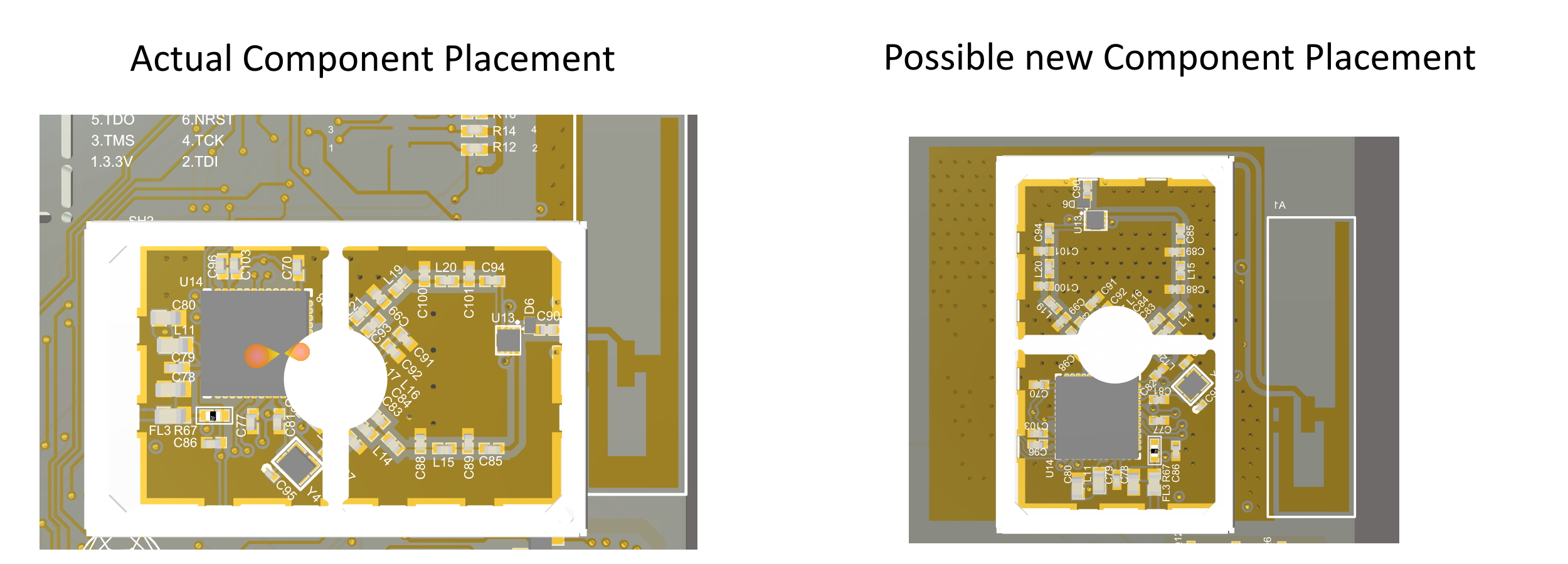

do you think it can work?

I understand that I am significantly lengthening the microstrip that goes from the RF switch to the antenna feeder, what additional considerations do I have to have about this microstrip?

Do you think the possibility we are raising is practicable?

Can the performance of the antenna be affected?

Thanks in advance,

Mauro

  • Hi Mauro,

    I think it might be possible, but I worry about placing long traces parallel to the antenna, which I see 3 of on your design (2 inputs to balun, 1 output out of balun). They may couple with the antenna, which would cause interference with the signal of interest. The antenna would also be susceptible to noise from the crystal you have next to it. Finally, your long paths may cause power loss.

    I would recommend staying closer to the reference design, which puts these traces perpendicular to the antenna, and also does not introduce the long winding RF path. I think you can still accomplish this with the inverted F design. You have a lot of empty trace near the input to your RF switch that isn't being used. The inverted-F is the first-choice TI-recommended antenna if possible.

    If you think it still takes up too much space, you may also consider using a meandered inverted F-antenna, which is significantly smaller in area, but it is less efficient and has narrower bandwidth. When you're ready, if you want a formal design review like last time too, that's also an option.

    Best,

    Nate