This thread has been locked.

If you have a related question, please click the "Ask a related question" button in the top right corner. The newly created question will be automatically linked to this question.

How to design an active filter circuit that can isolate a DC signal and pass through a 2Hz~5000Hz signal?

Other Parts Discussed in Thread: TLV07, TINA-TI

Hi team,

The sensor is powered by 24-V DC and the probe outputs an AC signal from 2 Hz to 5000 Hz.(The sensor is similar to mic, and it has two wires, Signal and GND, where the signal pin is both the supply V+ pin and the output voltage signal)

The customer wants to design a filter circuit to filter out spurious signals above 5000 Hz while ensuring less than 5% attenuation in signal voltage between 2 and 5000, and also the 24-V DC signal needs to be isolated. However, if the DC is isolated directly by a capacitor, there is a situation where the low-frequency (including 2 Hz) signal is attenuated.

Could you help tell how to design a circuit that can safely pass the 2-5000Hz signal, attenuate over 5K signals, and filter out the DC 24V? Thanks.

Best Regards,

Cherry

  • Hi Cherry, 

    Could you help tell how to design a circuit that can safely pass the 2-5000Hz signal, attenuate over 5K signals, and filter out the DC 24V?

    We have an online FilterPro tool that can do this. 

    https://webench.ti.com/filter-design-tool/filter-response

    We also have the previous offline FilterPro tool. I can send it to you if you want to check out. 

    I need the additional information about the bandpass filter between 2Hz to 5000Hz. 

    Questions:

    1. What are the desired attention at 2Hz and 5kHz near the -3dB pole region? In the BP region, the attenuation needs to be < 5% of the input signal. 

    2. What are spurious signals do you want to attenuate after 5kHz. I need to know the frequency range and levels of attenuation, which it determines the filter types (2nd, 3rd order or higher order LPFs etc. after 5kHz). 

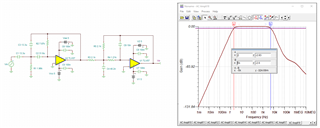
    I put one BPF together by combing HPF and LPF in one. I do not know what the requirements are.

    3005.2-5kHz TLV07 Active BPF 07252023.TSC

    Please provide me the details of filter requirements, and perhaps we are able to figure out what you would need. 

    Best,

    Raymond

  • Hi Raymond,

    Thank you for the support.

    Since the customer's probe is used to receive the vibration signal, the normal range of the vibration signal is approximately 2 Hz to 5000 Hz. But unusual high frequency vibration signals can be superimposed and the interference from the DCDC can also be affected.

    In general, signal attenuation between 2Hz and 5000Hz must be guaranteed to be less than 0.5%. Could you help share some learning documents on filtering for reference?

    According to the above responses, the conditions for 2 Hz and 5000 Hz are at -3 dB. With the 2Hz and 5000Hz signals, the signal amplitude is attenuated by a factor of 0.7, which is less than 0.5%. For example, a sinusoidal signal amplitude of 1 V is required to achieve a minimum signal amplitude of 1*0.95=0.95 after passing through this filter circuit. That is, all signals in the frequency range 2Hz-5000Hz must have an amplitude attenuation of less than or equal to 0.5%, which translates to an attenuation of -0.446 dB. 

    Thanks and regards,

    Cherry

  • Hi Cherry, 

    In general, signal attenuation between 2Hz and 5000Hz must be guaranteed to be less than 0.5%. Could you help share some learning documents on filtering for reference?

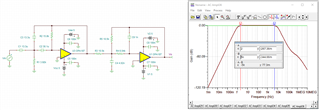
    Would this one work for the customer? We can adjust the active filter parameters and meet the additional requirements. I am trying to keep the BPF as narrow as possible to meet the above requirements. If BPF is widen, it can easily meet the requirements, but it may also let unwanted BP signals in.

    OPA187.2-5kHz Active BPF 07262023.TSC

    Here is the low cost approach with TLV07 op amps.  

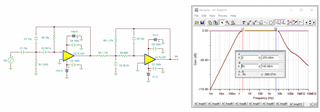
    FilterPro Designed BPF w TLV07 07262023.TSC

    I am using the online filter design tool and put two LPF and HPF together in this case. I am using MFB filter configuration per the filter design topology. 

    https://webench.ti.com/filter-design-tool/filter-response

    https://www.ti.com/lit/an/sloa049d/sloa049d.pdf?ts=1690294116328&ref_url=https%253A%252F%252Fwww.google.com%252F

    https://www.ti.com/lit/an/sboa230/sboa230.pdf?ts=1690304418160&ref_url=https%253A%252F%252Fwww.google.com%252F

    https://www.ti.com/lit/an/snoa387c/snoa387c.pdf?ts=1690378104138&ref_url=https%253A%252F%252Fwww.google.com%252F

    If you have other questions, please let me know. 

    Best,

    Raymond

  • Hi Cherry, 

    I am going to close this inquiry. 

    If you have other questions, please let me know. 

    Best,

    Raymond

  • Hi Raymond,

    Thank you for the response again and actually the customer does not know how to set and use the parameters of the bandpass filter in the online design tool, would you able to help elaborate more on this? Or is there any documents for reference?

    And one more concern is the output signal of this vibrating probe is an AC signal and the voltage may be positive or negative. The signal amplitude will not exceed 5 V. Will op amp filtering with single supply have an impact? 

    Thanks and regards,

    Cherry

  • Hi Cherry, 

    Or is there any documents for reference?

    I have sent you two application reference design. There are tons of design information over the TI website and youtube.com, but many of them are not specific to you case. 

    I used MFB 2nd order design in the BPF. Here is a video link that may help. 

    https://www.youtube.com/watch?v=L-V4sIJ9SNQ

    https://www.ti.com/video/6165744706001

    one more concern is the output signal of this vibrating probe is an AC signal and the voltage may be positive or negative.

    The MFB is designed with dual supply rails and it will response to AC signals that swing above and below GND (in this case). 

    I'd be happy to contact the customer via a WebEx call. Do you want to setup it up and I can demonstrate filter tool over the WebEx session. Please let me know. 

    Here is a copy of FilterPro, which is the PC based FilterPro tool (offline, which we found the copy in a drive recently).

    Once it is installed, you may explore a bit with the tool. 

    FilterPro.zip

    https://www.ti.com/lit/an/sbfa001c/sbfa001c.pdf?ts=1690849873288&ref_url=https%253A%252F%252Fwww.google.com%252F

    If you have other questions, please let me know. 

    Best,

    Raymond

  • Hi Raymond,

    Thank you again for the response.

    I'd be happy to contact the customer via a WebEx call. Do you want to setup it up and I can demonstrate filter tool over the WebEx session. Please let me know. 

    The customer is a student from Wuhan University in China, it's quite hard to arrange a meeting between you and them since I only support them via forum, I'm wondering could you please send a video(like screen recording video) with how to use filter tool via mail/WebEx, if possible? Please let me know if it's feasible or not. Thank you! 

    Thanks and regards,

    Cherry

  • Hi Cherry, 

    I have provided two filter design tools for the customer. I would recommend to use PC based FilterPro design tool.

    I found a link from youtube.com, which it may help the customer to get start it. If the customer is able to go through the application note and Filterpro design tool, he or she should have good understanding how these active filter works. 

    https://www.youtube.com/watch?v=0z5z5lwiS08&t=375s

    I am unable to provide video clip in how to design an active filter. There are plenty video clips over the youtube.com to learn these how to part of the design one. Our PC based FilterPro design tool is no longer supported, but many users still consider it as the better filter design tool than the current online one on our website.

    I have suggested that the customer should design an active 2nd order high pass filter first with the pole at approx. 1Hz range; then design an active 2nd order low pass filter with a pole at approx. 8-10kHz range separately. When you combine two filters together, you should get a bandpass filter that is similar to what I proposed. If the customer's input signals are large in amplitude, then TLV07 op amp will not work due to its slew rate. You have to find other higher slew rate op amps in order to get what you want. Once the designed BPF meets the design requirements, you can transfer the R and C parameters in TINA-TI simulator and check out the final filter performance. 

    If you have other questions, please let me know. 

    Best,

    Raymond   


  • Hi Cherry, 

    I am going to close this inquiry. 

    If you have other questions, please let us know. 

    Best,

    Raymond

  • Hi Raymond,

    Thank you and just got the feedback from the end customer:

    The circuit that you provide shows good pass through at 2 Hz, but at the same time there is still a signal passing through from 1 m to 2 Hz. Would it be better to design it directly as a low-pass filter? Such as a cutoff frequency of 5K.

    And the customer is wondering if there is a real difference between a 2 Hz to 5K band pass filter and a 5K pass filter until? 

    Thanks and regards,

    Cherry

  • Hi Cherry, 

    but at the same time there is still a signal passing through from 1 m to 2 Hz.

    Yes, you did not specify any design requirements. from 1mHz to 2Hz, the filter is attenuated at approx. +40dB/decade. This means, 0.2Hz signal will be attenuated at -40dB, at 0.02Hz, it will be attenuated at -80dB, 0.002Hz or 2mHz will attenuate at approx. -120dB. As the unwanted signal closer to 2Hz range, less signal amplitude is being attenuated. The filter I suggested is 2nd order MFB BP filter.  

    It is similar when frequency is greater than 5kHz range, which it will be attenuated at -40dB/decade. 

    Higher order filter can be designed, but I will need the filter design requirements. 

    The customer wants to design a filter circuit to filter out spurious signals above 5000 Hz while ensuring less than 5% attenuation in signal voltage between 2 and 5000, and also the 24-V DC signal needs to be isolated.

    This is not the filter design requirements. From the statement above, I know that you want to have fairly flat frequency response between 2Hz to 5kHz, but it did not say much about how steep the HPF and LPF are required for the application. 

    If you want to filter out 2mHz range frequency, -120dB should be good enough. If the customer wants to get rid of 0.02Hz range noises, -40dB may be adequate, but it may not be enough. It depends the amplitude of these noises. Is the low AC signal riding on 24Vdc supply? What are noise ripple and frequency responses of the 24Vdc supply?

    Best.

    Raymond