Part Number: TMS320F28384D
Tool/software:
Hey,
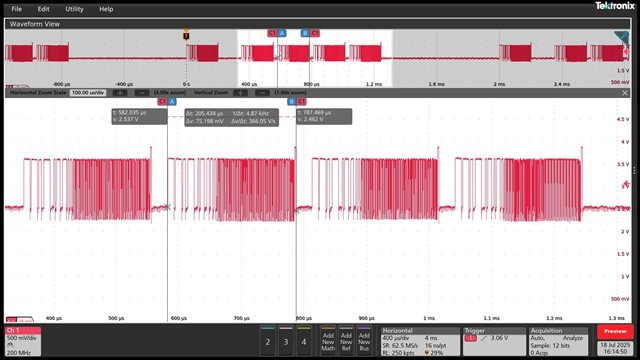
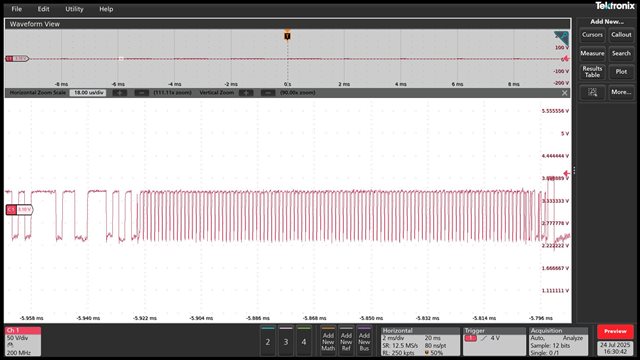
Similar to this question... I don't observe any transmissions (using a CAN FD Bus Analyzer) occurring between two nodes on my bus when I enable MCAN_TxBufElement.brs & MCAN_InitParams.brsEnable. My setup was working OK when MCAN_InitParams.brsEnable was 0 and MCAN_TxBufElement.brs was 1 but that means my data is also being transmitted at the speed of arbitration.
I was also checking the example code mcan_config_c28x with mcan_ex2_external_loopback in CM core, and my MCAN_CLK being 25 MHz. When I enable BRS in both MCAN_CCCR and in Tx Buffer Element, I get errors and the program stops at the error breakpoint for the most part but also at the Interrupt ISR error breakpoint a few times. Below is the code I'm working with for your reference://#############################################################################
//
// FILE: mcan_ex2_external_loopback.c
//
// TITLE: MCAN External Loopback with Interrupt
//
//! \addtogroup driver_example_cm_list
//! <h1> MCAN External Loopback with Interrupt </h1>
//!
//! This example shows the MCAN External Loopback functionality. The external
//! loopback is done between two MCAN Controllers. As there is only one MCAN
//! that exist this example can be changed to make MCAN Transmit or Receive
//! based on define selected. The GPIOs of MCAN should be connected to a CAN
//! Transceiver
//!
//! Before running this example, please run the mcan_config_c28x example
//! It will initialize the clock, configure the GPIOs.
//!
//! Selection of Mode : A define has to be selected to make the MCAN to
//! transmit or receive.
//! - TRANSMIT - MCAN to Transmit messages.
//! - RECEIVE - MCAN to Receive Messages.
//!
//! Run the example as with RECEIVE Define on one MCAN Controller before
//! running it as Transmit.
//!
//! \b Hardware \b Required \n
//! - A C2000 board with CAN transceiver
//!
//! \b External \b Connections \n
//! - MCAN is on GPIO30 (MCANRXA) and GPIO31 (MCANTXA)
//!
//! \b Watch \b Variables \n
//! - isrIntr0Flag - The flag has initial value as no. of messages to be
//! transmitted and its value decrements after a message is
//! transmitted.
//! - isrIntr1Flag - The flag has initial value as no. of messages that are
//! received and its value decrements after a message is
//! successfully received.
//! - error - Checks if there is an error that occurred when the data was
//! sent using internal loopback
//!
//
//#############################################################################
//
//
// $Copyright:
// Copyright (C) 2022 Texas Instruments Incorporated - http://www.ti.com
//
// Redistribution and use in source and binary forms, with or without
// modification, are permitted provided that the following conditions
// are met:
//
// Redistributions of source code must retain the above copyright
// notice, this list of conditions and the following disclaimer.
//
// Redistributions in binary form must reproduce the above copyright
// notice, this list of conditions and the following disclaimer in the
// documentation and/or other materials provided with the
// distribution.
//
// Neither the name of Texas Instruments Incorporated nor the names of
// its contributors may be used to endorse or promote products derived
// from this software without specific prior written permission.
//
// THIS SOFTWARE IS PROVIDED BY THE COPYRIGHT HOLDERS AND CONTRIBUTORS
// "AS IS" AND ANY EXPRESS OR IMPLIED WARRANTIES, INCLUDING, BUT NOT
// LIMITED TO, THE IMPLIED WARRANTIES OF MERCHANTABILITY AND FITNESS FOR
// A PARTICULAR PURPOSE ARE DISCLAIMED. IN NO EVENT SHALL THE COPYRIGHT
// OWNER OR CONTRIBUTORS BE LIABLE FOR ANY DIRECT, INDIRECT, INCIDENTAL,
// SPECIAL, EXEMPLARY, OR CONSEQUENTIAL DAMAGES (INCLUDING, BUT NOT
// LIMITED TO, PROCUREMENT OF SUBSTITUTE GOODS OR SERVICES; LOSS OF USE,
// DATA, OR PROFITS; OR BUSINESS INTERRUPTION) HOWEVER CAUSED AND ON ANY
// THEORY OF LIABILITY, WHETHER IN CONTRACT, STRICT LIABILITY, OR TORT
// (INCLUDING NEGLIGENCE OR OTHERWISE) ARISING IN ANY WAY OUT OF THE USE
// OF THIS SOFTWARE, EVEN IF ADVISED OF THE POSSIBILITY OF SUCH DAMAGE.
// $
//#############################################################################
//
// Include Files
//
#include "cm.h"
#include "inc/stw_types.h"
#include "inc/stw_dataTypes.h"
//
// Select one of the Modes.
//
#define TRANSMIT
//#define RECEIVE
//
// Defines.
//
#define NUM_OF_MSG (10U)
#define MCAN_STD_ID_FILT_START_ADDR (0U)
#define MCAN_STD_ID_FILTER_NUM (1U)
#define MCAN_EXT_ID_FILT_START_ADDR (48U)
#define MCAN_EXT_ID_FILTER_NUM (1U)
#define MCAN_TX_EVENT_START_ADDR (100U)
#define MCAN_TX_EVENT_SIZE (NUM_OF_MSG)
#define MCAN_TX_EVENT_WATERMARK (NUM_OF_MSG/2)
#define MCAN_TX_BUFF_START_ADDR (148U)
#define MCAN_TX_BUFF_SIZE (NUM_OF_MSG)
#define MCAN_TX_FIFO_SIZE (NUM_OF_MSG)
#define MCAN_FIFO_0_START_ADDR (548U)
#define MCAN_FIFO_0_NUM (NUM_OF_MSG)
#define MCAN_FIFO_0_WATERMARK (NUM_OF_MSG)
#define MCAN_FIFO_1_START_ADDR (748U)
#define MCAN_FIFO_1_NUM (NUM_OF_MSG)
#define MCAN_FIFO_1_WATERMARK (NUM_OF_MSG)
#define MCAN_RX_BUFF_START_ADDR (948U)
#define MCAN_EXT_ID_AND_MASK (0x1FFFFFFFU)
#define MCAN_TS_PRESCALAR (0xB0)
#define MCAN_TX_BUFF_ELEM_SIZE (MCAN_ELEM_SIZE_64Bytes)
#define MCAN_RX_BUFF_ELEM_SIZE (MCAN_ELEM_SIZE_64Bytes)
#define MCAN_RX_FIFO0_ELEM_SIZE (MCAN_ELEM_SIZE_64Bytes)
#define MCAN_RX_FIFO1_ELEM_SIZE (MCAN_ELEM_SIZE_64Bytes)
//
// Global Variables.
//
volatile uint32_t isrIntr0Flag = NUM_OF_MSG;
volatile uint32_t isrIntr1Flag = NUM_OF_MSG;
volatile uint32_t isrIntrTSFlag = 1U;
int32_t error = 0;
MCAN_TxBufElement txMsg[NUM_OF_MSG];
MCAN_RxBufElement rxMsg[NUM_OF_MSG], rxMsg1;
int32_t loopCnt = 0U;
//
// Function Prototype.
//
static void MCANConfig(void);
static void MCANIntrConfig(void);
static void MCANIntr0ISR(void);
static void MCANIntr1ISR(void);
void main()
{
#ifdef RECEIVE
int32_t dataCnt;
#endif
int i = 0;
uint32_t numOfMsg = NUM_OF_MSG;
volatile uint32_t mode = 0U;
uint32_t dataBytes = 8;
//
// Switching on the peripheral.
//
CM_init();
//
// Reset the peripheral.
//
SysCtl_resetPeripheral(SYSCTL_PERIPH_RES_MCAN_A);
//
// CrossBar and ISR Configuration.
//
MCANIntrConfig();
//
// Initialize message to transmit.
//
for(loopCnt = 0U ; loopCnt < numOfMsg ; loopCnt++)
{
txMsg[loopCnt].id = (0x0);
txMsg[loopCnt].id = (loopCnt) << 16U;
txMsg[loopCnt].id |= (0xFF);
txMsg[loopCnt].rtr = 0U;
txMsg[loopCnt].xtd = 1U;
txMsg[loopCnt].esi = 0U;
txMsg[loopCnt].dlc = 15U;
txMsg[loopCnt].brs = 1U;
txMsg[loopCnt].fdf = 1U;
txMsg[loopCnt].efc = 1U;
txMsg[loopCnt].mm = 0xAAU;
txMsg[loopCnt].data[i] = 0x1;
for(i = 1; i < dataBytes; i++)
{
txMsg[loopCnt].data[i] = txMsg[loopCnt].data[i-1] + 1;
}
i = 0;
}
for(loopCnt = 0U ; loopCnt < numOfMsg ; loopCnt++)
{
rxMsg[loopCnt].id = 0U;
rxMsg[loopCnt].rtr = 0U;
rxMsg[loopCnt].xtd = 0U;
rxMsg[loopCnt].esi = 0U;
rxMsg[loopCnt].rxts = 0U;
rxMsg[loopCnt].dlc = 0U;
rxMsg[loopCnt].brs = 0U;
rxMsg[loopCnt].fdf = 0U;
rxMsg[loopCnt].fidx = 0U;
rxMsg[loopCnt].anmf = 0U;
for(i = 0; i < dataBytes; i++)
{
rxMsg[loopCnt].data[i] = 0;
}
}
//
// Configure the MCAN Module.
//
MCANConfig();
#ifdef TRANSMIT
//
// This is transmitter side application.
//
//
// Enable Interrupts.
//
MCAN_enableIntr(MCAN0_BASE, MCAN_INTR_MASK_ALL,1);
MCAN_enableIntr(MCAN0_BASE, MCAN_INTR_SRC_RES_ADDR_ACCESS|
MCAN_INTR_SRC_TIMESTAMP_WRAPAROUND,0);
//
// Select Interrupt Line.
//
MCAN_selectIntrLine(MCAN0_BASE, MCAN_INTR_MASK_ALL,
MCAN_INTR_LINE_NUM_0);
//
// Enable Interrupt Line.
//
MCAN_enableIntrLine(MCAN0_BASE, MCAN_INTR_LINE_NUM_0, 1U);
//
// Enable Transmission interrupt.
//
for(loopCnt = 0U ; loopCnt < numOfMsg ; loopCnt++)
{
MCAN_txBufTransIntrEnable(MCAN0_BASE, loopCnt,1);
//
// Write message to Message RAM.
//
MCAN_writeMsgRam(MCAN0_BASE, MCAN_MEM_TYPE_BUF, loopCnt,
&txMsg[loopCnt]);
}
//
// Add request for all transmission.
//
HWREG(MCAN0_BASE + MCAN_TXBAR) = 0x000003FF;
//
// Wait till the flag becomes zero and all the messages are transmitted.
//
while(isrIntr0Flag)
{
}
#endif
#ifdef RECEIVE
//
// This is receiver side application.
//
//
// Enable Interrupts.
//
MCAN_enableIntr(MCAN0_BASE, MCAN_INTR_MASK_ALL,1);
MCAN_enableIntr(MCAN0_BASE, MCAN_INTR_SRC_RES_ADDR_ACCESS|
MCAN_INTR_SRC_TIMESTAMP_WRAPAROUND,0);
//
// Select Interrupt Line.
//
MCAN_selectIntrLine(MCAN0_BASE, MCAN_INTR_MASK_ALL,
MCAN_INTR_LINE_NUM_1);
//
// Enable Interrupt Line.
//
MCAN_enableIntrLine(MCAN0_BASE, MCAN_INTR_LINE_NUM_1, 1U);
while(1)
{
//
// Wait till the interrupt flag becomes zero.
//
while(isrIntr1Flag)
{
}
for(loopCnt = 0U ; loopCnt < numOfMsg;loopCnt++)
{
MCAN_readMsgRam(MCAN0_BASE, MCAN_MEM_TYPE_FIFO, 0U,
MCAN_RX_FIFO_NUM_1, &rxMsg1);
MCAN_writeRxFIFOAck(MCAN0_BASE, MCAN_RX_FIFO_NUM_1,
loopCnt);
rxMsg[loopCnt] = rxMsg1;
}
for(loopCnt = 0U ; loopCnt < numOfMsg ; loopCnt++)
{
if (rxMsg[loopCnt].id != txMsg[loopCnt].id)
{
error++;
}
if (rxMsg[loopCnt].rtr != txMsg[loopCnt].rtr)
{
error++;
}
if (rxMsg[loopCnt].xtd != txMsg[loopCnt].xtd)
{
error++;
}
if (rxMsg[loopCnt].esi != txMsg[loopCnt].esi)
{
error++;
}
if (rxMsg[loopCnt].dlc != txMsg[loopCnt].dlc)
{
error++;
}
if (rxMsg[loopCnt].brs != txMsg[loopCnt].brs)
{
error++;
}
if (rxMsg[loopCnt].fdf != txMsg[loopCnt].fdf)
{
error++;
}
if (loopCnt > 0)
{
if (rxMsg[loopCnt].rxts > rxMsg[loopCnt-1].rxts)
{
}
else
{
error++;
}
}
for (dataCnt = 0U ; dataCnt < dataBytes ; dataCnt++)
{
if (rxMsg[loopCnt].data[dataCnt]!=
txMsg[loopCnt].data[dataCnt])
{
error++;
}
}
}
#endif
if (error != 0)
{
//
// Stop if there is an error.
//
__asm(" bkpt #0");
}
//
// Stop Application.
//
__asm(" bkpt #0");
}
}
static void MCANIntrConfig(void)
{
Interrupt_registerHandler(INT_MCANSS_0,&MCANIntr0ISR);
Interrupt_enable(INT_MCANSS_0);
Interrupt_registerHandler(INT_MCANSS_1,&MCANIntr1ISR);
Interrupt_enable(INT_MCANSS_1);
Interrupt_enableInProcessor();
}
static void MCANConfig(void)
{
MCAN_RevisionId revId;
MCAN_InitParams initParams;
MCAN_ConfigParams configParams;
MCAN_MsgRAMConfigParams msgRAMConfigParams;
MCAN_StdMsgIDFilterElement stdFiltelem;
MCAN_ExtMsgIDFilterElement extFiltelem;
MCAN_BitTimingParams bitTimes;
//
// Initialize MCAN Init parameters.
//
initParams.fdMode = 0x1U; // FD operation disabled.
initParams.brsEnable = 0x1U; // Bit rate switching for
// transmissions enabled.
initParams.txpEnable = 0x1U; // Transmit pause enabled.
initParams.efbi = 0x0U; // Edge filtering disabled.
initParams.pxhddisable = 0x0U; // Protocol exception handling enabled.
initParams.darEnable = 0x1U; // Enable automatic retransmission of messages
// that were not transmitted successfully.
initParams.wkupReqEnable = 0x1U; // Wakeup request is enabled.
initParams.autoWkupEnable = 0x1U; // Auto-Wakeup is enabled.
initParams.emulationEnable = 0x1U; // Emulation/Debug Suspend is enabled.
initParams.tdcEnable = 0x1U; // Transmitter Delay Compensation is
// enabled.
initParams.wdcPreload = 0xFFU; // Start value of the Message RAM
// Watchdog Counter preload.
//
// Transmitter Delay Compensation parameters.
//
initParams.tdcConfig.tdcf = 0xAU;
initParams.tdcConfig.tdco = 0x6U;
//
// Initialize MCAN Config parameters.
//
configParams.monEnable = 0x0U; // Bus Monitoring Mode is disabled.
configParams.asmEnable = 0x0U; // Normal CAN operation.
configParams.tsPrescalar = 0x2U; // Prescaler Value.
configParams.tsSelect = 0x2U; // Timestamp counter value.
configParams.timeoutSelect = MCAN_TIMEOUT_SELECT_CONT;
// Time-out counter source select.
configParams.timeoutPreload = 0xFFFFU;// Start value of the Timeout
// Counter.
configParams.timeoutCntEnable = 0x0U; // Time-out Counter is disabled.
configParams.filterConfig.rrfs = 0x1U; // Reject all remote frames with
// 29-bit extended IDs.
configParams.filterConfig.rrfe = 0x1U; // Reject all remote frames with
// 11-bit standard IDs.
configParams.filterConfig.anfe = 0x1U; // Accept in Rx FIFO 1.
configParams.filterConfig.anfs = 0x1U; // Accept in Rx FIFO 1.
//
// Initialize Message RAM Sections Configuration Parameters
//
msgRAMConfigParams.flssa = MCAN_STD_ID_FILT_START_ADDR;
// Standard ID Filter List Start Address.
msgRAMConfigParams.lss = MCAN_STD_ID_FILTER_NUM;
// List Size: Standard ID.
msgRAMConfigParams.flesa = MCAN_EXT_ID_FILT_START_ADDR;
// Extended ID Filter List Start Address.
msgRAMConfigParams.lse = MCAN_EXT_ID_FILTER_NUM;
// List Size: Extended ID.
msgRAMConfigParams.txStartAddr = MCAN_TX_BUFF_START_ADDR;
// Tx Buffers Start Address.
msgRAMConfigParams.txBufNum = MCAN_TX_BUFF_SIZE;
// Number of Dedicated Transmit Buffers.
msgRAMConfigParams.txFIFOSize = MCAN_TX_FIFO_SIZE;
// Tx FIFO/Queue.
msgRAMConfigParams.txBufMode = 0U;
msgRAMConfigParams.txBufElemSize = MCAN_ELEM_SIZE_64BYTES;
// Tx Buffer Element Size.
msgRAMConfigParams.txEventFIFOStartAddr = MCAN_TX_EVENT_START_ADDR;
// Tx Event FIFO Start Address.
msgRAMConfigParams.txEventFIFOSize = MCAN_TX_BUFF_SIZE;
// Event FIFO Size.
msgRAMConfigParams.txEventFIFOWaterMark = MCAN_TX_EVENT_WATERMARK;
// Level for Tx Event FIFO watermark interrupt.
msgRAMConfigParams.rxFIFO0startAddr = MCAN_FIFO_0_START_ADDR;
// Rx FIFO0 Start Address.
msgRAMConfigParams.rxFIFO0size = MCAN_FIFO_0_NUM;
// Number of Rx FIFO elements.
msgRAMConfigParams.rxFIFO0waterMark = MCAN_FIFO_0_WATERMARK;
msgRAMConfigParams.rxFIFO0OpMode = 0U;
msgRAMConfigParams.rxFIFO1startAddr = MCAN_FIFO_1_START_ADDR;
// Rx FIFO1 Start Address.
msgRAMConfigParams.rxFIFO1size = MCAN_FIFO_1_NUM;
// Number of Rx FIFO elements.
msgRAMConfigParams.rxFIFO1waterMark = MCAN_FIFO_1_WATERMARK;
// Level for Rx FIFO 1 watermark interrupt.
msgRAMConfigParams.rxFIFO1OpMode = 0U; // FIFO blocking mode.
msgRAMConfigParams.rxBufStartAddr = MCAN_RX_BUFF_START_ADDR;
// Rx Buffer Start Address.
msgRAMConfigParams.rxBufElemSize = MCAN_ELEM_SIZE_64BYTES;
// Rx Buffer Element Size.
msgRAMConfigParams.rxFIFO0ElemSize = MCAN_ELEM_SIZE_64BYTES;
// Rx FIFO0 Element Size.
msgRAMConfigParams.rxFIFO1ElemSize = MCAN_ELEM_SIZE_64BYTES;
// Rx FIFO1 Element Size.
//
// Initialize Tx Buffer Configuration parameters.
//
stdFiltelem.sfid2 = 0x0U; // Standard Filter ID 2.
stdFiltelem.sfid1 = 0x4U; // Standard Filter ID 1.
stdFiltelem.sfec = 0x7U; // Store into Rx Buffer or as
// debug message, configuration of SFT[1:0] ignored.
stdFiltelem.sft = 0x0U; // Range filter from SFID1 to SFID2.
//
// Initialize Tx Buffer Configuration parameters.
//
extFiltelem.efid2 = (0x9U << 16U);
extFiltelem.efid2 |= 0xFFU;
extFiltelem.efid1 = (0x0U << 16U);
extFiltelem.efid1 |= 0xFFU;
extFiltelem.efec = 0x6U;
extFiltelem.eft = 0x0U;
//
// Initialize bit timings.
//
bitTimes.nomRatePrescalar = 0x9U; // Nominal Baud Rate Pre-scaler.
bitTimes.nomTimeSeg1 = 0x1U; // Nominal Time segment before sample point.
bitTimes.nomTimeSeg2 = 0x1U; // Nominal Time segment after sample point.
bitTimes.nomSynchJumpWidth = 0x1U; // Nominal (Re)Synchronization Jump Width Range.
bitTimes.dataRatePrescalar = 0x0U; // Data Baud Rate Pre-scaler.
bitTimes.dataTimeSeg1 = 0x1U; // Data Time segment before sample point.
bitTimes.dataTimeSeg2 = 0x1U; // Data Time segment after sample point.
bitTimes.dataSynchJumpWidth = 0x1U; // Data (Re)Synchronization Jump Width.
//
// Get MCANSS Revision ID
//
MCAN_getRevisionId(MCAN0_BASE, &revId);
//
// Wait for memory initialization to happen.
//
while(FALSE == MCAN_isMemInitDone(MCAN0_BASE))
{
}
//
// Put MCAN in SW initialization mode.
//
MCAN_setOpMode(MCAN0_BASE, MCAN_OPERATION_MODE_SW_INIT);
//
// Wait till MCAN is not initialized.
//
while (MCAN_OPERATION_MODE_SW_INIT != MCAN_getOpMode(MCAN0_BASE))
{}
//
// Initialize MCAN module.
//
MCAN_init(MCAN0_BASE, &initParams);
//
// Configure MCAN module.
//
MCAN_config(MCAN0_BASE, &configParams);
//
// Disable external timeStamp overflow interrupt.
//
MCAN_extTSEnableIntr(MCAN0_BASE,1);
//
// Configure TimeStamp Counter.
//
MCAN_extTSCounterConfig(MCAN0_BASE, MCAN_TS_PRESCALAR);
//
// Configure Bit timings.
//
MCAN_setBitTime(MCAN0_BASE, &bitTimes);
//
// Set Extended ID Mask.
//
MCAN_setExtIDAndMask(MCAN0_BASE, MCAN_EXT_ID_AND_MASK);
//
// Configure Message RAM Sections
//
MCAN_msgRAMConfig(MCAN0_BASE, &msgRAMConfigParams);
//
// Configure Standard ID filter element
//
MCAN_addStdMsgIDFilter(MCAN0_BASE, 0U, &stdFiltelem);
//
// Configure Extended ID filter element
//
MCAN_addExtMsgIDFilter(MCAN0_BASE, 0U, &extFiltelem);
//
// Enable external counter.
//
MCAN_extTSCounterEnable(MCAN0_BASE, 1U);
//
// Take MCAN out of the SW initialization mode
//
MCAN_setOpMode(MCAN0_BASE, MCAN_OPERATION_MODE_NORMAL);
while (MCAN_OPERATION_MODE_NORMAL != MCAN_getOpMode(MCAN0_BASE))
{
}
}
static void MCANIntr0ISR(void)
{
uint32_t intrStatus;
intrStatus = MCAN_getIntrStatus(MCAN0_BASE);
MCAN_clearIntrStatus(MCAN0_BASE, intrStatus);
if (MCAN_INTR_SRC_TRANS_COMPLETE == (intrStatus &
MCAN_INTR_SRC_TRANS_COMPLETE))
{
//
// Decrement the flag after each message is transmitted.
//
isrIntr0Flag--;
}
else
{
//
// Stop the application if error occurs.
//
__asm(" bkpt #0");
}
}
static void MCANIntr1ISR(void)
{
uint32_t intrStatus;
intrStatus = MCAN_getIntrStatus(MCAN0_BASE);
MCAN_clearIntrStatus(MCAN0_BASE, intrStatus);
if(MCAN_INTR_SRC_RX_FIFO1_NEW_MSG ==
(intrStatus & MCAN_INTR_SRC_RX_FIFO1_NEW_MSG))
{
//
// Decrement the flag after each message is received.
//
isrIntr1Flag--;
}
else
{
//
// Stop the application if error occurs.
//
__asm(" bkpt #0");
}
}
This is configured for 500 Kbps Nominal and 5 Mbps Data Bit Rate.
The previous issues I had with my setup are here for any reference. Thanks in advance.
Best,
Nalin