This thread has been locked.

If you have a related question, please click the "Ask a related question" button in the top right corner. The newly created question will be automatically linked to this question.

OPA182: Sources of noise above 300kHz?

Part Number: OPA182


Tool/software:

Hello team,

From the E2E thread below, I understand the chopping frequency of OPA182 is 200kHz and there is a notch filter to eliminate the noise.

https://e2e.ti.com/support/amplifiers-group/amplifiers/f/amplifiers-forum/1167314/opa182-what-is-its-chopping-frequency/4391332?tisearch=e2e-sitesearch&keymatch=opa182%252520chopping#4391332

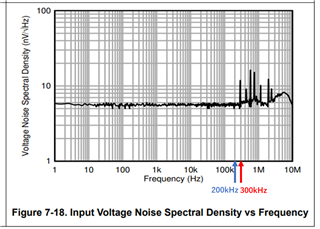
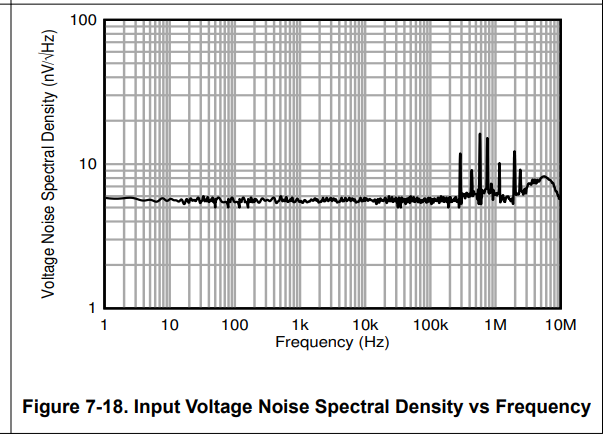
However, I can see several noise spikes at above 300kHz from the Figure 7-18.
What are the source of these noise?
Best Regards,
Kei Kuwahara

  • Kei,

    The synchronous notch filter substantially reduces the chopping noise tones at the chopping frequency and harmonics of the chopping frequency (see figure 2-4 in the document linked below).  The noise curve you are seeing is the after the chopping noise has been reduced.  The chopping noise is due to the internal chopping as well as charge injection on the input switches.  All choppers will have this tone.  Normally the first tone you see in a graph like figure 7-18 is the fundamental frequency of the chopper amplifier.  Optimizing Chopper Amplifier Accuracy covers the theory behind this and show methods for minimizing the noise tones.  For most applications a simple RC filter at the output of the op amp can virtually eliminate these noise tones.  If your application requires operation at 200kHz and above you may want to consider a non-chopper device.

    Best regards, Art

  • Hello Art-san,

    Thank you for your answer!

    first tone you see in a graph like figure 7-18 is the fundamental frequency of the chopper amplifier.

    I thought the fundamental chopping frequency for OPA182 is 200kHz, but from the Figure 7-18, the first tone is at 300kHz.

    Does this mean that the chopper frequency of OPA182 is 300kHz?

    Best Regards,
    Kei Kuwahara

  • Kei,

    You are correct, in general the chopping frequency is the lowest frequency noise tone (200kHz in this example).  There is significant tolerance on that frequency +/-20%.

    Best regards, Art

  • Hello Art-san,

    You are correct, in general the chopping frequency is the lowest frequency noise tone (200kHz in this example).

    Let me confirm, isn't the chopping frequency of OPA182 be 300kHz?
    Because the first tone looks like 300kHz.

    Best Regards,
    Kei Kuwahara

  • Yes.  It is 300kHz.

    Art