This thread has been locked.

If you have a related question, please click the "Ask a related question" button in the top right corner. The newly created question will be automatically linked to this question.

INA149: Offset Voltage Drift

Part Number: INA149

Hi,

Can the offset voltage drift is less than 10uV/℃ @ Max if the temperature range is from 0℃ to 70℃ ?
In addition, could you please provide the distribution data for the offset voltage drift at the teperature range from 0℃ to 70℃ ?

Best regards,
Kato

  • Kato,

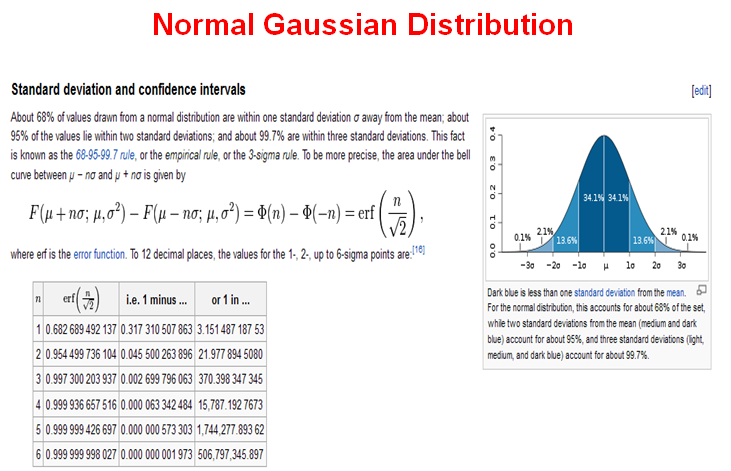
    There is no way of knowing what is the distribution of INA149 drift from 0C to 70C vis-a-vis -40C to 125C because we don't test it within this temperature range but it's safe to assume that the drift is linear.  Since the typical value of 3uV/C represents one standard deviation of INA149 Vos drift distribution, 10uV/C would represent 3.3 sigma, and thus 99.9% of all the units should be within the +/-10uV/C limit - this means that on average one unit out of one thousand will NOT meet +/-10uV/C drift spec.

  • Hi Marek-san,

    Thank you for your quick response.

    Is there a way to reduce the output voltage drift by devising the usage conditions other than narrowing the ambient temperature range ?

    Best regards,
    Kato

  • Hi Sadanori,

    it's a bit difficult to give proper answers when a topic is discussed so theoretically without any real circuit...

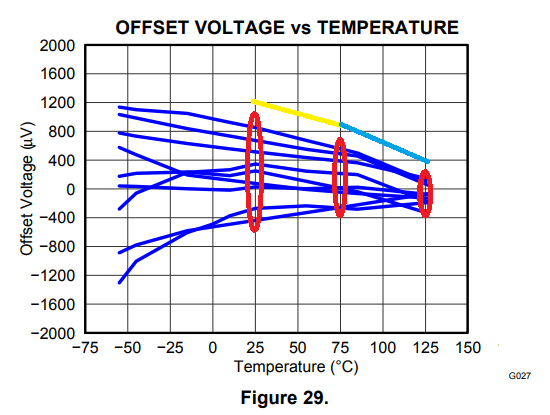
    If you look carefully at figure 29 of datasheet, you will notice that the temperature drift between 0°C and 75°C is the higher the higher the initial offset at 25°C is. This can often be seen with precision OPAmps. But, of course, figure 29 is no guarantee that this is valid for each individual INA149. So, without giving a guarantee, selecting the INA149 for mimimum inital input offset voltage at 25°C can help to reduce the temperature drift between 0°C and 75°C.

    Kai
  • Hi Kai-san,

    Thank you for the advice.

    Although I guess that it is difficult to guarantee, is there a way to reduce the offset drift besides calibrating at 25℃ ?

    Best regards,
    Kato

  • The voltage offset drift is NOT related to an absolute value of the offset at any given temperature but rather ONLY to a change of Vos with temperature - the steeper slope, the higher the drift.  Thus, the average Vos temperature drift in INA149 is lower between 0C to 75C (yellow line-see below) than from 75C to 125C (blue line) even though the entire Vos distribution is tighter at 125C and 75C than at 25C (see red elliptic circles) - this is a direct result of Vos being trimmed last at 125C. Having said that, as Kai mentioned, Fig 29 shows Vos drift of just handful of units and for that reason is no guarantee of a drift for any individual INA149.  For that reason, in your worst case analysis you must rely on the fact that typical drift of 3uV/C represents one standard deviation of the entire Vos drift distribution. 

    This means that:

    95.4% of all units will have a drift of less than +/-6uV/C (+/-2 sigma) - 1 out of 22 units will NOT meet the limit,

    99.7% of all units will have a drift of less than +/-9uV/C (+/-3 sigma) - 1 out of 370 units will NOT meet the limit,

    99.99% of all units will have a drift of less than +/-12uV/C (+/-4 sigma) - 1 out of 15,787 units will NOT meet the limit,

    99.9999% of all units will have a drift of less than +/-15uV/C (+/-5 sigma) - 1 out of 1,744,277 units will NOT meet the limit,

    See below statistics behind Normal Gausian distribution:

  • Hi Marek-san,

    Thank you for the information.

    If I cannot understand it by reading carefully, I will contact you again.

    Best regards,
    Kato