This thread has been locked.

If you have a related question, please click the "Ask a related question" button in the top right corner. The newly created question will be automatically linked to this question.

UA7805C Linear Voltage Regulator Amplification

Other Parts Discussed in Thread: LM317

Hello 

I'm currently using a UA7805C voltage regulator to get a 5V output to power certain sensors on my PCB board. However, I have another application on my PCB that requires 15V. The datasheet suggests that it's possible to amplify the output voltage of the regulator. 

Datasheet: http://www.ti.com/lit/ds/symlink/ua78.pdf

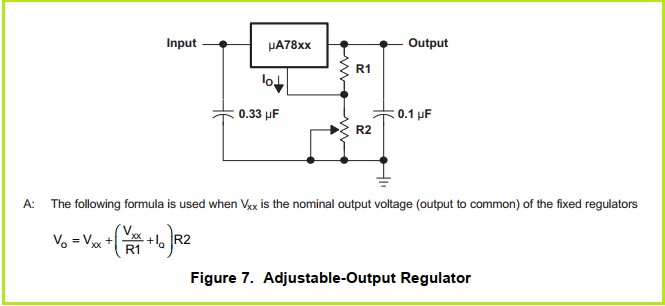
Please refer to Page 13, Figure 7: Adjustable-Output Regulator 

Initially, I chose R1 and R2 as 150 and 270 ohms respectively. According to the formula given on the datasheet, the output voltage should be 15.161V. But I only got 11.78V. I observed that the voltage across R1 was 3.98V only which normally should be 5V.

Then I went with R2 as 330 ohms and R1 as 150 ohms thinking that higher R2 would result in a higher voltage drop across R2 thereby increasing the output voltage from 11.78V. However, the output voltage stayed the same (11.78V) and the voltage across R1 dropped to 3.3V from 3.8V. This leads me to believe that the output voltage is saturating at 11.78V. 

Note: I got the same result when I used 270 and 520 as R1 and R2 respectively. 

Could you please confirm that my theory is true or could point out the mistake in my circuit?

Thank you 

Varun R 

  • Hi Varun,

    what is the input voltage? You will need at least 17V, better more.

    Kai

  • The input voltage is 13V. 

    The problem is, 11 to 15 is what I have. If I had 17V, I would have used the UA7812C regulator and would have got 12 V constant output. 

    The application is as follows:

    11-15V battery --> 5V regulator --> Amplify to 14.1V atleast --> 12V regulator(UA7812C) --> to get 12 V regulated voltage. 

    11-15V battery --> 5V regulator --> Power temp sensors

    Note: I need 14.1 V because UA7812C needs a minimum of 14.1V. This 12 V will be used to power a voltage divider circuit that is connected to an ADC. It has to be precise. It cannot fluctuate like a battery. 

    If my plan is not practical then is there any way to amplify the fluctuating 12V output of a battery to 14.1V so that I can regulate it using UA7812C?

    Thank you 

    Varun  R

  • Hi Varun,

    when you create 15V with the help of 7805, then 5V is dropping across R1 and 10V across R2. But to keep the 7805 in regulation it needs at least 7V between its input pin and its ground pin (which sits at the connection point between R1 and R2). So, you will need a voltage of 7V + 10V (across R2) = 17V at the input of this circuit.

    You can also look into the datasheet of LM317 which works rather similar.

    One way to increase the supply voltage is to use a charge pump. But this will only work for rather limited load currents. How much current do you need from the 12V supply?

    Kai

  • Hello Kai, 

    I would need around 0.3-0.5 A. The voltage regulator would provide 1.5A. So I thought this design would be practical. 

    I have considered opamps but they will saturate when the output reaches supply voltage. Is there any other way except charge pumps? 

    If I replace UA7805C with UA7810C, then will I be able to get over 14.1V from 11-15V battery? I'm guessing no considering 10V will be across R1 and not much left for the voltage across R2. But I still was to check with you. 

    Thank you 

    Varun R

  • Hi Varun,

    ok, 0.3A...0.5A is too much for a charge pump. But you could take a step-up switcher or a preassembled, ready-to-use DC/DC-converter modul.

    With the trick shown in your link you can make a 5V regulator work as a 10V or 15V regulator, e.g.. But you will always need the same input voltage as if you would use a true 10V or 15V regulator. There is no difference at all. The trick is useful, if you don't have a 10V or 15V regulator but only a 5V regulator. And, to tell the truth, a true 10V or 15V regulator will give a much better performance than the trick with the 5V regulator.

    Kai