This thread has been locked.

If you have a related question, please click the "Ask a related question" button in the top right corner. The newly created question will be automatically linked to this question.

OPA858DSGEVM: OPA858DSGEVM

Part Number: OPA858DSGEVM
Other Parts Discussed in Thread: OPA858,

Hi, an urgent help request.

We have purchased an Evaluation Module for OPA858 amplifier, OPA858DSGEVM several days ago, and have tried

the module to test it for our OPA858 pulse amplification circuit design for our product.

However, the module doens not work at all. we have found the circuit uses R3 zero ohm resistor connected

in parallel with the differential input terminal to the ground. That means resistor R3 shorts out the RF input signalm and

consequently the module doe not output any siganl waveform to eh oscilloscope at the output connector.

Why did you short the input terrminal by R3. How can we test the moduel? Please explain the situation. Is it an mistake?

Do we have to remove the resistor R3, which is also very small and thus even very difficult to remove it.

Please give me immediate answer. I don't understandwhy this happened.

Regards,

Ki-Chang Lee

P.S. My collegue Iksoo Choi already have asked this matter to you on Friday. But still he did not get answer from TI. 


  • Hello Ki-Chang,

        The OPA858DSGEVM is configured in a non-inverting gain of 7 by default which can be reconfigured to be used with different gains by changing out the feedback/gain resistors or in a different configuration such as an inverting amplifier by taking out R3 and R10. At its default configuration, you would not be able to input a signal in In- (J1), you would however be able to in In+ (J2). 

       We were not able to find your colleague's post. Would you be able to send us the link?

    Thank you,

    Sima

  • Very thanks for your prompt reply.

    Still some questions.

    1. Then what is the use of J1 if it doesn't work by R3

          shorting?

    2. How can we input differential RF signal. which requires J1

          and J2 together?

    Regards

  • Very thanks for your prompt reply.

    Still some questions.

    1. Then what is the use of J1 if it doesn't work by R3

          shorting?

    2. How can we input differential RF signal. which requires J1

          and J2 together?

    Regards

  • Hello Ki-Chang,

      The EVM was designed in this manner to be used in either a non-inverting configuration (default) or an inverting configuration by removing R3 and R10. You could input a differential input signal by removing just R3; however, it was not designed for this purpose. 

    Thank you,

    Sima

  • Hello Ki-Chang,

       Were you successfully able to input a differential signal?

    Thank you,

    Sima 

  • Hello Ki-Chang,

       I will be closing this thread; since, you have started a new thread.

    Thank you,
    Sima

  • Hi, Sima,

    By the way David Lin suggested me his opinion that he used it with a photodiode connected to the input jack.

    Is it OK to connect photodiodes in steadof RF signal generator. In this case we can not see any signal output

    because of no varying singal.

    The EVM still does not work. Perhaps maybe the OPA858 is failed?

    Ki-Chang Lee  

  • the EVM still not working inspite of inputting J2 to a RF signal generator.

  • Hello Ki-Chang,

      As stated from the newer thread: Would you be able to provide scope shots of both the input to J2 as well as at the output at J5? Or would you be able to tell me the characteristics of your input signal? Have you made any changes to the OPA858EVM? Also, I posted a reply to David's response here: https://e2e.ti.com/support/amplifiers/f/14/t/856194

    Thank you,

    Sima 

  • Hello Ki-Chang,

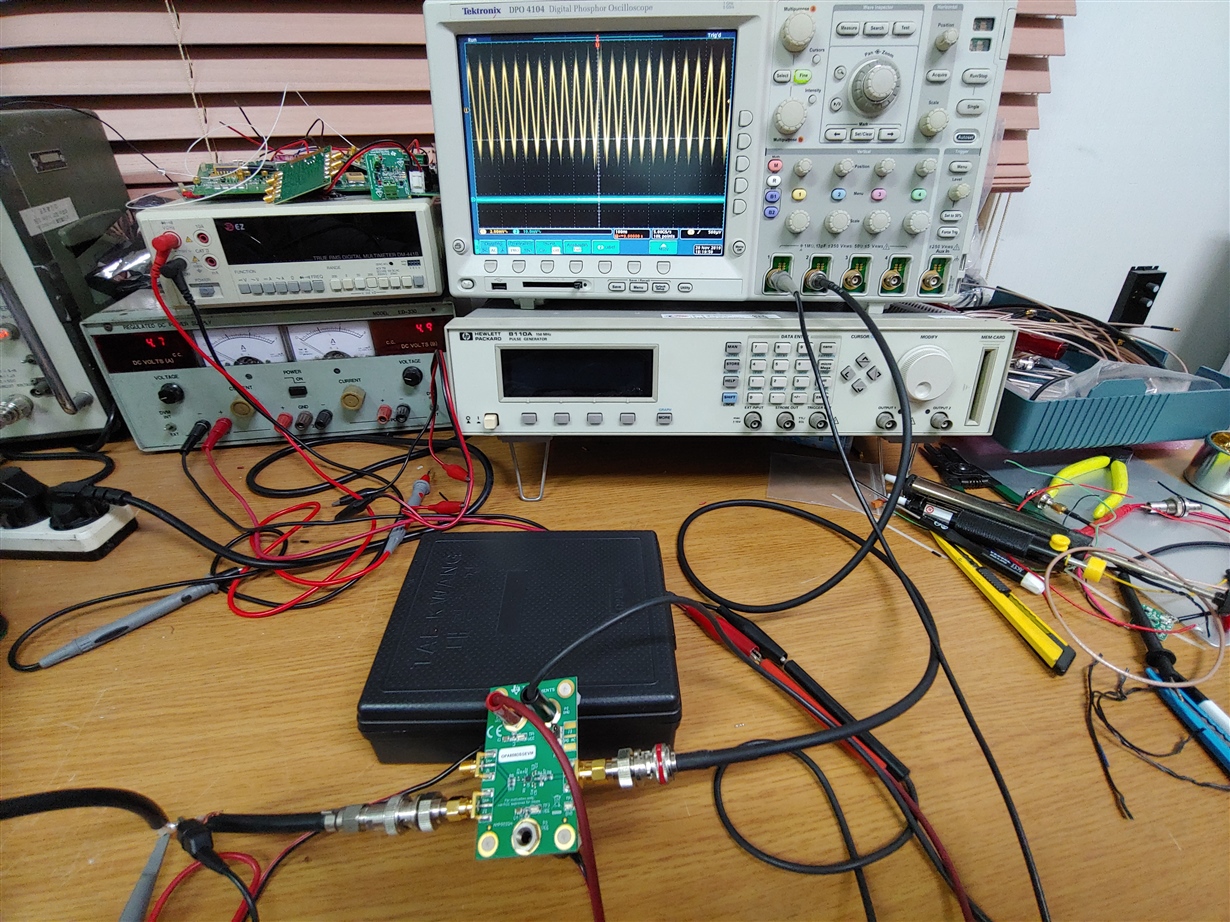
        I am moving my replies to this thread. Thank you for sharing an image of your setup which you have shared in another thread:

           I was unable to determine your input characteristics from the image. Would you be able to show me a closer image with the measurement of both amplitude and frequency of the input and output signal?

    Thank you,

    Sima

  • Actually, I have told you in my previous mail, even thogh the photo do not show thw value.

    The input level was about 3mV and we varied it up and down by an attenuator at the frequency range of 5MHz to 30MHz varied.

    However, no output signal detected at J5 as shown on the photo. If you still need a close up photo, we will take another phot0 and

    will send you again within a few days. 

    Also we have tried the inputting signal directly to J2 and through a 33nF capacitor fron the 50-ohm RF signal generator,

    and no output for both cases.  

    And I am asking you that you replace thios EVM with another one tha you confirmed the output.

    Ki-chang Lee


  • Hello Ki-Chang,

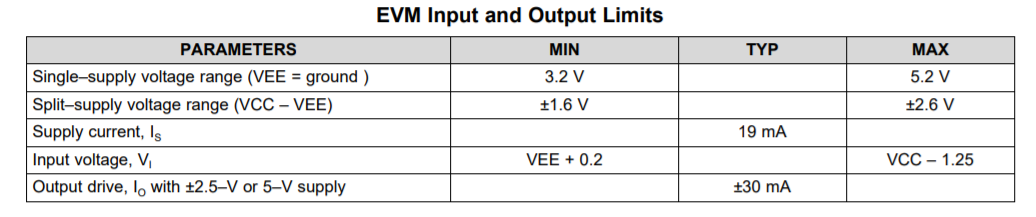
       Thank you for clarifying the input characteristics. From your previous set-up image, there seems to be a connection to VCC and GND, but not to VEE. With a low input voltage of 3mV ; I would suggest using split supply of +-2.5V. If you are using singly supply voltage, you would need to connect VEE to ground. Regardless, there should be a connection to VEE. Your transient voltage output should be around 21 mV. Below, I have attached the input and output limits for the OPA858 EVM.

    I have also attached a snippet from the OPA858 datasheet on the allowed range when using a +5V or +3.3V single voltage supply. As you can see, your output would have to be above 1.05V for either 3.3V or 5V supply.

    Thank you,

    Sima

  • Dear Sima;

    Thanks for your continuous help for our project.

    As per your suggestion, we have tested the EVM using Split Power Supply of +/- 2.5V, and we found it works

    showing output waveform sithe less than gain fo 7.

    However, it still doens not work for Single Power Ssupply with 5V of course we grounded Vee.

    What is the reason. we will be using single power mode normally for our prototype.

    At least, the OPA858 chip in not failed. We found any other condition for the single power operation.

    We still need your assistance.

    Regards,

    Ki-Chang Lee    

  • Hello Ki-Chang,

       I am glad to hear that the OPA858EVM is working properly. The reason you are unable to use single supply with a low input voltage of 3mV at the current default EVM with a non-inverting gain of 7 is because the output voltage is lower than the recommended low output voltage of 1.05V. You will not see a signal until the output voltage is at typically 1.05V. However, the reason it works with split supply is because now your Vs- is lower than ground, in this case it is -2.5V. This means your output voltage could be as low as -1.5V which is well below your output voltage of about 21mV (Note: this is not directly specified in the datasheet, I am giving a rough estimate). If it is required to use single power supply, I would suggest increasing the input signal and increasing the gain configuration of the amplifier. This will depend if you can increase your input signal, and will depend on the necessary bandwidth of your application. If increasing the input signal is not possible, I would suggest to add another amplifier which has atleast an output rail to Vs-. 

    Thank you,

    Sima 

  • Hello Ki-Chang,

       Do you have any updates, concerns, or questions since my last reply?

    Thank you,
    Sima

  • Hello,

    I am closing this thread due to inactivity. If you have any further concerns, please open a new thread. 

    Best,

    Hasan Babiker