Other Parts Discussed in Thread: VCA824, VCA820, VCA810, LOG114
This thread has been locked.
If you have a related question, please click the "Ask a related question" button in the top right corner. The newly created question will be automatically linked to this question.
Other Parts Discussed in Thread: VCA824, VCA820, VCA810, LOG114
Hi Hardik,
Thank you for your post. We do have collateral on how to select and design a TIA: http://www.ti.com/lit/an/sboa268a/sboa268a.pdf
However, we do not have any AGC amplifiers. The closest we have are PGAs (programmable gain amplifiers) but these will require external programming.
-Tamara
Hello Hardik,
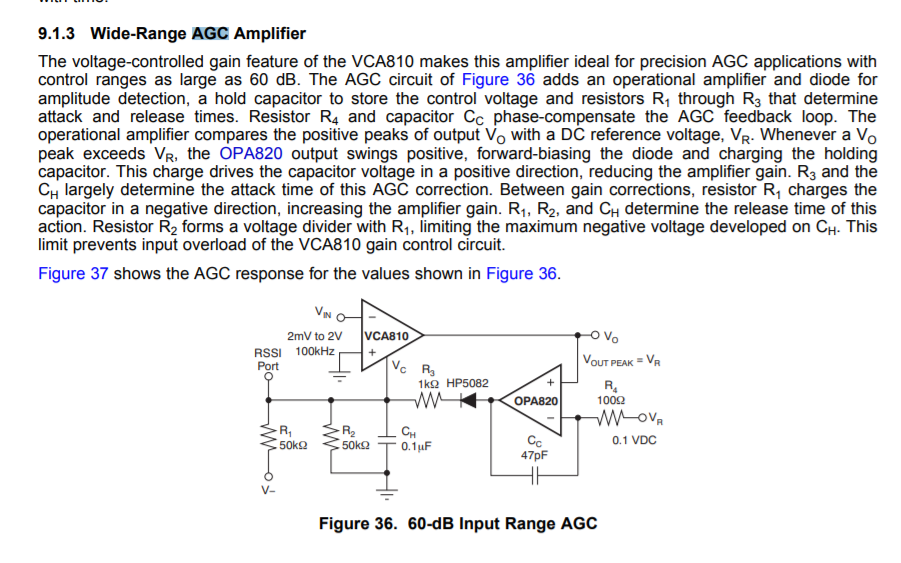
When Tamara says we do not have AGC amplifiers she means the TI lower speed precision amps group - there are plenty of AGC parts in some of the other TI groups, look at the VCA820 Section 9.2.5. You need to use the dB/V gain control variants for AGC loops (constant AGC loop gain). If that is not fast enough look at the VCA824.
Your post is very difficult to respond to without some more detail, speed, eventual output swing, supplies, power constraints.
1. Zt stage,
a. source C
b. output current range
c. desired gain
d. desired speed,
Sorry, your 300kHz speed was in the original message - The VCA820 seems overkill, their is also the VCA810 which is much slower,
Hello Hardik,
As Tamara indicated TI does not have any AGC products in the Precision Amplifier product line-up. However, you may want to consider an amplifier having a logarithmic current ratio (LOG I1/I2) response. A log amplifier is a transimpedance amplifier having a current input/voltage output transfer characteristic. The log amplifiers have a very wide dynamic range from 100 pA on the low end, to a few milliamperes on the high end (7 to 8 decades). The very wide dynamic range may actually circumvent the need for an AGC amplifier.
The bandwidth attainable by a log amplifier is dependent on the input current levels; higher input current, higher bandwidth. The LOG114 has the widest bandwidth of the our LOG amplifiers. You can view the datasheet here:
https://www.ti.com/lit/ds/symlink/log114.pdf
The LOG114 is ideally suited for photodiode applications.
Regards, Thomas
Precision Amplifiers
Hi Thomas,
Will this serve my purpose?
Photodiode will receive UART Data with frequency of 10KHz and depending on the the intensity of light which may vary i want to receive fix output.
Due to variable distance(which may vary intensity of light) at the input of photodiode, still i want fix output.
Can you help further?
Hi Thomas,
I found below link with AGC inbuilt.
As per my application photodiode is used at the input.
My transmitter will throw light on the Photodiode but transmitter may be at variable distance and thus intensity of light falling on the photodiode may vary intensity of light falling on the photodiode.
I above link, they have mentioned internal AGC, which can internally set gain to deliver fix output voltage.
Will this work for my application?
Awaiting your kind response.
Hello Hardik,
The LOG114 does not provide an AGC capability so on its own it cannot provide a fixed output level if the light intensity is variable. It provides a VLOGOUT voltage that is a function of the log of the I1, I2 current ratio as described in the datasheet. Therefore, the LOG114 doesn't provide the exact function you need.
Regards, Thomas
Precision Amplifiers Applications Engineering
Hi Hardik,
The ONET4291TA is produced by another TI division so I was not really aware of its capabilities. Looking over the datasheet it does appear that it will do what your application requires.
TI certainly has an e2e forum where the ONET4291TA is supported. If you have any questions, they people supporting the device would be able to assist you. If you think the ONET4291TA is going to fulfill your application requirements I would appreciate it if you would close this Precision Amplifiers e2e thread.
Regards, Thomas
Precision Amplifiers Applications Engineering
Hi Hardik,
why not using a low Q bandpass filter, tuned for the UART frequency, followed by a comparator?
See also here:

Kai
Hi all,
Closing this thread now. Reply to re-open if you have additional comments / questions.
-Tamara