This thread has been locked.

If you have a related question, please click the "Ask a related question" button in the top right corner. The newly created question will be automatically linked to this question.

OPA4344 / Input offset voltage

Other Parts Discussed in Thread: OPA4344

Hi,

Our customer has understood about the behavior/specification of OPAx344 as following description.

It seems they referred "Fig.2 - Simplified schematic" on the datasheet -page9.


- OPAx344 has 3 modes of input stage behavior depends on input Vcm as below,

        (a) Activated only P-ch amplifier

        (b) Activated both P-ch and N-ch amplifier

        (c) Activated only N-ch amplifier

 - The specification of offset voltage on the datasheet is shown for the case (a).


If above understandings are correct,

 -> Could you pls let me know the specification for (b) & (c)?

 -> If there are some different of each Vos, is the behavior rapidly or gradually

       when the mode transition between a-b-c?

Best Regards,

Sonoki / Japan Disty

  • Sonoki,

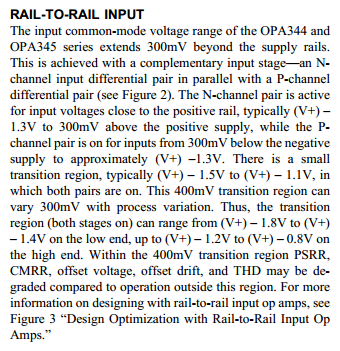
    Both input differentia pairs are trimmed to zero at the wafer level but the die packaging-related stress causes a random Vos shift in both (a) and (c) modes.  Mode (b) is a 400mV Vcm transition between P and N input differential pair being active where Vos moves gradually from P-channel Vos to N-channel Vos or vice-versa – see below for more details.

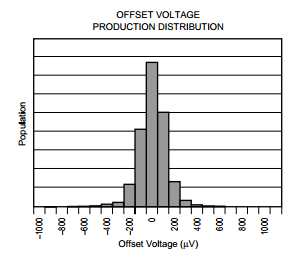
    P-channel Vos , mode (a), is specified in PDS as typical of 200uV (one-sigma) and maximum +/-1mV – see histogram below.


    Since the random Vos change between P and N input pairs dominates the Common Mode Rejection Ratio spec, the expected Vos for N-channel Vos may be back-calculated from the CMRR spec shown below.  For example, for Vs=5.5V, -0.3V<Vcm<5.8V, typical CMRR is 84dB (63uV/V) while the maximum CMRR is 70dB (316uV/V); thus the typical Vos change between (a) and (c) is: [(5.8V-(-0.3V)]*63uV/V=6.1V*63uV/V=384uV (twice the typ Vos in PCH) while the maximum Vos change is: 6.1V*316uV/V=1928uV (twice the max Vos in PCH); of course, they both may have positive or negative polarity.

    From the above calculations you may see that the typical and maximum Vos shift as the input common-mode transition from (a) to (c) mode, or vice versa, is around twice the Vos specified for P-channel input differential pair so the expected distribution of Vos for N-channel (c) must be similar as for P-channel: typical 200uV and maximum 1mV.  However, the two input offsets are completely random so there is no correlation between the two pairs - that means that, for example, PCH Vos of +200uV may typically transition to NCH Vos of +600uV or -200uV(200uV +/-400uV); therefore, it is critical to understand that the magnitude or polarity of the input voltage offsets in PCH input differential pair (a) does NOT relate in any way ANY information about the magnitude or polarity of Vos in NCH input pair even though both, (a) and (c), offset voltage distributions look very much the same as the one shown above.

  • Dear Marek-san,

    I really appreciate for your detailed explanation. I understand how to expect the Nch Vos by using CMRR spec.

    Now I would like to ask more about the Vos at region of both Pch and Nch activated (b). From the description about Rail-to-Rail input you inserted, I understand that the Vos will be degraded compared with Vos at only Pch or Nch activated. Can you expect the Vos at region (b)?

    Best Regards,

    Sonoki

  • Sonoki,

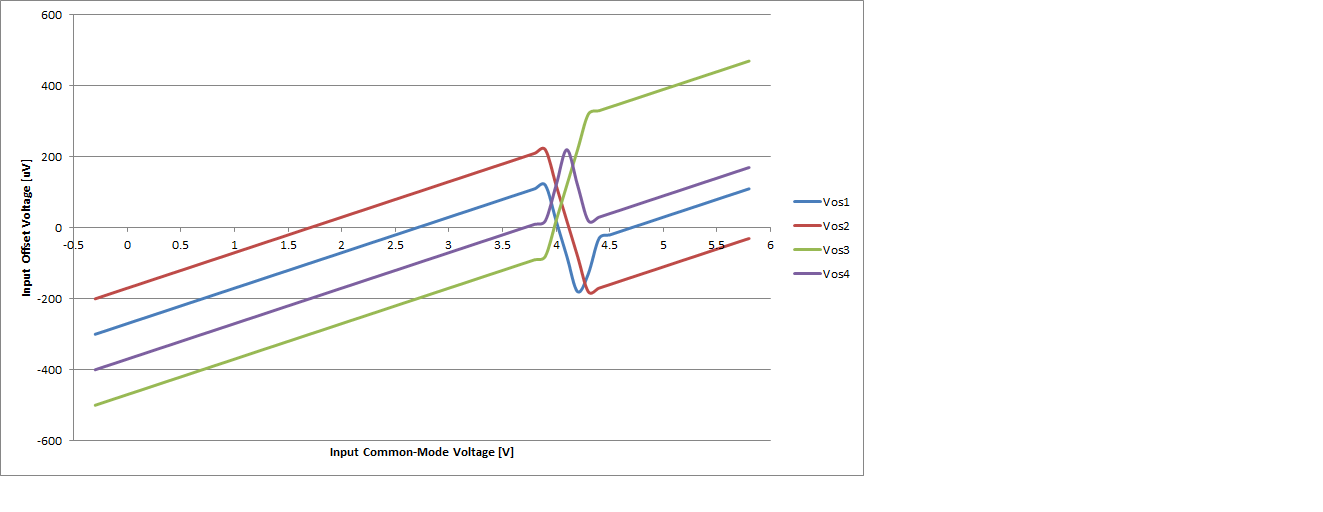
    The OPA4344 input offset voltage in the transition region is NOT tested but in general is smaller then the typical 400uV Vos shift between P and N channel input differential pairs - please see below few typical Vos vs Vcm curves for Vs=5.5V


  • Dear Marek-san,

    Thank you for sending input common mode voltage vs. input Vos. This is very helpful to understand the behavior of Vos depend on input common mode voltage.

    Now I would like to ask further about calculating Nch Vos by using CMRR. I would like to understand further about it, so do you send the related document or URL? It's appreciated you would contact me directly if the document you have is internal use only.

    Best Regards,

    Sonoki