This thread has been locked.

If you have a related question, please click the "Ask a related question" button in the top right corner. The newly created question will be automatically linked to this question.

differential output instrumentation amplifier

Other Parts Discussed in Thread: PGA281, PGA280, THS4521, THS4031, ADS8363, THS4032

Hi,

Is there any single chip fully differential instrumentation amplifier ? 

Or differential output Instrumentation amplifier ?

If not, is there any specific reason why ?  Is it because it is too complicated to design the chip ?

Thank you

  • Siauhwa,

    The PGA280 and PGA281 are the closest chips we have to a differential output instrumentation amplifier. However, rather than the gain being set by an external resistor, programmed using an SPI interface (PGA280) or by pulling the gain set pins high or low (PGA281). 

  • Siauhwa,

    In addition to John's recommendation, THS4521 is a rail-to-rail output fully differential amplifier.  If you do not require fully differential output, we offer a number of INA’s from low voltage single supply, INA321 and INA331, to dual supply, Vs=+/-15V, INA826INA114, INA118, INA128 to high input common-mode voltage, Vcm=+/-275V, INA149, etc. where the overall gain may be controlled with a low precision external resistor without sacrificing other specifications like CMRR.

  • Hi John,

    Would they be suitable for High sampling rate adc says 0.5 MS/s, run on burst mode (not continuous sampling)  ?

    Signal being converted is pretty slow of less than 100hz, actually..

    Thanks

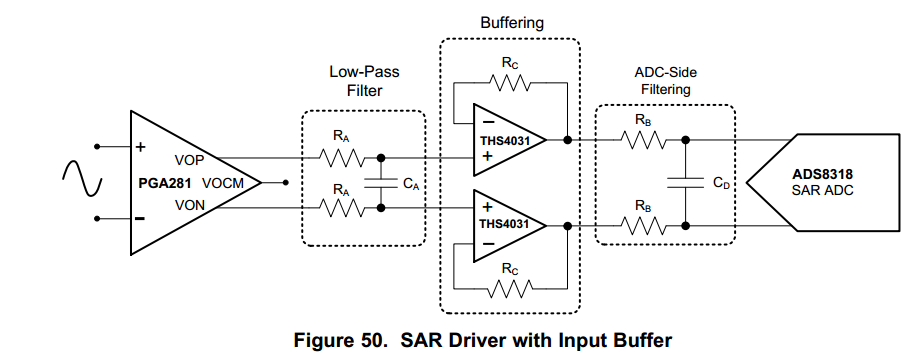
  • The gain bandwidth product of those parts (for gains greater than 4 V/V) is 6MHz so it would depend on your input signal bandwidth and your gain requirements. The PGA281 datasheet application section shows the addition of two high speed amplifers as buffers in front of SAR converters that are being used at a high sampling rate. This is done to prevent eliminate errors intoduced by the switching capacitance on the front end of the converter. 

  • Hi John,

    Do you mean that pga281 is designed with buffers on the last stage to overcome the typical spikes due to SAR ADC ?

    In other word, the output of pga281 will be spike free when connecting it to sar adc ...?

    Thank you

  • I was referring to figure 50 in the PGA281 datasheet which shows the addition of THS4031 buffers to the output of the PGA281 to improve the linearity of the system when using a SAR ADC:

  • Hi, John,

    Can I connect PGA281 directly to ADS8363, with out the buffer?

  • Hello Celia,

    It is not recommended to drive the inputs of a SAR ADC such as the ADS8363 with a lower-bandwidth amplifier such as the PGA281. The primary reason is because the settling time of the PGA281, at 20 μs to 40 μs, is significantly slower than the acquisition time of the ADS8363 at 100 ns. Therefore, it's likely that the PGA281 will still be adjusting its output voltage when the ADS8363 has finished its acquisition, causing linearity performance to suffer.

    If you consider the settling time of the THS4032 (45 ns to 90 ns), it is clear that higher-bandwidth devices are better suited to SAR ADC input drive. Equation (1) in the ADS8363 data sheet provides a recommendation for the minimum -3dB bandwidth of the driving amplifier, with a result of 19 MHz for the 16-bit resolution of the ADS8363.

    Best regards,

    Ian Williams
    Linear Applications Engineer
    Precision Analog - Op Amps