This thread has been locked.

If you have a related question, please click the "Ask a related question" button in the top right corner. The newly created question will be automatically linked to this question.

INA231: Mode Questions

Part Number: INA231

Hi Support,

Since ‘Shunt and bus, continuous’ is the default mode, does this mode start operations immediately after power up?

If I select ‘Power down’ mode, and then immediately select ‘Shunt and bus, continuous’ mode, what is the time delay before ‘Shunt and bus, continuous’ mode begins operation?

If I select ‘Shunt and bus, triggered’ mode, what is the time before the ‘Conversion Ready’ bit is set, given that the acquisition time = #samples*(Vbus time + Vshunt time) ?

Thanks,

Mike 

  • Hello Mike,
    Thanks for using our forum. Once power-up is complete the default mode of operation is in effect.
    After the slave INA231 reads the final bit, we expect it to be ready within a few internal clock cycles and not greater than 4us.
    Yes, the formula you have for the triggered mode is basically correct; however, if you want a little more precise answer it would be: acquisition time=#samples*(Vbus time+Vshunt time)+calculation time. The design team told me that this calculation time is between 10 and 50us.
  • If the INA231 is in the Shunt and bus continuous mode, is the time for each cycle = #samples(bus conversion time + shunt conversion time) ?  

    Whether in continuous mode or triggered mode, do the results remain in the registers until the next continuous cycle or next triggered cycle?

  • Hello Steve,

    Yes after each conversion ends, a new conversion begins regardless of whether the calculations based the conversion are done or not.

    As per section 8.3.1 of the datasheet, the previous "remain in the data output registers until they are replaced by the next fully completed conversion results.” So regardless of whether the INA231 is in triggered mode, continuous mode, or switching between modes the results will remain until replaced by the next cycle. Only exception would be at power-up before the first conversion completes. At that point in time the register values will be "0." Current and power calculations also will not update until the calibration register is programmed.
  • Thanks Patrick.  Regarding your first answer, if a continuous mode cycle length is determined by the the equation #samples*(bus conversion time + shunt conversion time), how is it possible, if the INA 231 is always in continuous mode, for a new conversion to begin before the previous conversion has finished?   isn't the situation of one conversion beginning before the previous one finished only possible in triggered mode or if switching modes?

  •  Hello Steve,

    I do not think I explained the conversion process very clearly in my last thread.

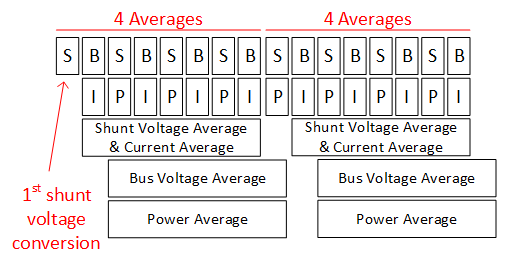
    At the end of a conversion a shunt or bus value, the values are loaded and accumulated into the shunt voltage and bus voltage registers.  While these values are loaded, a new conversion begins in parallel.  Sampling and conversion takes longer than the appending of the averaged value to these registers.  Once these values are loaded into the bus or shunt voltage register, the calculations for current and power are performed.  This calculation step also is faster than a conversion and therefore is also done in parallel with the conversion for the next measured value.

    Below is an example of the conversion sequence in which only 4 averages are taken per cycle.  Here "S" corresponds to a shunt voltage conversion, while "B" corresponds to a bus voltage conversion.  "I" corresponds to a current calculation and "P" corresponds to a power calculation.  Note the shunt voltage accumulation for the averaging starts after the first shunt conversion.  This current value based on the shunt voltage measurement is also calculated at this point.  Similar to the shunt voltage, the bus voltage averaging begins after the first bus voltage conversion of the averaging cycle. Once the 4th bus voltage conversion completes, the final averaging and calculation of the power can be completed while the next averaging cycle begins with shunt voltage conversion.

  • Hi Patrick,

    Your explanation is excellent, and I really appreciate the drawing.  However, you gave an indirect answer to my specific questions.  From your answer, I assume:

    In the continuous Bus and Shunt mode, it is not possible to stop a calculation/conversion sequence prior to the next sequence starting.

    In the Bus and Shunt trigger mode, it is possible to stop a calculation/conversion before it has completed.

    If I start in the continuous mode and then swicth to a triggered mode, it is possible to stop a calculation/conversion before it has completed.

    Again, I like your explanation.  I simply want to confirm the answers to my specific questions.

    Thanks.

  • One additional question:  If I start another trigger mode before the previous trigger mode has finished, does the first trigger mode keep going until complete, or simply stop and display partial results?

  • Hello Steve,

    1. If you are in continuous mode and do not switch between modes, you cannot stop a conversion.
    2. By resetting the device to trigger mode, you can abort an ongoing conversion for a device already in trigger mode.
    3. If you switch modes, you will abort the conversion taking place.
    After a disrupted conversion from starting a new triggered conversion, the shunt and bus registers will continue to hold the last complete conversion result until overwritten by the conversion initiated by setting the device to triggered mode.