


Part Number: LMX2571
Hi Support,
Here it's set up for rx at 469.975, a frequency where spurious responses are a problem, with LO output at 420.025MHz. The VCO runs at 12x this, 5040.3MHz. With the 50.4MHz reference frequency, there's going to be a spurious signal generated at 300kHz offset. And so there is, except it's at 300kHz offset from the 420.025MHz output whereas I'd expect it to be at 300kHz/12. Similarly, if I change the output divider to /8 and look at the output at 630.075MHz, the spurious signals are still exactly 300kHz away, ditto if the divider is increased to /14 so the output is at 360.021MHz.
Added to this, there's a second spur, always at 150kHz offset regardless of the output division ratio. If the main divider is reconfigured with the prescaler at /4 instead of /2, that second spur sits at 75kHz offset, again regardless of the output division ratio. These spurs don't change with fractional N order or dithering. There's some strange sort of crosstalk going on inside the chip.
In situations where such spurs are a problem, the reference dividers and multipliers can be used to change the phase detector frequency to move away from near integer division. In the case in point, The solution that has been tried is:
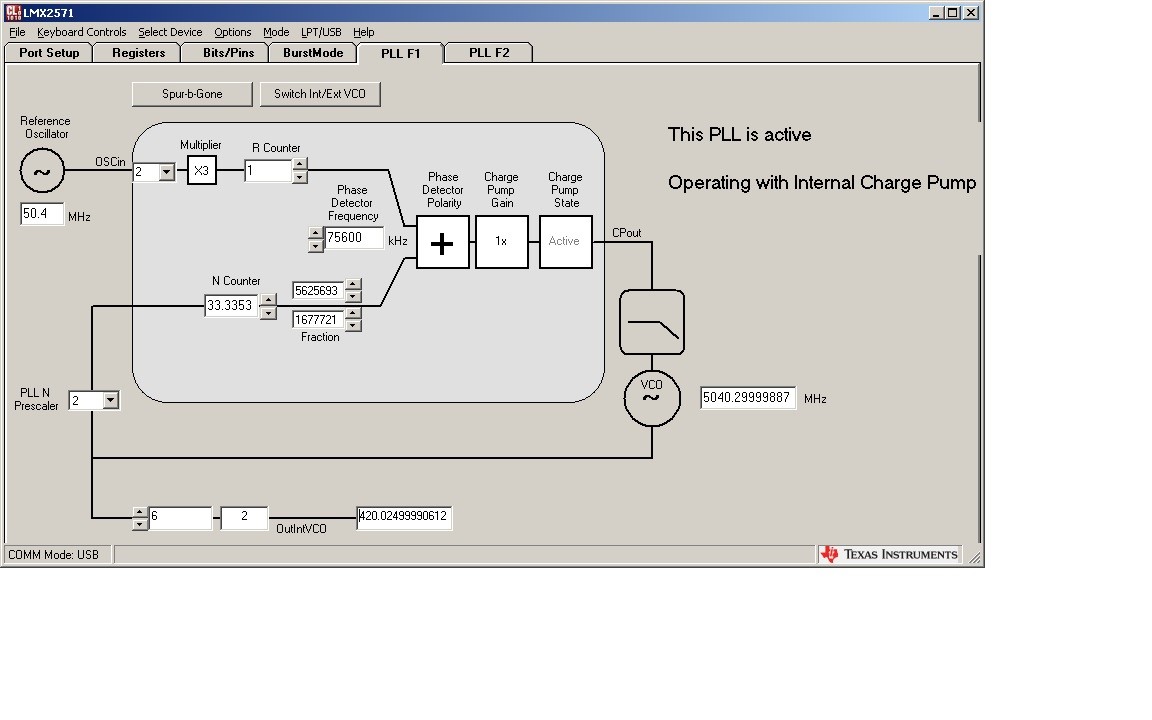
The odd thing with this is that the 150 and 300kHz spurs are still there, actually at a higher level
The LMX data sheet has scant data about the reference input and nothing about the characteristics of the input stage. (For anyone interested in a comparison of how it can be done, see Analog Devices ADF4350) For single ended use the specified input is 1.4 - 3.3V p-p and for differential 0.15 - 1.5V p-p. We're using single ended and the drive levels are 800mV p-p at 50.4MHz and 1.1V p-p at 12.288MHz.
Another unexpected oddity has shown up. Looking at the wider spectrum, there were two noisy spurs at about +/- 350kHz, like signals with digital mod on them, about 8kHz wide. Swapping between TCXO and signal generator as the reference input made no difference. Changing the output divider to /12 to get 480.15MHz output and the spurs are still at +/-350kHz. Back to 400.125MHz, using the signal generator and varying the input frequency, the spur at 400.47MHz doesn't move. The wanted frequency moves and the mirrored spur on the other side of it moves to be symmetrical. Move the wanted frequency from one side of 400.47 to the other and the three signals go through zero beat and off on the other side, just like a mixer product. So how is the synth chip generating a fixed frequency from a varying input?
Thanks.
