Part Number: ADC121C021
Other Parts Discussed in Thread: TPS22917
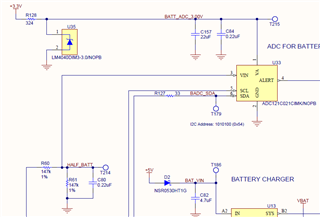
We are using the ADC12C021 similar to that shown in "ADC121C021: Oddly sensitive to value of capacitor on VIN" but with the battery voltage taken directly from the "HALF_BATT" location rather than after a buffer / amp.
We have a problem in that sometimes when we first apply external power to our unit (including the ADC121C021), the chip doesn't respond to I2C commands; I suspect it's not getting an "Acknowledge" bit but I haven't been able to confirm that yet. Repeated attempts to read the I2C bus continually fail until we power the unit down and back up again, at which point it works perfectly. No other devices on the same I2C bus exhibit this problem.
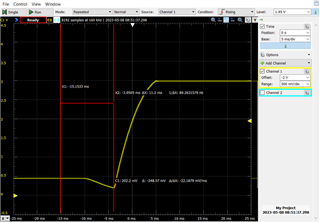
We suspect that the issue has something to do with the fact that there is still a small current (< 25uA) coming through VIN from the battery when the device is powered down. This can leave a residual voltage on VA (the chip's power pin) of about 450mV, which takes a dip down to 200mV just after external power is reapplied (see scope image below). The datasheet indicates "The internal registers will lose their contents if the supply voltage goes below 2.4V. Should this happen, it is important that the VA supply be lowered to a maximum of 200mV before the supply is raised again to properly reset the device and ensure that the ADC performs as specified."
If we don't leave the unit off long, we don't always go below 200mV as shown in the plot, but I have never seen the chip fail an I2C access when I've scoped it up like this. However, if I let the unit sit overnight with power off, and battery current slowly leaking through the dividers and the chip - perhaps draining fully - on (only) the very first power-up in the morning, I2C accesses for this chip fail. All other power-ups throughout the day are fine.
Unfortunately, this chip doesn't have an external reset pin, so we can't force it to a known state if the I2C bus locks up. Fortunately it doesn't affect other devices on the bus when this happens. This failure has been very hard to reproduce in the lab, but it comes up often enough on the production floor to delay testing / deliveries. I have tried reproducing the problem by letting the battery drain 1 to 5 hours, but it seems to require an overnight duration for it to show up.
To meet the full datasheet requirements, it looks like we will need a circuit to disconnect the battery when power is off to avoid this problem, but we haven't tested that yet as that would require major board changes. Can we avoid this problem by increasing the battery divider resistors to some minimum level? Can you give us any insights in how to mitigate this issue?
Thanks,
Cynthia