This thread has been locked.

If you have a related question, please click the "Ask a related question" button in the top right corner. The newly created question will be automatically linked to this question.

ADC32RF52: SNR calculation

Part Number: ADC32RF52

Hello team,

My customer is wondering how SNR of ADC32RF52 is calculated. Could show me the calculation?

For example, Dither enabled, fin = 900MHz, Ain = -20dBFS, the SNR is 69.5dBFS.

My customer is thinking that

Signal is -20dBFS
NSD is -158.7dBFS/Hz, so noise should be calculated -158.7dBFS/Hz + 10*10log10(1500MHz / 2) = -88.75dBFS
So SNR = -20dBFS - (-88.75dBFS) = 68.75dBFS

So there is difference between the datasheet.
Could please show me how SNR from datasheet was calculated?
Also why is the unit for SNR dBFS? Shouldn't it be dB?

Best Regards,
Kei Kuwahara

  • Hi Kei-san,

    I am not fully sure on the exact method used for the datasheet numbers since the SNR spec was gained from ATE. I will have to check.

    Thanks, Chase

  • I could not achieve the same answer as the customer using the equation posted, instead of getting -88.75dBFS, I calculate -69.949. Since the customer calculated number is slightly low, I wonder if they are not ignoring the first 60MHz of bandwidth as mentioned in the footnote of the table. The customer should use 10log(690MHz) instead of 10log(1500MHz/2). I wonder if that will get the correct value.

  • Hi Kei-san,

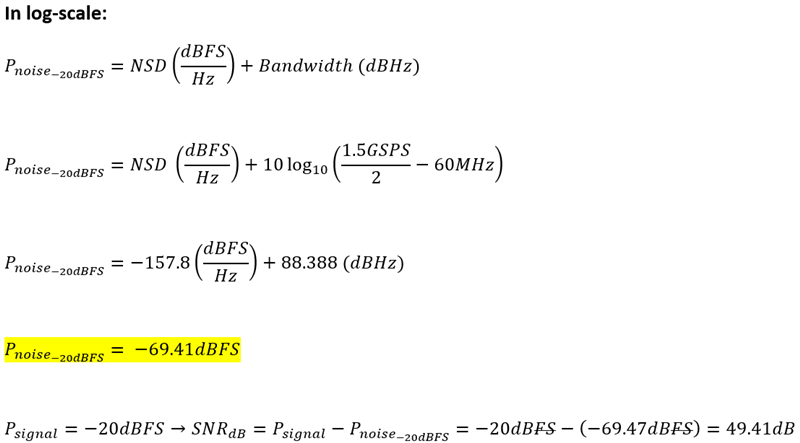
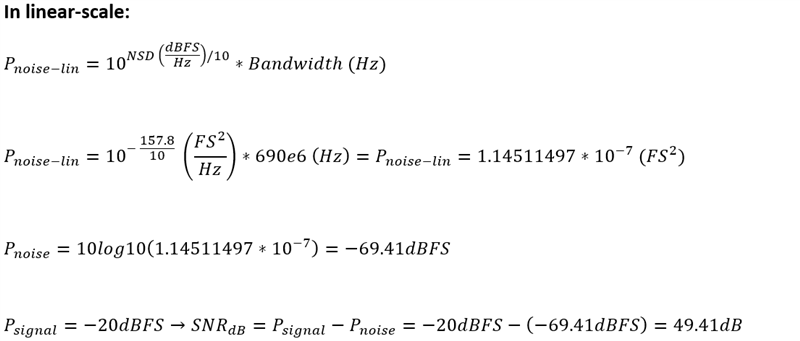
    After checking with the team, there seems to be a typo when the datasheet was written. The document showing the data sheet numbers (before it is manually entered shows -157.8dBFS/Hz rather than -158.7dBFS/Hz. The equation to calculate is attached but I'll post below as well.

    SNR_NSD_equations.docx

    The last 0.1dB difference is likely due to ATE measurement vs bench measurement. Hope this helps.

    Regards, Chase

  • Kei-san, I almost forgot the other part of the question.

    The SNR is in terms of dBFS because the NSD measurement is already in terms of dBFS. When calculating the total noise power using the NSD value in terms of dBFS, the NSD is valid at that specific input level, -20dBFS in this case. If the total noise power was not in dBFS but instead dB, you can scale by the input signal level and that would be the equivalent SNR in terms of dBFS at any input level. This is not specified in this manner because the NSD will not be linear vs amplitude or frequency. -20dBFS was chosen for this datasheet because that is what is used historically for the spec. 

    Regards, Chase 

  • Hi Chase-san,

    Thank you for the detailed answer!

    Happy holidays!

    Best Regards,
    Kei Kuwahara