This thread has been locked.

If you have a related question, please click the "Ask a related question" button in the top right corner. The newly created question will be automatically linked to this question.

DS90UB960-Q1: Different sync mode

Part Number: DS90UB960-Q1

Hi team

I would like to ask a question about DS90UB960 sync mode:

Are the two synchronization modes of TI960 External FrameSync Control and Internally Generated FrameSync the same effect? What application scenarios need to distinguish between these two synchronization modes. Could you please help to clarify when should we use external framesync mode and internal frame sync mode? Thank you.

  • Hello Zirui,

    Thanks for placing your request in E2E - we will look into it for you can respond back ASAP. Since Monday is a US holiday, please expect a response by Tuesday next week 

    Best Regards,

    Casey 

  • Hello Zirui,

    In External FrameSync mode, an external signal is input to the DS90UB960-Q1 through one of the GPIO pins on
    the device. The external FrameSync signal may be propagated to one or more of the attached FPD3 Serializers
    through a GPIO signal in the back channel.

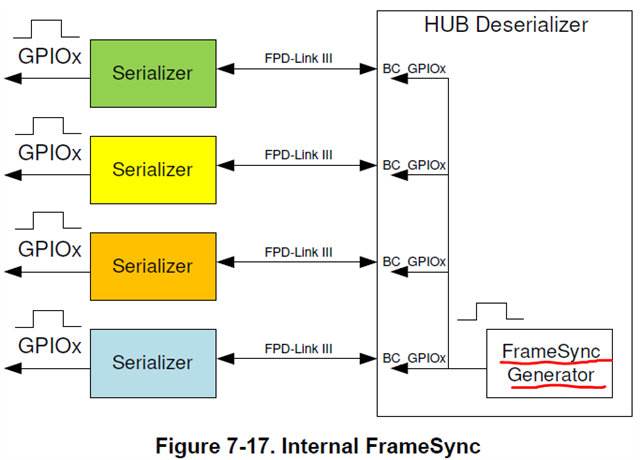
    In Internal FrameSync mode, an internally generated FrameSync signal is sent to one or more of the attached
    FPD3 Serializers through a GPIO signal in the back channel. The accuracy of the internally generated FrameSync is directly dependent on the accuracy of the 25-MHz oscillator used as the reference clock.

    For your questions:

    Are the two synchronization modes of TI960 External FrameSync Control and Internally Generated FrameSync the same effect?

    Yes

    What application scenarios need to distinguish between these two synchronization modes? Could you please help to clarify when should we use external framesync mode and internal frame sync mode? 

    Determining which synchronization mode to use depends on your application and your preference. 

    Hope this helps. 

    Best Regards,

    Shruti More