This thread has been locked.

If you have a related question, please click the "Ask a related question" button in the top right corner. The newly created question will be automatically linked to this question.

I2C Bus Extender with power over bus

Other Parts Discussed in Thread: TIDA-010076, TCA9617B, P82B96, THVD8000

Hi All,

i have few questions regarding I2C bus:

1) Does ti has an alternative to I2C bus extenders like NXP PCA9615 or LT LTC4331 ?

2) IF yes, is it possible to supply DC power over the Extender IC  Twisted pair to the slave I2C device like in the PoDL in T1 automotive ethernet?

TIDA-010076

Best Regards,

David.

  • Hi David,

    1. These are two different devices. Are you specifically looking for hot swap or do you just want an I2C bus extender? Do you need FM+?

    We have multiple I2C bus extenders but the only one that is FM+ is the TCA9617B. It does look like the ISO team has hot swap buffers that can do FM+ I will add them to the thread to see if needed.

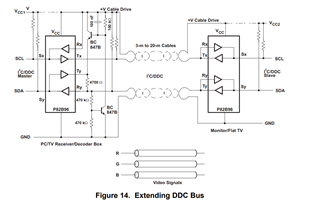
    If you do not need FM+ but you need a long distance cable expander we do have more options here. The option that would be best for long cables and high capacitances would be the P82B96.

    2. The P83B96 actually uses the same idea as ethernet to send power over a twisted pair:

    Let me know if this is something you are looking for.

    Best,

    Chris

  • Hi Chris,

    thank you for the feedback. I don't need FM+ i only need I2C bus extender ( 2m to 4m). And i want to pass the DC power to the I2C slave device via same twisted pair wires.

    Looking at your provided block diagram do i need 2x twisted pairs (4 wires) for I2C or can it be done only via one twisted pair? ( The PCA9615 and LTC4331 use only one twisted pair , two wires , but i don't know if they can do PoDL)

    Ideally would be to have I2C and power over one twisted pair ( like in automotive  ETH T1), and because my device has I2C i would not like to change to other protocol.


    What would you suggest?

    Best Regards,

    David.

  • Hi David,

    The LTC4331 is a relatively complex device that changes protocols through a link controller in order to transmit over long distances using a differential signal. The remote side then interfaces on a completely separate I2C bus after translating the data back to this protocol. While any transaction through this device is underway, the I2C master is waiting for a response with a relatively long clock stretching period to facilitate this data translation. Because the protocol is translated into an asynchronous format, the long distance differential signal may be used in applications that support power-over-ethernet-type designs. TI does not offer any similar device that can do both this translation and transmission in the same device.

    The PCA9615 is much more similar to the P82B96 device that Chris mentioned and simply redrives the same I2C signal on the extended bus without translating the protocol. Because these signals are still in a synchronous I2C format, it is not possible to implement a power-over-ethernet-type solution with only a single twisted pair. The P82B96 suggests how this might be done with two twisted pair cables without the need to translate the data into an asynchronous protocol. 

    If you are interested in a way to implement this through an interface that supports asynchronous formats, the THVD8000 describes the system layout and requirements for a two-wire (one twisted pair) solution for power over communication lines. 

    Regards,
    Eric Schott

  • Hi Eric,

    thank you for clarification regarding different ICs.

    So i could use P82B96 with two twisted pairs, one for SDA and one for SCL. Can you please explain how can i send DC power through those two twisted pairs?

    If i'm looking at THVD8000, then i would first have to convert tI2C to UART? 

    Best Regards,

    David.

  • Hi David,

    With two twisted pairs, there are a total of four wires. Because SDA and SCL are independent signal lines, it is best to keep them separated to avoid cross-talk. Therefore, each signal should be paired with a supply (Vcc or GND). The figure that Chris shared shows how this might look. 

    Yes, UART is a common asynchronous protocol used for RS-485 transceivers like THVD8000. Converting I2C to UART is similar to what the LTC4331 does to accomplish the power-over-signal-line functionality. With THVD8000, this conversion would need to be done separately, but this would facilitate a true two-wire solution. 

    Regards,
    Eric Schott