Part Number: DS90UB960-Q1
Hi Expert,
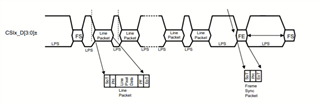
Watched the " CSI-2 Aggregation Breakdown" , and find below picture, not quite understand, could you explain more detail about this?
Thanks

Best regards,
David
This thread has been locked.
If you have a related question, please click the "Ask a related question" button in the top right corner. The newly created question will be automatically linked to this question.
Part Number: DS90UB960-Q1
Hi Expert,
Watched the " CSI-2 Aggregation Breakdown" , and find below picture, not quite understand, could you explain more detail about this?
Thanks

Best regards,
David
Dear David,
Thank you for your question and supporting image!
Yes, so the image that you have provided shows how a video frame can use two different ways (low D-PHY and high D-PHY ways) of transferring data using the CSI-2 video transfer protocols.
Now, an advantage of using CSI-2 is that it does NOT require transmission of discrete horizontal timing information allowing flexibility for video aggregation. This is especially useful when transmitting at high D-PHY lane speeds.
The image on the left that you have provided is how video, active region, is transferred using low D-PHY lane speeds (eg. 800 megabits/sec). The image on the right is sending the same video, active region, but using high D-PHY lane speeds(eg. 1500 megabits/sec).
As reflected in the image, increasing the lane speeds while sending the same frame with the same frame rate will increase the vertical blanking time. However, it is important to note that the the transmitter is outputting it's lower power, or LP11 state during the blanking time so that no data bytes are being sent by the transmitter. During the blanking state, the transmitter is idle and does not consume any signaling bandwidth at that time.
Very Respectfully,
William Yi
Hi Willliam,
Thanks for your feedback.
Several further question:
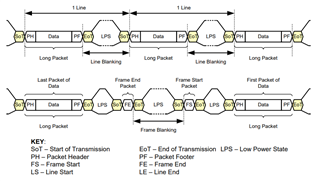
1. Based on below picture , the D-PHY transferred the data by line packet and FS/FE is the frame start and frame end.
So can not quite understand why "does NOT require transmission of discrete horizontal timing information".
Could you help illustrate the picture changed reason based on the protocol diagram?


2. Why only increasing the vertical blanking to maintain the same frame rate? what about increase the horizonal blanking?
3. Would like to use detail quantity to describe the case. Still take 800Mbps for left and 1.5G bps for the right.
If the target image is 1920*720, use 800Mbps for the left;
if use 1.5Gbps, the right side image active will become 1920*384?
384=720*1500/800, is my understanding correct?
4. How to select the correct D-PHY speed with a specific condition? what kind of parameters need to provide to sepcify a condition?
5. You mentioned "This is especially useful when transmitting at high D-PHY lane speeds.", means high D-PHY lane speed will be useful?
What kind of advantage can high D-PHY lane speed bring?
Thanks
Best regards,
David
Dear David,
Thank you for your questions!
If you would care to learn more about these protocols, I would recommend researching more about CSI-2 video data transfer protocols and standards.
Very Respectfully,
William Yi
Hi William,
Thanks for you feedback.
1. My understanding the frame start, frame end is VS, which is the vertical timing. Horizontal timing is the HS, will CSI-2 also send below parameters be short packet?
HLW : Horizontal Low Pulse width
HBP : Horizontal Back Porch
HACT : Horizontal Address
HFP : Horizontal Front Porch
VLW : Vertical Low Pulse width
VBP : Vertical Back Porch
VACT : Vertical Address
VFP : Vertical Front Porch
DCLK :Data Clock
2. For the CSI-2, line packet should contain the entire line data as showed in below in yellow including the active data and blanking data of the line.
So did not buy in the point of "Horizontal Blanking is not transferred in CSI-2," could you help share more to clear about this?

3. If the picture resolutions remains the same at 1920*720, the picture showed in the video is not correct. The correct should be as below:
Is this understanding correct?

4. "Selecting the D-PHY speed would depend on how much LP-11 time and latency your system will be able to handle. You may expect more LP11 time with higher D-PHY speeds."
Not quite understand this statement, could you help share what factors will effect the requirement of , example is better
Thanks
Best regards,
David
1. Vertical and Horizontal Blanking includes the vertical and horizontal width and porch information. Below shows what data types are stored in the Short packets.
2. During the LP11 blanking states, these are low power states and would not be transferred as data or take bandwidth. They are still in the packet.
3. Yes, that is right.
4. LP-11 blanking time is affected by the data rate. When you pass through a higher data rate, there will be more vertical blanking time. This would affect the latency due to the extra amount it would take.
If you have more question on CSI-2. This is a helpful data sheet on CSI-2 that may help clear up any confusions.
Hi William,
Thanks for your feedback.
1. I think caught your point, the short packet include the information of frame start, frame end, line start, line end, but did not include the width and porch information, so the statement of "Horizontal Blanking is not transferred in CSI-2" refer to the width and porch information are not included
Is this understanding correct?
2. What does this state mean? Maybe need to bother you to explain "During the LP11 blanking states, these are low power states and would not be transferred as data or take bandwidth. They are still in the packet."
4. Clear about this, Thanks
Best regards,
David
Dear David,
Thank you for your follow up questions.
1. No, that is not correct. All horizontal timing information including width and porch information is sent with the long packets. The only difference between CSI-2 and other video protocols it that horizontal timing is not discrete. Meaning that it does not take bandwidth or data to send. It is still in the packet as NULL in the blanking state, which does not take bandwidth.
2. There is still horizontal blanking. However, since it does not take bandwidth or data, it is considered not to be transferred.
Very Respectfully,
William Yi
Hi William,
Thanks for your feedback.
1. Went through the CSI-2 spec, there are long packet data types, 0x10 for NULL and 0x11 for blanking, it means there will a dedicated long packet with a data type ID of 0x10 to indicate the NULL long packet?
Per your statement, if it included in the long packet why it did not take bandwidth ?

2. Clear and thanks
Best regards,
David
Dear David,
Good question. Here is another picture from the datasheet:

Once the receiver reads the data type is blanking data or NULL. It will ignore the packet payload and consider it to have no data.
Very Respectfully,
William Yi
Hi William,
This a another separate long packet or a long packet combined with active data?
Thanks
Best regards,
David
Dear David,
Thank you for your question!
It is a separate long packet that has a variable length.


Respectfully,
William Yi
Hi William,
Thanks for your feedback. Clear about this.
BTW, based on this blanking mechanism, how the high speed D-PHY setting will make the picture like below:

Thanks
Best regards,
David
Hello David,
Thank you for your question!
1. Lets say that in your first example on the left, your data rate (D-PHY) is 800Mbps.
Data rate = PCLK * number of bits per pixel. (In standard RGB888 video this would be 24 bits. 8 bits each for red, green, and blue)
Inversely, your PCLK = Data Rate / number of bits per pixel = 800Mbps / 24bits = 33 Mhz.
Lets say your frame rate = 60 Hz
Then, your the total pixels that you are sending = 33Mhz / 60 Hz = 0.55 Mpixels per frame.
2. Lets say that in your second example on the right, your data rate (D-PHY) is 1.6Gbps.
Data rate = PCLK * number of bits per pixel. (In standard RGB888 video this would be 24 bits. 8 bits each for red, green, and blue)
Inversely, your PCLK = Data Rate / number of bits per pixel = 1.6Gbps / 24bits = 66 Mhz.
Lets say your frame rate = 60 Hz
Then, your the total pixels that you are sending = 66Mhz / 60 Hz = 1.1 Mpixels per frame.
Because you are increasing your data rate, and keeping your frame rate the same. The extra pixels per frame are added to your vertical blanking that you see in the second image.
I hope this helps clear up any confusion!
Best Regards,
William Yi
Hi William,
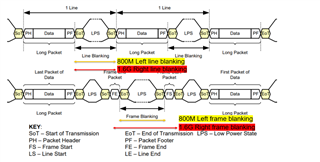
Thanks for you detail feedback. Just illustrate the in below picture, please help confirm it is correct or not?

If it is correct, why only frame blanking increase and line blanking keep same?
Thanks
Best regards,
David
Dear David,
Yes, the above image is correct. Because the line time stays constant, you will not see an increase in the line blanking. Instead, you will see an increase in the vertical blanking.
I hope this answers your questions. If you have any additional questions, please reference the MIPI CSI-2 datasheet.
What FPD-Link product are you using? If you have application specific issues, we can help to solve them. This will allow me to provide more specific information to your application.
Very Respectfully,
William Yi