This thread has been locked.

If you have a related question, please click the "Ask a related question" button in the top right corner. The newly created question will be automatically linked to this question.

TCA9617A: do we have higher VOL (>0.6V)device than TCA9617A

Part Number: TCA9617A
Other Parts Discussed in Thread: TCA9803

Hi Team,


my customer is using TCA9617A as the I2C level shifter.


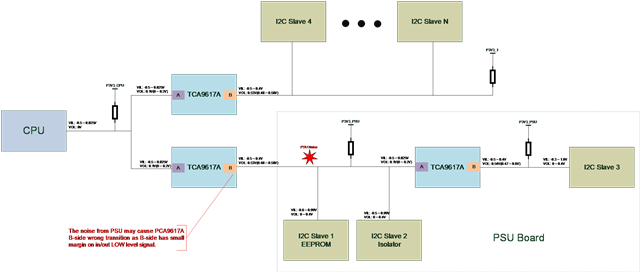
But we met one issue: There is big noise on B side from the slave side, and during the A -> B transition(I2C write), the B side Vol(~0.55V) will be dropped to be below than 0.45V due to the noise, which cause the TCA9617A does the B -> A transition, but actually it is A -> B transition.

This wrong direction transition causes the I2C bus stuck, 2 clks missed on the level shifter A side (master side).

So, here I have below questions:

  1. Please check if we have other level shifter parts that have higher B-side Vol voltage.
  2. Please check if Twe have the similar issue on TCA9617A and how we fix the issue.

 thanks very much!

  • Hey Kelly,

    Given the current info- it seems that their system noise may be violating the requirement of VILC when driving a low signal from A to B side. Note that the driver on B side will drive a low as soon as the signal dips to 0.4V.

    Does the customer have any waveforms on the noisy signal from B side as well as the schematic that they can share to further debug this issue? 

    Regards,

    Jack 

  • A level shifter with an entirely different architecture like the TCA9803 might help, but it supports only 400 kHz.

    But no level shifter can protect against noise that looks like a valid signal. In general, if you have an I²C noise problem, you have to add low-pass filters to the I²C lines, and reduce the signal frequency so that only the noise is filtered out. (Alternatively, make the software error tolerant, but this might not be possible.)

  • so can we keep using TCA9617A but swap A & B side and let A side to face this noisy signal? as both side is powered by 3.3V?

    below is the structure, can you help check whether this can work? thanks.

    before:

    after:

  • You can try, but I doubt that this will prevent all noise issues. If the noise is large enough, it will be propagated to all bus segments.

  • Hey Kelly,

    Is the customer able to capture any waveforms of the I/O? 

    Regards,

    Jack