We have excessive inventory of SN65HVD251QDRQ1, is there a way of using them as replacement for RS485 transceiver?
(They will be mixed with other RS485 transceivers on the same bus, but the speed of the line won't exceed 115K.)
This thread has been locked.
If you have a related question, please click the "Ask a related question" button in the top right corner. The newly created question will be automatically linked to this question.
No, CAN is a totally different protocol. Thomas
We are thinking of using the SN65HVD3085 RS-485 transceiver with our CAN controller. That should be possible, correct? I've read that connecting the input to DE and grounding D should make it possible. I just haven't been able to make it work. Any suggestions?
Switching the driver frequenctly from disbale to enable and back requires longer transition times than if the drivere were enabled and one just changes data from low to high. For exact timing values refer to the data sheet. There you can see how long it can take the driver to turn from high-impedance low-impedance state.
Also a CAN transceiver has internal resistors connecting to Vcc/2 potential. For an RS-485 transceiver you would have to add those externally and by doing so you probably modify the internal biasing of the receiver.
I have seen this type of applications and noticed the data rates to be extremely slow (I guess due to the long transition times between high-tand low-impedance states).
Unfortunately we don't have application information for this operation mode because we design CAN transceivers for this type of operation.
Sorry,
Thomas
Okay Areej,
you have made me curious again and against better judgement I need to know.
1) I'm assuming you are terminating the bus with 120 ohms at each end so that your differential impedance is 60 ohms.
2) Measuring at the bus terminals of the HVD3085 with D = 0V:
In the Off-state (DE = LOW) you should measure around 2.2V to 2.4V at the A and B terminals; in the On-state (DE = High) around 1.7V at B and 3.3V at A .
3) Comparing the timinng between a true CAN transceiver and a HVD3085 CAN substitue:
HVD251 Differential Output signal rise time = 80ns (for Rs=0), 150ns (for Rs=10k), 950ns (for Rs=100k)
HVD3085 High-Z to High/Low level output = 1000ns ! ! !
HVD251 Differential Output signal fall time = 80ns (for Rs=0), 150ns (for Rs=10k), 950ns (for Rs=100k)
HVD3085 High/Low level output to High-Z= 60ns ! ! !
These values are taken from the data sheets. You see that the Enable time of the HVD3085 is extremely long and requires slow CAN timing .
I hope this helps.
Good luck,
Thomas
Wow, thanks Thomas! No, I am not terminating the bus with 120 ohms. Right now I have the TX_CAN line connected to DE, D connected to ground, RE connected to ground, RX_CAN connected to R, and outputs A and B connected directly to the other RS-485 transceiver. Doing some more research online, I apparently also need pull-up and pull-down resistors? Where exactly and what values?
I really appreciate it!
Areej
I'm also trying to use a RS485 transceiver for CAN Bus.
Arrej did you finally solve the problem?
Are you using pull-up and pull-down resistors? And don't you need to invert the Input of Driver Enable?
Thomas
Thomas,
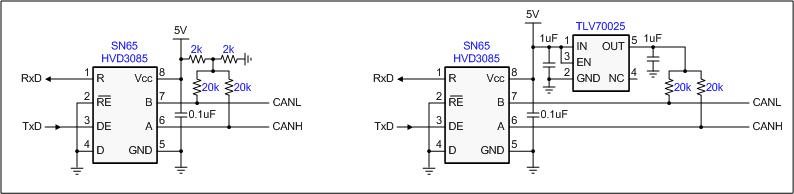
in general you connect D and /RE to ground. The driver enable pin ,DE, becomes the data input. The A and B lines must be connected via pull-up resistors to a 2.5V (Vcc/2) potential. You can create this potential via a resistive voltage divider as shown in the left circuit. you must ensure that the current through the divider is ~10-times the load current, hence the factor 10 difference in resistor values. Or you can use a low-cost 2.5V regulator as shown in the right circuit.
Hoe this helps. Regards, Thomas K.

Thank you for the quick answer and circuit.
I guess for transmitting the circuit is working, but isn't there a problem detecting (with the RS485 resceiver) the bus state?
If the state is recessive, CANL and CANH is at same level, VCC/2, A - B = 0V (ideal) and for that level the resceiver output is indeterminate.
Did you test this circuit, is it working?
Thank you
Regards, Thomas Z.
Yes, this was my little fault. The/RE pin was supposed to be connected to high to disable the receiver, as the design was meant to be a driver-only function.
For a receiver-only function you can do similar handstands but the amount of external componnets required increases.
At the end there is a reason for the development of dedicated CAN and RS485 transceivers.
TK-out