This thread has been locked.

If you have a related question, please click the "Ask a related question" button in the top right corner. The newly created question will be automatically linked to this question.

TUSB216: How to set BOOST Level ?

Part Number: TUSB216
Other Parts Discussed in Thread: , TUSB215

Hi expert,

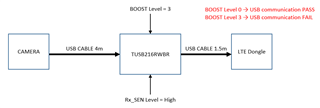
I am using the TUSB216RWBR as shown in the diagram.
Connecting a 4m camera and a 1.5m LTE dongle to TUSB216.

In this state, communication passes at BOOST Level 0, and communication fails at BOOST Level 3.
    BOOST Level 0 → USB communication PASS
    BOOST Level 3 → USB communication FAIL

■How do you calculate BOOST Level and RX_SEN ?
What is the optimal BOOST Level when using 4m and 1.5m cables ?
What is the optimal RX_SEN when using 4m and 1.5m cables ?

Please let me know.
  • Hi Takahashi-san,

    ■How do you calculate BOOST Level and RX_SEN ?

    Do you mean the values that these setting provide to the signal? We do not spec these values for most of these settings, however, there is some information for how much gain can be expected from the AC Boost portion of the BOOST settings:

    AC Boost at 240MHz (typ) 

    Boost 0: 3.0 dB
    Boost 1: 3.5 dB
    Boost 2: 4.7 dB
    Boost 3: 5.2 dB

    What is the optimal BOOST Level when using 4m and 1.5m cables ?
    What is the optimal RX_SEN when using 4m and 1.5m cables ?

    The best way to determine what settings are optimal for your setup would be to place the redriver into the system at its lowest settings, and measuring the signal with an eye diagram, seeing what sections of the eye need to be improved, and by how much. The settings needed to properly compensate for the loss in a system tend to be unique, making it hard for there to be settings that fit every situation. As such, I would recommend testing on your side to see what settings work best.

    In this state, communication passes at BOOST Level 0, and communication fails at BOOST Level 3.
        BOOST Level 0 → USB communication PASS
        BOOST Level 3 → USB communication FAIL

    Going by this, I would be inclined to believe that BOOST level 3 is causing your signal to overshoot, which is causing the signal to exceed the USB disconnect threshold, resulting in the host PC disconnecting the device. At BOOST level 0, the signal is likely open enough to not exceed the disconnect threshold while still passing the eye diagram test. It would be best to take an eye diagram of the signal that comes out of the redriver at BOOST level 3 and 0, and look at the different margins of boost that are being provided.

    Please let me know if you have any other questions!

    Thanks,

    Ryan

  • Hi, Ryan san
    Thank you for answering.

    I would like to ask you something additional.

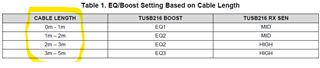
    About TABLE1 on page 4 of the document "TUSB216EVM User's Guide".

    ■Is this "CABLE LENGTH" the length of the Pre-channel? Or the length of the Post-channel?

    ■If the pre-channel is 4m and the post-channel is 1.5m, which length should I set the BOOST to?

    Thanks,

    Takahashi

  • Hi Takahashi-san,

    ■Is this "CABLE LENGTH" the length of the Pre-channel? Or the length of the Post-channel?

    This cable length is pre-channel.

    ■If the pre-channel is 4m and the post-channel is 1.5m, which length should I set the BOOST to?

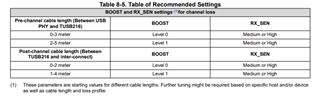
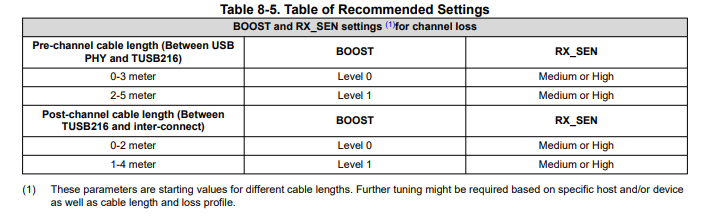
    These settings are somewhat dependent on the system, cable length, and loss in the system. However, on the TUSB216 Datasheet, we do have some general guidelines for starting settings based on the pre and post-channel length.

    These settings should be a good starting point for testing with the device.

    Please let me know if you have any other questions.

    Thanks,

    Ryan

  • Hello, Ryan
    thank you. I understand that Table 1 in the evaluation board documentation is pre-channel.
    I would like to ask an additional question regarding the evaluation board data sheet.
    ■What is the expected cable length range for the post channels corresponding to each pre-channel in Table 1?
    thank you,
    Takahashi

  • Hi Takahashi-san,

    ■What is the expected cable length range for the post channels corresponding to each pre-channel in Table 1?

    There is no expected post-channel length, as the distance after the redriver is used can very depending on use, such as if the redriver is placed between the host and the device, if the redriver is places at the connector of the device, or if the redriver is placed at the connector of the host.

    In reference to this first table you posted, depending on the cable length and drive strength of the host, I believe a max post-channel cable length would be 4 meters, with anything exceeding that needing another redriver on the end of the post-channel.

    Please let me know if you have any other questions.

    Thanks,

    Ryan

  • Hello, Ryan-san
    thank you.

    I saw the following thread on the TUSB216 forum.
    e2e.ti.com/.../4671554

    >TUSB216 supports 8m cable length at HIGH DC Boost as the table above, but maximum post-channel is 3m 28AWG. If the post-channel is longer than 3m, it doesn't support the compensation. It is matched your test status between 4m cable and 3m cable of post-channel.
    >4m pre-channel + 4m post-channel = 8m -> Failed
    >4m pre-channel + 3m post-channel = 7m -> Passed
    >5m pre-channel + 3m post-channel = 8m -> Passed
    >To clarify, the cable length must be less than 5m 28AWG of pre-channel and 3m 28AWG of post-channel at HIGH DC Boost. If one of channel is longer, the compensation would not be provided.
    >Best,Josh

    From the above, I'm thinking that when you have 4m connected to the pre channel, the post channel is at max 3m.

    In the first diagram, 4m is connected to the pre-channel.
    Does your previous answer mean that the post channel cable length can be 4m?

    When 4m is connected to the pre-channel, which is the maximum length of the post-channel, 4m or 3m?

    Best regards,
    Takahashi.

  • Hi Takahashi-san,

    In the first diagram, 4m is connected to the pre-channel.
    Does your previous answer mean that the post channel cable length can be 4m?

    Yes, depending on the system, a max post-channel length of 4m should be possible, however, this is the the farthest it can support, and it would be likely that at this great a distance, the signal quality would likely diminish back down to the point of needing a redriver. As such, the closer the redriver is to the device, the stronger the signal will be. 

    Looking at the first diagram you posted, that setup should be sufficient, and going by the test results you posted with it, you should be fine at boost level 0 or level 1.

    Also, please not that the table listed on that previous E2E thread is for up to the TUSB215, and does not include the TUSB216 in it. As such, I believe this table should not be counted as applicable to the TUSB216.

    When 4m is connected to the pre-channel, which is the maximum length of the post-channel, 4m or 3m?

    With a 4m pre-channel, a max cable length of 4m should be applicable to the post-channel length, though again, keep in mind that at the max post-channel length, it is possible that a redriver will be needed at the end of the post-channel cable if there is still a greater distance that needs to be covered.

    Please let me know if you have any other questions.

    Thanks,

    Ryan

  • Hi, Ryan san

    Thank you for answering.

    I have another question regarding the maximum length of TUSB216.

    ■Can the combination of 4m pre-channel and 3m post-channel be applied to TUSB216?

    ■I would like to use a 4m cable for the pre-channel, and 1.5m, 2m, 2.5m, and 3m cables for the post channel. Please tell me the recommended settings for RX_SEN and BOOST in that case.

    ■Please tell me the maximum length that does not require a redriver at the end of the post channel.

    ■Is there any material that shows the difference in specifications between TUSB215 and TUSB216?

    Thanks,

    Takahashi

  • Hi Takahashi-san,

    ■Can the combination of 4m pre-channel and 3m post-channel be applied to TUSB216?

    Yes, this should be a setup where the TUSB216 would be applicable.

    ■I would like to use a 4m cable for the pre-channel, and 1.5m, 2m, 2.5m, and 3m cables for the post channel. Please tell me the recommended settings for RX_SEN and BOOST in that case.

    These settings can depend based on a few factors, such as the driving strength of the host, number of connectors in the path, and noise/jitter.

    I would recommend starting with boost level 1 and RX_SEN at medium, and then seeing from there if the signal needs further improvement. As the cable length gets longer, it becomes more likely that Boost level 2 or even 3 may be necessary.

    ■Please tell me the maximum length that does not require a redriver at the end of the post channel.

    The max length for a USB2 signal without a redriver is spec'd at 5 meters, while with a TUSB216 redriver placed at the connector, we spec it as 4 meters past the redriver as the max.

    ■Is there any material that shows the difference in specifications between TUSB215 and TUSB216?

    We do not have any official documentation comparing the TUSB215 to the TUSB216. Some key differences to highlight between the two, however, are that the TUSB215 and TUSB216 are NOT pin-to-pin compatible, the TUSB215 does not have any form of RX_SENS ISI compensation, and that the TUSB215 layout does not allow for a short under the data lanes, while the TUSB216 does.

    Please let me know if there are any other questions!

    Thanks,

    Ryan

  • Hi Takahashi-San, 

    Is there any follow-up to this thread? If not, then I will go ahead and mark it as resolved.

    Thanks,

    Ryan