This thread has been locked.

If you have a related question, please click the "Ask a related question" button in the top right corner. The newly created question will be automatically linked to this question.

SN65LVDS050: MLVDS

Part Number: SN65LVDS050
Other Parts Discussed in Thread: SN65MLVD040

We are currently using LVDS to connect two devices.
It is a point-to-point communication system.
In addition, we are planning to develop a new system.
We are planning to use MLVDS in newly developed systems for several reasons.
In that case, it is necessary to communicate correctly even when the existing system and the new system are combined.
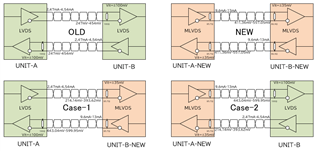
The following combinations can be considered:
In my opinion, we can communicate without any problem.
Distance is 5m, clock speed is 20MHz
Are there any issues with this mixed LVDS and MLVDS system?
  • Hello Osamu,

    Yes you would be correct. There isn't much of a problem mixing LVDS and M-LVDS.

    Just a few notes:

    1) When using LVDS → M-LVDS then make sure the M-LVDS device has a Type 1 receiver. If using a Type 2 receiver then your output will always be Low. 

    2) When using M-LVDS → LVDS, we need to make sure the output differential voltage of the M-LVDS device doesn't exceed the maximum input differential voltage, |VID|, of the LVDS receiver. Some LVDS receivers have a VID of 0.6 V. If the output of the M-LVDS is too high, then using a double termination scheme will reduce the amplitude in half.

    Regards,

    Josh

  • Joshua,
    Thank you very much for your reply.
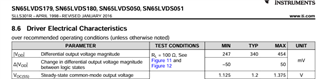
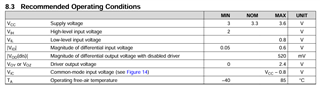
    According to the data sheet of the SN65LVDS050 that we are currently using, the VID is max 0.6V as shown below.

    In the case of M-LVDS->LVDS, what kind of problems can be expected if the voltage exceeds max 0.6V?
    I think Case-1 and Case-2 in the images I attached when asking the question apply to this case.
    What is a double termination scheme?
    Could you please tell me more details?

  • Hello Osamu,

    If the voltage exceeds 0.6V then we cannot guarantee the values for each parameter since all parameters are captured based on Section 8.3 Test Conditions.

    Double termination is when you have two termination resistors on the LVDS bus. Similar to what you have on Case-2.

    Regards,

    Josh

  • Joshua,
    Thank you very much for your reply.

    I understand that the VID can be lowered by using your suggestion of double termination.
    In that case, is it okay to set both resistance values to 100Ω like in case-2?
    Or should I choose a resistance lower than 100Ω?

    My understanding is that the impedance becomes 50Ω from a parallel 100Ω resistor, and the voltage driven at 11mA at that time is 550mV.
    Is this the typical drive voltage of the MLVS driver?

    If my understanding is correct, the drive voltage of the driver is 650mV for a 50Ω load impedance, which means that the current is 13mA.
    I think that in order for VID not to exceed 0.6V, the load resistance must be 46.15Ω at the drive current is maximum 13mA.
    In that case, I think the two terminating resistors must be less than 92.3Ω.
    Is this correct?


  • Hello Osamu,

    The output current on M-LVDS drivers ranges around 11 - 13 mA. For a worst case scenario let's assume the output current is 13 mA.

    Since the input of LVDS/M-LVDS receivers are high impedance, all the current goes through the termination resistor. At this point it's Ohm's Law to calculate the VOD. You are correct, when we have a double termination scheme, the effective resistance is the parallel of the two resistors.

    If the goal is VOD ≤ 0.6 V, then R = 0.6 V / 13 mA = 46.15 Ω. Using the double termination scheme will result in a resistor of 92.3 Ω at each side. 

    Regards,

    Josh

  • Hello Joshua,

    Thank you for your detailed explanation.
    I understood the basic theory.

    I assumed each drive current from the data sheet as follows.

    I_Drive_LVDS=2.47mA - 4.54mA
    I_Drive_MLVDS=9.6-13mA


    As I explained below in my first post, I am concerned about compatibility issues with existing systems.

    >>We are currently using LVDS to connect two devices.
    >>It is a point-to-point communication system.
    >>In addition, we are planning to develop a new system.
    >>We are planning to use MLVDS in newly developed systems for several reasons.
    >>In that case, it is necessary to communicate correctly even when the existing system and the new system are combined.

    This is because existing LVDS systems already use terminating resistor of 100Ω.
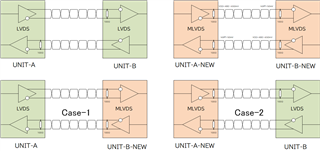
    Therefore, when connecting new M-LVDS unit to existing LVDS unit with 100Ω termination, we believe that the termination resistance on the M-LVDS side must be 85.7Ω or less in order to comply with the VOD ≤ 0.6 V constraint.

    The connection will be as shown below, is there any problem?


  • Hello Osamu,

    One quick note:

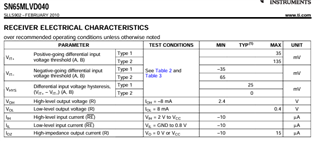
    For M-LVDS interfacing with M-LVDS, you don't need to use a double termination scheme since M-LVDS receivers can support higher input voltages. For example, if we look at the SN65MLVD040 datasheet, it says VID can support up to VCC.

    Double termination should only be used when interfacing M-LVDS → LVDS. This can save you a couple of resistors.

    Otherwise the diagram looks good!

    Regards,

    Josh

  • Hello Joshua,

    Thank you for your support.
    I really appreciate your various advice.