This thread has been locked.

If you have a related question, please click the "Ask a related question" button in the top right corner. The newly created question will be automatically linked to this question.

DS90UB928Q-Q1: Problem of Serial Link Fault Detect

Part Number: DS90UB928Q-Q1

Hello,

In the datasheet, we have this part of specification

But when I do the test of RIN+ short to the GND, I read the register at address 0x1C, I have the same value of 0x0B even without the Short-Circuit.

Normally, like described in the datasheet, the bit 0 of the register has to be low ('0') when I have the signal RIN+ short to the GND.

Best Regards,

Camille HUYNH

  • Hello 

    During our testing, only the use case n°1 : OC is detected

  • Hi Camille,

    I will test this in the lab and get back to you by tomorrow. Also, did you test this on a custom board or a TI EVM? And which serializer are you using this with?

    When you tested this, was LOCK pin probed continuously? Also, was the short to RIN wire right at the RIN pin?

    Best regards,
    Ikram

  • Hi Ikram,

    We test the 928 on our custom board and it is connected to a TI EVM 929.

    Yes, the LOCK pin is continuously probed by our software.

    The short to GND is directly done just before the capacitor on the RIN pin.

    Best Regards,

    Camille HUYNH

  • Hi Camille,

    I tested this, and each time the LOCK does drop when shorted to ground. A few more questions:

    - Is there a way you could manually probe the lock pin with an oscilloscope or maybe even a DMM? Is it possible the software is not picking it up?

    - Could you share the LOCK portion of the schematic or tell us how the network is, between LOCK pin and SoC?
    - Are you continuously shorting it? Or is it possible that between the polling, you are releasing the wire and it is not picked up by the software?

    - Is there an MCU on the DES (928) side that you are using to read these registers? Since lock is lost, you cant read it via I2C from the SER
    - Could you check the 0xC registers on the 929 for link or lock lost flags. And CRC errors on registers 0xA- 0xB.


    Best regards,
    Ikram

  • Hello Ikram,

    I have done the test again with a probe directly on the LOCK.

    With the probe of lock pin with an oscilloscope, we have this behavior :

    The RIN+ signal is continuously connected to the GND.

    We can see that the Pin Lock is not permanently down, I think it's why the software can't read exactly the right value of the LOCK.

    The signal Lock is directly connected to the MCU on the schematic.

    The Read is done from the DESER part and not by the USB of the Evalboard SER.

    Is it a normal behavior from the component ?

    Best Regards,

    Camille HUYNH

  • Hi Camille,

    If LOCK is not down, that might indicate that the wire from RIN+ to ground might now be a strong connection. Could you also probe there to check if it's actually shorted to ground the whole time?

    Like I mentioned, we dont see this issue on the TI EVMs. Also, are you testing this on one board, or have there been multiple instances of this?

    Best regards,
    Ikram

  • Hello Ikram,

    I have probe the RIN+ and it's permanently shorted to the Ground (Blue signal).

    See the followed screenshot : 

    I have tested on one board but I have others colleagues who have tested on another board and they have the same behavior.

    Best Regards,

    Camille HUYNH

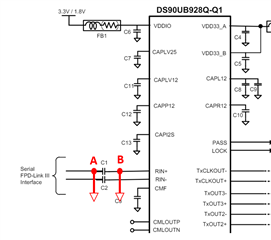
  • Hi Camille, just to clarify, are you shorting using wire at point A or B?

  • Hello Ikram,

    I'm shorting the wire at point A.

    Best Regards,

    Camille HUYNH

  • Hi Camille,

    Lock is dropping occasionally indicating the serial link fault. If you have a differential (STP) connection, then the deserializer might be recovering PLL lock, and that's why LOCK is not low throughout. 

    You could consider having the LOCK connection to SoC as an interrupt so it can be detected.

    Also, could you please check the 929 0x0C General Status register Link Detect and Link Lost bits. The Link Lost flag and CRC Errors (0xA and 0xB) can be used to detect when the link is lost due to the fault.


    Best regards,
    Ikram

  • Hello Ikram,

    We need for our system at least 500ms of the low status for the stability of the product.

    Today, the DESerializer can't provide us this function.

    We can't use the check from 929 because our product only focused on the 928 part.

    Is there another solution about that ?

    Best Regards,

    Camille HUYNH 

  • Hi Camille, is there a way to trigger an interrupt on the SoC if the LOCK pin goes low? Are you using this in coax single-ended or differential STP? 

    - Ikram

  • Hello Ikram,

    Even if we have a possibility to trigger an interrupt from the SoC if the Lock pin goes low, we won't have the time of minimum 500ms for this status. So it's not a solution for us.

    We used the differential STP.

    So the component can't guaranteed the function of detection of the Serial Fault Link Detect except for the absence of cable ?

    Best Regards,

    Camille HUYNH

  • Hi Camille, I am checking this with the team to get back to you. 

    Regards,
    Ikram

  • Hi Camille,

    We tested this and we found that you can use the 929 Link Lost register 0xC[4] flag to detect any momentary loss of LOCK/ Link.

    1. When there is a continuous LOCK drop (such as an OPEN cable), the LOCK pin, and 0x1C register on 928 can be used to detect the fault. Also, there will be a loss of I2C communication to the SER

    2. When there is a momentary loss of LOCK: after enabling I2C passthrough (so the deserializer-side MCU can read the SER and DES), you can read the SER 0x1C[4] flag to detect that there was a momentary loss of lock.


    Please let us know if this solves the issue for your case.

    Best regards,
    Ikram