This thread has been locked.

If you have a related question, please click the "Ask a related question" button in the top right corner. The newly created question will be automatically linked to this question.

SN75LVPE5421: MUX's post channel length need match or maximum difference?

Part Number: SN75LVPE5421
Other Parts Discussed in Thread: SN75LVPE5412

Tool/software:

Hi Team,

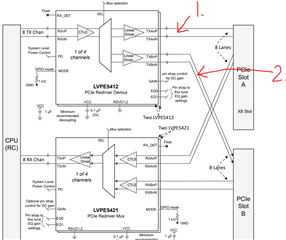
Customer would like to know the post channel of MUX, the maximum length difference between 1 & 2 can be?  In the Pin strap mode and I2C mode will have different result?

Or the length between 1 & 2 should be keep the same as possible ?
Thanks!

BR, Kai

  • Hi Kai,

    We don't have specific guidelines on the length differences between differential pairs in the redrivers (within differential pairs, we strictly recommend length matching between P/N to be clear). In this case it seems like the question is about port A (#1 in diagram) and port B (#2 in diagram)?

    Small differences that can be measured in mils should not be a problem, this length difference does not directly affect the device and in general, PCIe TX/RX can detect and compensate for timing skew between channels/lanes. The only potential problem I can imagine is if the length difference (and therefore insertion loss) of port A compared to port B is extreme to the point that each port needs a different EQ setting - in this case it may be necessary to use I2C mode because pin mode does not have as much flexibility in programming and adjusting EQ. However, I don't think I have ever seen this problem in a customer application before.

    Is there some factor in the customer's project that motivates this question?

    Best,

    Evan Su

  • Hi Evan,

    Sorry let me correct my questions again.

    1. Group A (TXAn_P/N) will have 4Ch,  Group B (TXBn_P/N) will have another 4Ch, the longest of group A and shortest of group B can have how many inch different maximum  inch ? Or we should keep no matter which Ch in those all Ch in the same length?
    2. If Group A (TXAn_P/N) average have 7 inch length and group B have average have 10 inch length, is that acceptable? Or in this case we will recommend the I2C mode since we may need different EQ with different group?
    3. If there is no redriver(only passive mux) in design an the total loss below 36dB, then customer will no need to care about the group A / B each Channels length difference right? Since the CPU will auto compensation by link training preset? 
    4. Follow Q3, if in this case the total loss below 36dB, but customer still use our SN75LVPE5421/12 but set the EQ fix in the lowest EQ index0(pin strap mode), is it fine?
      Can the CPU still ok to compensate the different group A/B length?
    5. If the system loss have confirm over 36dB, so in this case use our SN75LVPE5421/12, then in this case, they need to care about the different group A/B length right? This question should similar to Q1

    BR, Kai

  • Hi Kai,

    Group A (TXAn_P/N) will have 4Ch,  Group B (TXBn_P/N) will have another 4Ch, the longest of group A and shortest of group B can have how many inch different maximum  inch ? Or we should keep no matter which Ch in those all Ch in the same length?

    As I mentioned, we don't have specific guidelines on the length so I can't say what amount of difference would start to become concerning.

    If Group A (TXAn_P/N) average have 7 inch length and group B have average have 10 inch length, is that acceptable? Or in this case we will recommend the I2C mode since we may need different EQ with different group?

    7 inches compared to 10 inches is probably around 3-5 dB of difference in insertion loss in the two paths, which is not considered a large difference. As I mentioned, we have not seen any actual customer project yet where there has been a problem with each group needing different EQ settings, so based on this information I would not be concerned yet.

    If there is no redriver(only passive mux) in design an the total loss below 36dB, then customer will no need to care about the group A / B each Channels length difference right? Since the CPU will auto compensation by link training preset? 

    Yes, 36 dB compensation is required by the combination of the CPU and EP behavior if I remember correctly.

    Follow Q3, if in this case the total loss below 36dB, but customer still use our SN75LVPE5421/12 but set the EQ fix in the lowest EQ index0(pin strap mode), is it fine?
    Can the CPU still ok to compensate the different group A/B length?

    Yes.

    If the system loss have confirm over 36dB, so in this case use our SN75LVPE5421/12, then in this case, they need to care about the different group A/B length right? This question should similar to Q1

    Based on my understanding, not necessarily. Maybe in an extreme case where one path has very high insertion loss and the other path is only slightly greater than 36 dB, the different group length would need to be considered. But in an average case where the SN75LVPE5412/421 only needs to perform a small to medium amount of EQ in both paths, then the redriver can operate at a fixed setting that is appropriate for the longer path. When the mux is switched to the shorter path, the new link is initialized and the CPU and EP should just apply less of their own TX/RX signal conditioning during automatic negotiation (basically, they should not work as hard) and the signals should be fine.

    Best,

    Evan Su

  • Thanks, Evan.

  • No problem. I will close this thread now, you can post a new reply if there are further questions.

    Best,

    Evan Su