This thread has been locked.

If you have a related question, please click the "Ask a related question" button in the top right corner. The newly created question will be automatically linked to this question.

THVD8000: Airfield Communication

Part Number: THVD8000
Other Parts Discussed in Thread: THS6222, THVD8010

Tool/software:

Based on application note SLLA590, can the THVD8000 communicate reliably over a 120/240 VAC power line that can extend to 3000 feet ?

My application requires communicating with up to 22 lighting control cabinets in an airfield environment.

Thanks in advance for any help !

  • Hi Dean,

    So it is highly variable with how the system is setup - 3000ft is not generally out of the question - but it really will depend on multiple factors - namely effective impedance as seen by driver, cable properties of the shared power/data line (capacitance and DCR mainly), the effective impedance of the transformer separating communication node from shared bus, modulation frequency, if the system is pseudo-differential or true-differential,  and how noisy the environment is.  

    In these high voltage applications the THVD8000 isn't acting as the driver (THVD8000 requires an RS-485 bus setup to be used without additional line driver and for high voltage systems like a 120VAC system is not realistic - as to why we add the additional line driver) - it is acting as the modulator and receiver while  the THS6222 is the actual driver and does limit the max length more so than the THVD8000 (THVD8000 is very sensitive so signal swings don't have to be that large) 

    To maximize distance the general trend is to:

    1. Choose lowest modulation frequency possible for data rate - max suggested data rate is modulation frequency / 10. 125KHz is the lowest modulation frequency possible (allows up to 12.5kbps of a data rate) and will minimize most AC losses across the line and then you really only need to worry about the insertion loss over the transformer and DCR of the cable.

    2. Choose a power cable that has a low DCR - shielded cable is also a nice thing to have - but often not used due to cost so it isn't required. 

    3.  Employ noise filtering on the communication nodes (SLLA590 shows how this should look)

    4. Use a true differential setup - SLLA590 uses a Pseudo-differential setup - the design guide for our reference design here: https://www.ti.com/tool/PLC010935BP does show a true differential setup (the reference design says its for solar inverters - but in reality it is our generic THVD8000 + THS6222 Guide for High Voltage (AC or DC) / Low Effective impedance busses. Essentially design is basically the same except you run both outputs of the THS6222 to the transformer. 

    With all that being said - it is really hard to say "yes 3000 feet is easily achievable" because there are multiple factors that can impact that bus length - but in general I am not that concerned with lower modulation speeds up to around 4000 feet / 1.2km - however there is a lot of variability so I wouldn't guarantee it - but I do think it is potentially possible depending on system. 

    Please let me know if you have any other questions and I will see what I can do. 

    Best,

    Parker Dodson

  • Hi Parker,

    Thank you so much for your expertise. Your information is very helpful. We will be using the THVD8000/THS6222 to supply a 2Hz synchronization signal to the lighting cabinets. We are planning to do the actual communication via an ST7580 PLM. I'm a little concerned about interference between the 2 devices even though their carrier frequencies are different. I guess as long as they are not integer multiples of each other we should be ok ? At such a low rate, will 3000 feet be more likely to succeed ?  I have no idea what the characteristics of the power lines are, I'm sure they differ from airport to airport even though the physical installations should be similar. This is a stupid question but would it be worthwhile going to a few sites and try to characterize the impedance of a few installations ? There are huge issues when it comes to messing with a live system on an active runway.

    Any additional guidance is welcome.

    Regards,

    Dean 

  • Hi Dean,

    So having multiple frequencies on the line could be challenging because the internal bandpass filter on the THVD8000 is not very selective - this is partially due to the part being cost effective and that the modulation frequency does have a +/-25% tolerance. So to achieve the multiple frequency bands on the same line I would highly suggest to have as much space between the THVD8000 modulation frequency on the other communication signal - if you are using a 125KHz modulation frequency (which for a 2Hz sync signal I would imagine should be sufficient) I would highly suggest something in the 10s of MHz (1 or 2 MHz may still cause false detections - but it is much less likely) - also I would highly encourage that the optional bandpass filter external to the THVD8000 is not skipped over - it should be implemented - and it may be worthwhile to add another stage to it to help filter any non OOK signal from the node. 

    Yes you would have the best chance of maximizing distance by using the lowest modulation frequency - in a standard application 125KHz can go up to 1500m which is past 3000ft - however that is on a standard "RS-485" type bus setup which doesn't have the issue of insertion loss over the transformer - as that is my main concern. Essentially how the bus "looks" from the driver point of view - a lot of power busses can be approximated at like 5 ohms - it does depend on the specific system though  - but in general it is pretty low. We have tested driving down to 1 ohm loads without much issue (the power usage in the line driver can be pretty large though). Based on our test that we did with 110 VAC - we were getting about 1/4 (~8Vp-p originally down to about 2Vp-p) of the signal at the reception end of the bus at 125KHz (figures 5-5 through figures 5-9 in SLLA590) - and this test was mainly looking at insertion loss - but it didn't characterize cable as our cable, while probably pretty standard power cable, was only about a foot long. If the only real thing requesting the high frequency current is the receiver than the current for the comm signal would be pretty low - which would lead to lower losses. The good news is that power cable usually has a pretty low DCR - so I don't think 3000 feet is out of the question with the low effective data rate that you need - but it will depend on the insertion loss of the transformer.

    I don't know how worthwhile it would be try to characterize impedance at each site - a lot of power cable is not impedance controlled so it could be a lot of different things and having a measurement at one doesn't necessarily impact the measurement of another. The big thing is - what is the effective impedance as seen by a 125KHz signal - this is less about the cable (DCR would be nice to know - so resistance per unit length - but realistically on power cables it is lower than standard RS-485 cable typically so I am not super concerned here) - but more what is requesting the current from the main voltage source - as the OOK current is what impacts insertion loss - so knowing how the power is distributed and what it loads look like - i.e. is there filtering that would make it look higher impedance to a 125KHz signal etc... 

    I know that this is kind of a non-answer - and I apologize for that - but the reality is there is a lot of system parameters that affect how this subsystem works - and the biggest one here is the effective impedance as seen by 125KHz signals - generally the AC losses will most likely be pretty minimal and DCR from cable would be the biggest impact from the cable point of view - but how the system looks - with all of its loads - as an impedance would be a necessary thing to understand. Essentially lets says that under normal conditions it is 120VAC and the loading is about 5A so like 20 ohms of impedance- is the loading still 5A if we move from 60Hz to 125KHz - as the effective current draw at a higher frequency is what sets the bus impedance as seen by the driver - and what is going to really determine insertion loss into the system. 

    Please let me know if you have any other questions and I will see what I can do!

    Best,

    Parker Dodson

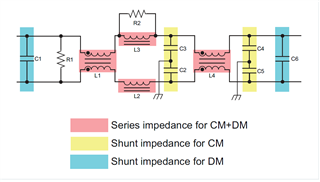
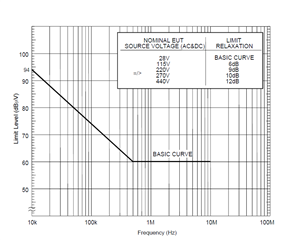
  • Hi Parker ! Thanks again for all the great information. As far as modulation frequencies, the ST7580 carrier frequencies range from 9kHz to 250kHz so a 125kHz modulation frequency could be a problem. The ST7580 has two basic modulation modes, FSK and several PSK modes. Perhaps the PSK modes would be less of an issue ? Also, would there be an advantage to using active bandpass filters vs passive ? When you talk about transformer insertion loss does that apply only to the coupling transformer ? From the installation schematics I've looked at, there are no distribution transformers involved. In regards to impedance of the AC line, each of the (up to) 21 lighting control cabinets has transient/surge line protection followed by a MIL-STD-461 CE102 compliant conducted emissions filter. I don't have a schematic of the actual filter but the image below, I believe, is a good representation. I got this from a Vicor app note. I will reach out to the manufacturer of the filter we use to get more information.

    Below is the CE102 limits table.

    I'm hoping that the filter will provide adequately high impedance at the modulation frequencies.

    I will have to do more research to get an idea of what the peak/average current looks like. The lighting cabinets control low voltage xenon flashing lights. I'm sure you have seen them at major airports. They are part of a larger lighting system called ALSF-2. I'm also wondering how adding these frequencies will affect CE102 compliance since their voltage levels will range from hundreds of millivolts to volts.

    Any additional feedback would be greatly appreciated.

    Regards,

    Dean Munson

  • Hi Parker,

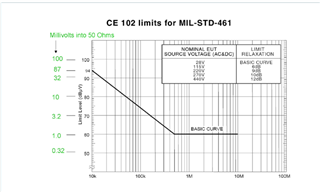
    This table has a translation from dBuV to Millivolts. It's from the same app note.

  • Hi Parker,

    I talked with my FAA Liasson and he said there is no requirement for the power line communication to meet CE102 so one less thing to consider. 

  • Hi Dean,

    So since the STM device is working in a lower frequency band - it does complicate things. 

    From our best understanding you can think of the main passband of the THVD8000 set to 125KHz to be approximately between 60KHz and 270KHz - so anything in that range has a chance of being detected by THVD8000 when set to 125KHz (THVD8000 is very sensitive) - this also isn't a guarantee - but based on simulation of the design so actual silicon could be slightly different as this spec. wasn't directly defined like our published specifications in datasheet. 

    Generally PSK can use less bandwidth than FSK - but if there is signal between 60KHz and 270KHz (Quality factor ~0.59 - this should be pretty constant across modulation frequencies) it will have the potential to be detected regardless of modulation technique from the other power line communication setup on the bus. 

    I would be worried to push to a higher modulation frequency as then the 3000feet would be much harder to meet - because there is pretty much no way to hit 3000ft / ~900 m at 1MHz modulation frequencies or higher - on a standard application we cap it to 750KHz for 900m - but standard application power cable most likely is less capacitive than higher voltage lines so AC losses could be greater on higher voltage bus's. However you'd probably need to be at least at 1MHz - but even then harmonics from other data on line could be detected. 

      For the standard EMI filtering that is on the power line - that is a pretty good indication that the bus will be seen as having a higher impedance for the OOK frequencies - most EMI filters are pretty good at removing the OOK data from further down stream. 

    In terms of emissions - we don't really have a large knowledge base around emissions for this device - it just generally hasn't been an issue that we have seen with this device.  In general we don't really consider this device to risky for radiated emissions because it is relatively lower frequency - but for conducted emissions our basic guidance is to add a EMI filter to the main power bus - similar to what you have shared already - as that generally will remove the vast majority of the signal - obviously it will depend on specific component values- but in general the architecture looks like what we suggest to help prevent issues with emissions. 

    Please let me know if you have any further questions and I will see what I can do!

    Best,

    Parker Dodson

  • Hi Parker,

    Thank you again for your feedback. I guess one last question, would active bandpass filters be a better option than the passives used in design guide TIDUF48A ?

  • Hi Parker,

    Another question: Can the modulation frequency be "tuned" by varying the FSET resistor ?

  • Hi Dean,

    The passive bandpass filter was chosen purely because it is generally cheaper to implement and it implements at least  ~50% reduction in all frequencies. Active bandpass filters generally, in my opinion are better, and you can make a 2nd order active bandpass without any inductors and generally still can implement a 0.5 gain at center frequency. The reason cost effectiveness was a major factor is because the THVD8000 is a very cost effective part when compared to other similar PLC type communication schemes - so we did want to limit the amount of silicon we included in our reference design - but it can be active or passive - in general I would probably lean towards active if no other reason exists to not consider it -  just because it is easier to avoid inductances and I generally don't like adding inductors unless absolutely necessary. 

    For your second question - yes you can "tune" the FSET resistors for a modulation frequency- but there is a pretty big caveat there and that is that there is a +/-25% tolerance on the modulator frequency at any given FSET value. 

    Using the table 8-1 from the data sheet we can draw a trendline that tracks pretty close the table value. 

    y = 7871.8 x^(-0.946)

    Where x is the FSET resistor value in kOhms and y is the frequency in kHz

    So for example this equation if we want to use a 77kOhm resistor that would be y = 7871.8 * 77^(-0.946) = 129kHz - 77k will give you 125kHz according to table 8-1 - so the regression isn't perfect but it is the best estimation that we have.

    So RFSET = (Fmod/7871.8)^(-1/0.946)  -> that will get you in the ballpark of designed value - but there is a 25% tolerance to consider as well. 

    That is why generally we advise just to use table 8-1 - but it is possible to tune the modulation frequency. 

    Please let me know if you have any other questions and I will see what I can do!

    Best,

    Parker Dodson

  • Hi Parker,

    So if I use a POT to adjust the frequency to what I want, will it drift 25% or is that wide tolerance have something to do with spread spectrum clocking ?

    In our products, production test procedures that include calibration procedures are common. This is the world of the FAA so the bottom line is functionality and reliability, not so much cost. If I can tune the modulation frequency to within a few percent of ideal using a low drift pot, then I can design very narrow band active bandpass filters that would help reduce the power line device frequencies from stepping on each other. What do you think ?

  • Hi Dean,

    So I did just check our simulations that we have for this specification - the 25% tolerance that we guarantee is conservative (as in you most likely will never see 25% tolerance from programmed value) - but there could still be a worst case of 10% to 20% of shift in vast majority of applications (across operating temperatures) and that isn't including the 30kHz spread spectrum - so even with a low drift pot - it would be hard to guarantee a  the frequency band within 10% to 20% (25% is the level we guarantee but that is very unlikely to occur (it is beyond our µ +/- 5σ simulation bounds - but that is simulation not silicon test)).  That is across temperature (-40C to 125C) - so it may not be as stark in this particular application as I'd assume that the lighting control cabinets are not getting to 125C - if I had to hazard a guess I'd imagine maybe it could reach half of that 125C if there is a lot of heat generation of the cabinets - this is something you probably would have a better guess on - but that could possibly reduce the tolerance of the modulator - however we don't have data that would be very helpful to that question- so any tighter control would have to be tested/qualified on your side - which understandably may not be an attractive option for you.  The one note I will add - that pot cannot go below 1.5k or above 77k - if it does you may cause the THVD8000 to enter undefined functional modes that are not OOK modulated (originally this device was going to be able to do standard RS-485 or OOK modulated RS-485  - the standard RS-485 doesn't work well so its not mentioned in datasheet because this part really shouldn't be used as standard RS-485)- but if the resistances are outside of the 77k to 1.5k range (with up to a  2% tolerance on resistors) - you could see extremely unexpected behavior. 

    As much as I'd like for you to try and test out the THVD8000 + THS6222 for this type of application because I still think there could be a chance that it would work well enough to satisfactorily meet the system goals - there is some significant risk that would have to be fleshed out in actual system testing and verification and I can't in good conscience tell you this is a complete slam dunk and will 100% guarantee work - I think there is a possibility it could - but my main concern is the other data stream on the bus and the large possible modulator output frequency tolerance - I will say there are a lot of different PLC technologies that are more precision focused than this one (pretty much every other PLC type - this is the one that I am most familiar with though by large margin)  - this part was originally designed for lower voltage HVAC based applications where precision is not the main concern (cost was though)- also this is why it is RS-485 based and unfortunately it retains the lack of precision that RS-485 in general also lacks. With the off-datasheet High voltage applications with the THVD8000 and THS6222 the main concern was "does it work" - but those tests were done assuming 1 data stream on the bus so the modulator tolerance wasn't as much of a concern from an application point of view.

    I am more than happy to help with any further questions you have - because as I said I don't think this is impossible, but I don't have enough data or known use cases to confidently say this will guarantee work and it would be understandable if you want to look at other options as well.

    Best,

    Parker Dodson 

  • Hi Parker,

    We do have a temperature chamber so we could sample a few parts. The temperature requirements are industrial (-40C to +70C). The flasher control cabinets are powered by 120/240 AC. Do you think placing the THVD8000 + THS6222 on one phase and the ST7580 on the other would help ? I guess there might be some capacitive coupling between the power cables but I can't imagine it would be much but I don't know for sure. The main reason we would like to use this method is that the original design uses two half-duplex RS485 lines, one for command/status and the other for the 2Hz. Keeping a similar arrangement makes it much easier to leverage existing MCU code. I would definitely like to try this approach but use a higher modulation frequency for the THVD8000. I was just looking at the receiver specs for THVD8010. Since the receiver is less sensitive, although the modulation frequency is limited to 300kHz, maybe it would be a better choice ? 

    Regards,

    Dean

  • Hi Dean,

    If you can test in a temp chamber that would be super helpful. 

    If it is a 3-phase power system - keeping signals on different phases would most likely work - the only caveat is that during installation the communication node is consistently placed on the correct phase (i.e. 2 Hz signal is always on A-B) - the only reason I bring this up is because I have seen 3 - phase applications with this part - but installation was always a concern that I had heard - if that concern is mitigated in this case then that would be a much better system setup since there are two different communication streams.  which could possibly interfere with one another. 

    The THVD8010 is much less sensitive so it does better in the face of a noisy environment - the reason I didn't recommend it is because you may need up to 1.3V for the received signal to be read - so the signal can handle way less attenuation before its unreadable - at 3000ft you may need the more sensitive receiver because of the attenuation on the bus. You could possibly increase the gain on the differential amp (THS6222) because our guidance basically puts the gain right at 1 - so a higher gain may better handle the distance and keep voltages higher - but we have never tested above unity gain so I don't have direct insight on how helpful it would be to do that - but I would be very worried with unity gain on the amp to hit that 3000ft mark consistently. 

    Best,

    Parker Dodson

  • Hi Parker,

    Thank you for your patience and all your excellent information and support. I think I have all the information I need to get started !

    Regards,

    Dean