This thread has been locked.

If you have a related question, please click the "Ask a related question" button in the top right corner. The newly created question will be automatically linked to this question.

TCAN4550: All Registers Cannot be Write and Always Return 0x00

Part Number: TCAN4550


Tool/software:

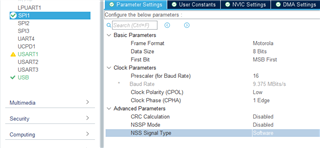
I am using the TCAN4550 on the STM32G4 platform and encountered an issue with being unable to read or write registers. Except for the 0x0000 status register, which can correctly read out the chip model and version information, all other registers do not respond to my read/write operations, and the read values are always 0x00. The VIN input is 12V power, VIO provides a 3.3V reference voltage, and after power-on, the FLTR pin shows a voltage of 1.5V. I have tried using 25MHz and 40MHz crystals, but neither worked.

  • Hi Morthine,

    The TCAN4550 has a couple internal LDOs.  There is a 5V LDO that steps the VSUP (which you call VIN) down to 5V, and then there are additional LDOs that step the 5V down to the digital levels used by the CORE.

    The 5V LDO requires a 10uF capacitor on the VCCOUT pin to be stable.  Your schematic shows the VCCOUT pin is floating and this required 10uF capacitor is missing.  This is likely why the digital core is non-responsive to your SPI read/write attempts.

    The Status and Device ID registers which are in the range of 0x0000 to 0x002F are implemented in discrete logic hardware and do not require the digital core or the crystal to be fully operational in order to return a value.  This is why you are able to read register 0x0000.

    I don't know if it is possible for you to add a 10uF capacitor to the VCCOUT pin (pin 16), but the device requires this capacitor to operate correctly as specified in the datasheet.

    If you have to make any PCB revisions, I would also recommend adding a series resistor between the OSC1 pin and the crystal which is very helpful in optimizing the clock performance.  Please review the TCAN455x Clock Optimization and Design Guidelines Application Report (Link) for more information.

    Regards,

    Jonathan