This thread has been locked.

If you have a related question, please click the "Ask a related question" button in the top right corner. The newly created question will be automatically linked to this question.

THVD8010: Application issues.

Expert 2020 points

Part Number: THVD8010

Tool/software:

Hi Team,

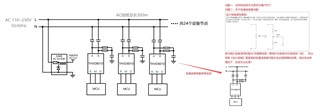
1. Is the application method shown in the following figure correct?(total 24 nodes)
2. Regarding the issue of low-pass filters, please provide an answer based on the schematic diagram.

The device is using an AC non isolated power supply (N line connected to GND), and the low-pass filter may not achieve the expected effect. What should be done in this case?
  • Hi Reed,

    We are reviewing your questions, and we will try to get a response to you by the end of day tomorrow. 

    Best,

    Ethan

  • Hi Reed,

    1. Is the application method shown in the following figure correct?(total 24 nodes)

    I'm not entirely sure. I see a power supply that generates 3.3V? And words in grey that say AC 110V to 250V.

    Our device can't be connected to an AC line with that high of a voltage. You probably need to use a transformer to isolate the voltage and then use a redriver to drive the transformer. Please see the reference design below.

    https://www.ti.com/lit/ug/tiduf48c/tiduf48c.pdf?ts=1737587174043

    2. Regarding the issue of low-pass filters, please provide an answer based on the schematic diagram.

    The device is using an AC non isolated power supply (N line connected to GND), and the low-pass filter may not achieve the expected effect. What should be done in this case?

    We have examples of an input filter in the ti design I referenced earlier (figure 2-6). I'm not entirely sure what kind of filter you are looking for since yours looks more like it's trying to stabilize the common mode. 

    -Bobby

  • Hi BOBBY,

    Thank you for your reply,

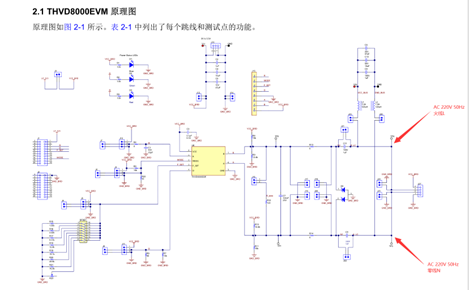
    a. The following is the schematic diagram of the development board application. Is the AC power line shown in the figure directly connected to the TP3 and TP4 networks for use?

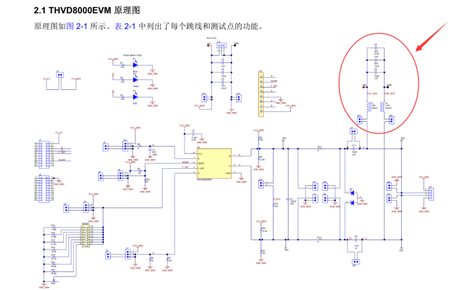
    b.  The following is the schematic diagram of the development board application. What is the actual function of the circuit inside the red circle in the picture?

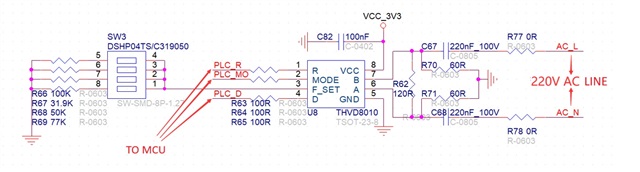
    c. Is there a problem with the circuit schematic diagram of the actual application shown below (where the neutral line N is connected to GND ground)?

  • a. The following is the schematic diagram of the development board application. Is the AC power line shown in the figure directly connected to the TP3 and TP4 networks for use?

    What is the AC voltage? If it is too large, the THVD8000 will likely break. For higher voltages you will need a transformer to isolate and attenuate the AC signals. Our THVD8000 won't be able to directly drive a transformer though.

    b.  The following is the schematic diagram of the development board application. What is the actual function of the circuit inside the red circle in the picture?

    That section of the board is for DC power (like power over cable not the board/device power). The inductors L1 and L2 isolate the power from the device's modulating signal output. 

    c. Is there a problem with the circuit schematic diagram of the actual application shown below (where the neutral line N is connected to GND ground)?

    220V AC is too much for this device to handle and it will break.

    You need to use a transformer to protect our device.

    Please take a look at the TI design below:

    https://www.ti.com/lit/ug/tiduf48c/tiduf48c.pdf?ts=1739487567937&ref_url=https%253A%252F%252Fwww.ti.com%252Ftool%252FTIDA-010935

    -Bobby

  • Hi BOBBY,

    Thanks,

    a. In the plan, how to modify the circuit if the input terminal is between 20~50V and connected to 220V?

    b. Can using two HTVD8000s, one receiver and one transmitter, increase the transmission distance? If so, how much can it be improved?

  • a. In the plan, how to modify the circuit if the input terminal is between 20~50V and connected to 220V?

    I don't think you can directly connect two different power rails/outputs to each other in this topology. They would probably need to use two separate networks. 

    b. Can using two HTVD8000s, one receiver and one transmitter, increase the transmission distance? If so, how much can it be improved?

    This is required for communication to work. One of the transmitters sends the signal across the cable encoded. A receiver is needed to decode the encoded signal back from differential to TTL. You cannot use only one. (Atleast 2x THVD80X0 is required in all set ups, one for transmission and one for receiving).

    -Bobby

  • Hi BOBBY,

    Thanks.

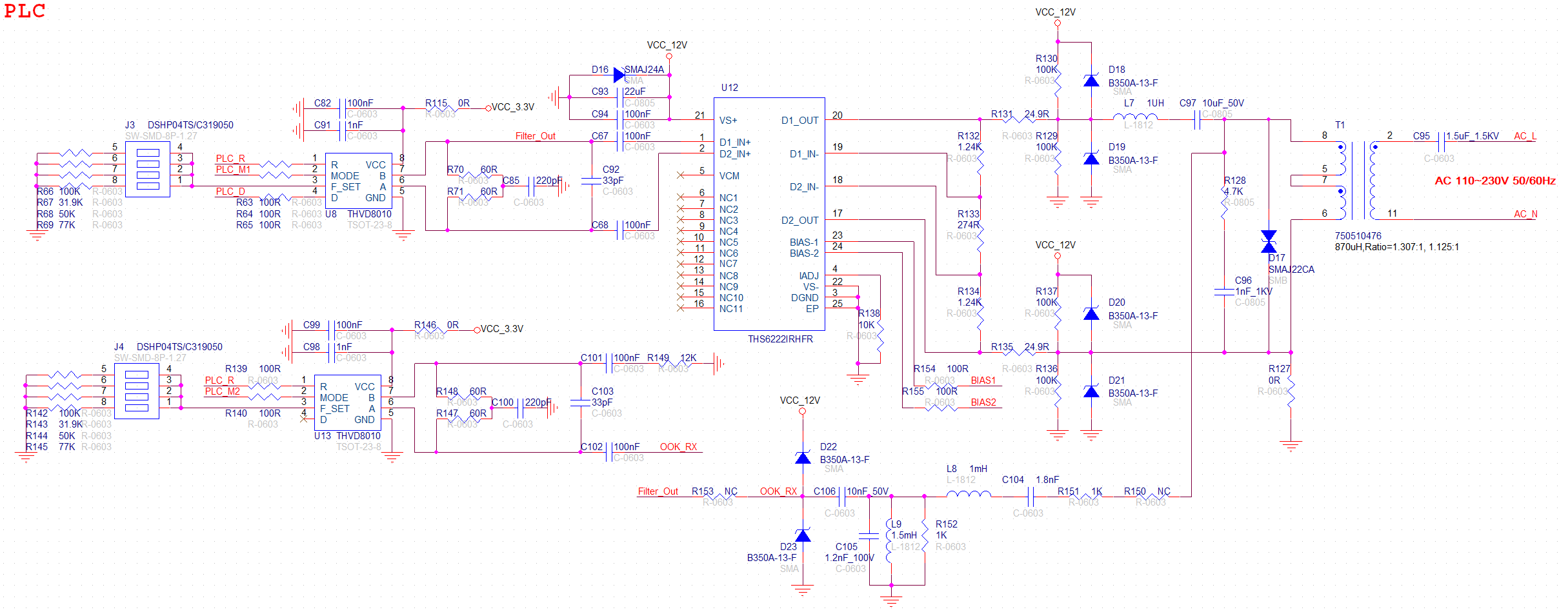
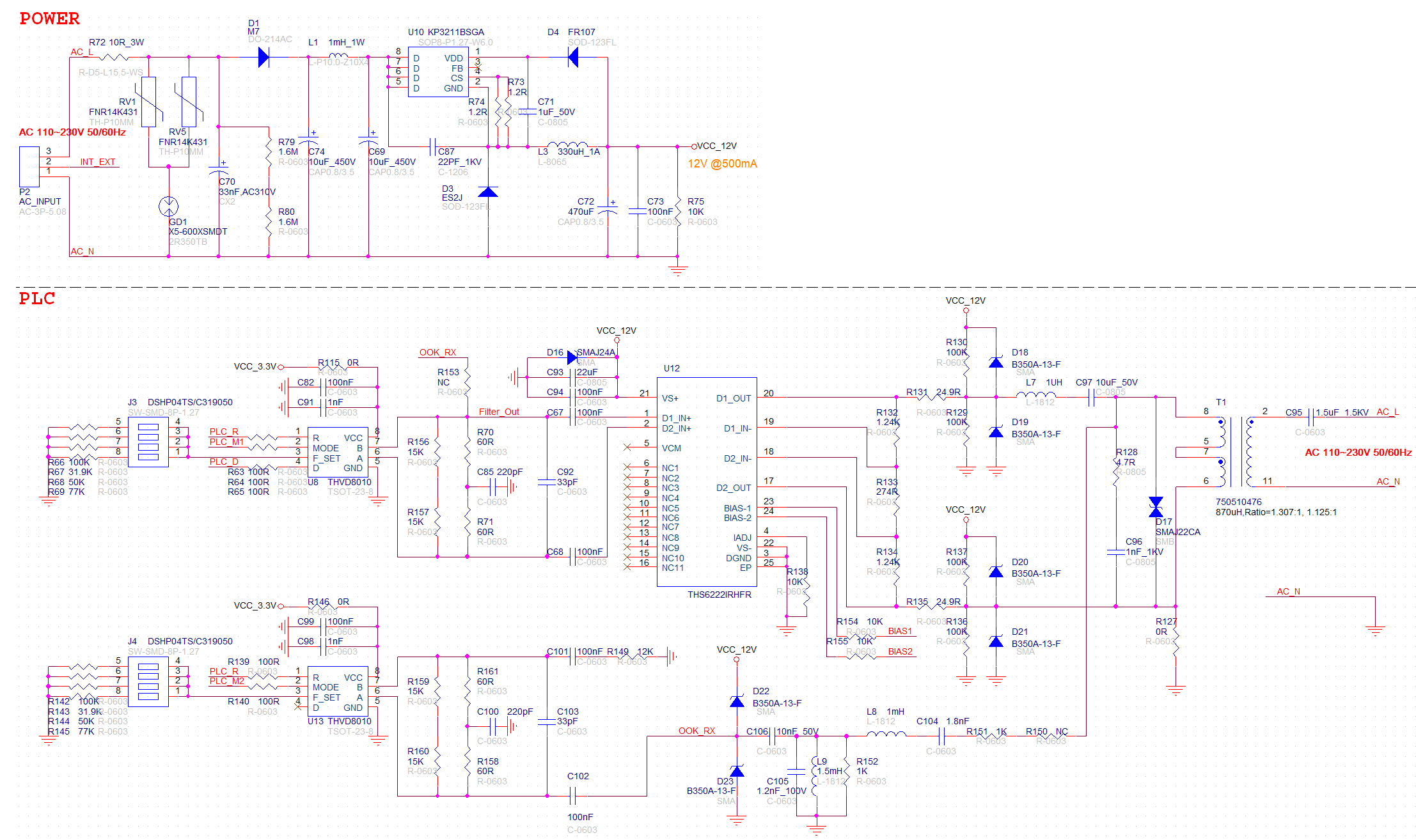
    Please help to check if the schematic diagram below is reasonable.

  • Reed,

    EDIT: I modified my response because I realized you are using the pseudo-differential mode.

    The biasing resistors R154/155 are 10k in the reference design and in your schematic it is 100 ohms. 

    The schematic in the reference design includes 15k pull down resistors to GND on the THVD80x0 A/B pins which I don't see in your schematic. I would set them there and use as do not populate (DNP) just in case.

    The snubber resistor (R128) should be 4.7 ohms. This was a mistake on the reference design.

    -Bobby

  • Hi BOBBY,

    Please help check below schematic diagram .

    This image is compatible with the use of a single THVD8000 solution.

    The document in this link states that a single THVD8000 solution can be used. Do I understand correctly?

       Using THVD80x0 Devices to Communicate Over an AC Outlet   www.ti.com.cn/.../slla590

  • Hi Reed,

    This was the design I was referencing before: https://www.ti.com/lit/ug/tiduf48c/tiduf48c.pdf?ts=1740443380163

    The one you reference also works. The one above in the TI design have the 15k resistors (R156 and R157) going to GND so you can modify that in your schematic but I think you can make those resistors DNP (do not populate). 

    The document in this link states that a single THVD8000 solution can be used. Do I understand correctly?

    Yes, the idea is you have one for driving -----cable------one for receiving. 

    So you would use one for the transmitting board and one for the receiving board. (Only one needs to be populated at a time).

    -Bobby