This thread has been locked.

If you have a related question, please click the "Ask a related question" button in the top right corner. The newly created question will be automatically linked to this question.

THVD4411: Concerns about pin settings

Part Number: THVD4411
Other Parts Discussed in Thread: THVD4421, THVD4431

Tool/software:

I am trying to build a 232/422/485 circuit using the THVD4411.

Before that, I have some questions, so I will leave them here.

1. Regarding RS232 settings (MODE1/0 = L/H)

  a. Is the setting of "DIR" PIN Don't care, or should I set a specific state among H/L?

  b. Is the setting of "TERM_TX/RX" Don't care, or should a specific state be set between H/L?

2. Regarding RS485 Full duplex setting (MODE1/0 = H/L)
  a. Is the setting of "DIR" PIN Don't care, or should a specific state be set between H/L?

3. Inquiry regarding RS422
  a. If RS485 full duplex setting and physical wiring are RS422, is RS422 communication possible?

That's all.

Waiting for your reply.

  • 1. When in RS-232 mode, the RS-4xx control pins are ignored. (But the pins must not float.)

    2. In half duplex mode, the DIR pin would control whether the driver or the receiver is active. In full duplex mode, the receiver is always active (see table 7-5), and the driver is enabled with DIR=H (see table 7-4).

    3. For practical purposes, the electrical characteristics of RS-422 and RS-485 are the same. Just call it "RS-4xx", and wire the bus lines and termination resistors according to the requirements of your application.

  • Clemens comments are correct, I've gone ahead and added a few comments myself though.

      a. Is the setting of "DIR" PIN Don't care, or should I set a specific state among H/L?

    The DIR pin has a weak internal pull down resistor but it is also a don't care when in RS232 mode.

      b. Is the setting of "TERM_TX/RX" Don't care, or should a specific state be set between H/L?

    Both these pins also have weak internal pull downs. They are also don't care when in RS232 mode.

    2. Regarding RS485 Full duplex setting (MODE1/0 = H/L)
      a. Is the setting of "DIR" PIN Don't care, or should a specific state be set between H/L?

    Clemen's comment is correct, basically only used in half duplex mode. I recommend a pull up resistor L1 if you are toggling the DIR pin since L1 will go HI-Z when you disable the receiver.

    3. Inquiry regarding RS422
      a. If RS485 full duplex setting and physical wiring are RS422, is RS422 communication possible?

    Yes, technically RS485 is a more stringent version of RS422 (meaning RS485 is compatible with RS422). 

    -Bobby

  • 1. So, in RS232 mode, do not let the "DIR" and "TERM_TX/RX" pins float, but set them to H or L? It has no effect on the operation.

    2. a. Whether it's RS422 or RS485, in half-duplex mode, the physical transmission and reception communication lines are the same, so I understand that physical communication collisions are prevented by controlling "DIR" in the transceiver.

       b. However, in full-duplex mode, since the physical transmission and reception communication lines are different, there is no need to control "DIR" in the transceiver.

    You said "the driver is enabled with DIR=H" as the answer, but shouldn't the "DIR" pin be set to H?

    In full-duplex mode, reception is always enabled, so whether "DIR" is H or L, reception occurs. And transmission operates according to the setting of the "DIR" pin. Then, in full-duplex mode, to enable transmission/reception, shouldn't the "DIR" pin be set to H?

  • Thank you for your reply.

    I have a question about the content, so I am leaving a reply.

    "Clemen's comment is correct, basically only used in half duplex mode. I recommend a pull up resistor L1 if you are toggling the DIR pin since L1 will go HI-Z when you disable the receiver."

    1. Are you saying that in half-duplex mode, if you disable the receiver, it will be HI-Z?

    2. L1 is "Logic output" in RS232 mode. Since you are using half-duplex mode, shouldn't "Logic output" be "L2" in 422/485?

      2-1. If L2 is correct, is it correct to put a pull-up resistor on L2?

  • Sorry, I confused THVD4421.

  • 1. So, in RS232 mode, do not let the "DIR" and "TERM_TX/RX" pins float, but set them to H or L? It has no effect on the operation.

    The DIR and Term pins have internal resistors so they aren't floating anyways. You don't have to connect them externally since they are biased internally.

    You said "the driver is enabled with DIR=H" as the answer, but shouldn't the "DIR" pin be set to H?

    In full duplex mode, the direction pin should be should be held high if you want the driver enabled. If it is low or floating/open then the drivers are disabled. It follows the truth table in section 7-4.

    1. Are you saying that in half-duplex mode, if you disable the receiver, it will be HI-Z?

    If DIR is high, the receiver (L1 TTL output) goes high-z. I recommend putting a pull up resistor on L1 so that it doesn't float to GND which may cause a glitch o Rx.

    2. L1 is "Logic output" in RS232 mode. Since you are using half-duplex mode, shouldn't "Logic output" be "L2" in 422/485?

      2-1. If L2 is correct, is it correct to put a pull-up resistor on L2?

    L1 is an output for THVD4411 and L2 is an input for THVD4411. 

    For RS232 L1 and L2 are outputs and L2 only is an output for RS485 for THVD4421.

    -Bobby

  • I have some questions.

    1. If a 232 signal is applied while the mode is set to 485, will thvd4411 receive electrical damage?

    What I am concerned about is when the physical wiring is shared between 232 and 485 and thvd4411 is set to 485 to receive a 232 signal.

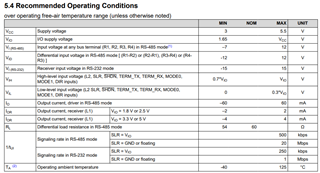
    When it is 485, the input voltage is -7~12, and when it is 232, the input voltage is -15~15. Therefore, there are cases where it exceeds -8/3V, and in that case, I am worried that thvd4411 will continuously receive electrical damage.

  • The recommended operating conditions specify what your circuit must do to allow the device to work correctly. With RS-232 signals in RS-485 mode, the device would not be able to receive correct signals anyway, so the recommended operating conditions do not matter.

    The absolute maximum ratings allow ±16 V on the bus pins, so RS-232 signals will not damage the device.

  • Hi Byungjoo,

    Clemens is correct about the recommended operating (it is the values we use to test the datasheet electrical parameters around, like bounding limits).

    Using the device outside of the recommended but within the absolute max ratings will mean the device may not perform to datasheet electrical parameters but won't break the device. The absolute max ratings are the limits that are set which if violated could result in the device being damaged.

    With the internal termination enabled for RS485 mode, an RS232 signal on the pins would definitely break the device. (max rating differential is +/-6V)

    With the internal termination disabled for RS485/422, RS232 signals are usually +/-5.5V or +/-9V which would not break the device. I believe if the RS232 signals were +/-11V and the worse case happened where A-B >+/-22V then the device could break. So if the RS232 device outputs larger than +/-11V then there could be a risk of breaking the device.

    -Bobby

  • I am contacting you with further questions.

    I would like to know how thvd4411 behaves when both Mode 0 and Mode 1 pins are L.

    Please reply and thank you for your help.

  • Hi Byungjoo,

    This device is a part of the THVD4431 superset which uses mode 0 = mode1 = logic low as a loopback mode for RS232. I would assume this is the same for the 4411 device but they may have modified the metal to remove this feature. I will need to double check. (I'll see if I can make time in the lab tomorrow to test it on our EVM).

    -Bobby

  • Hi BOBBY,

    What would be the results of your experiment with Mode0 = Mode1 = Low?

  • Hi Byungjoo,

    Sorry for getting back to you so late!

    So when I did my testing, I put the device in RS232 and probed the charge caps and saw it was on then switch it to Mode0=Mode1=GND/LOW and saw no changes to the charge pump (the device was still in RS232 mode). I toggled the TTL input side and the RS232 output followed it. The RIN did not mirror it so that means it wasn't using the internal loopback that I thought it would. 

    End result is I think the device still is in a normal RS232 mode though since the datasheet doesn't seem to want users to be in this mode is because originally the super set has the pins tied to multiple inputs on the RS232 side so the internal loading on the RS232 side might still be shorted in that way so I wouldn't recommend putting the device in this mode for actual use.

    -Bobby