This thread has been locked.

If you have a related question, please click the "Ask a related question" button in the top right corner. The newly created question will be automatically linked to this question.

THVD2450: TVS diode and Protection

Part Number: THVD2450
Other Parts Discussed in Thread: THVD1510

Tool/software:

Hi TI experts

I have a differential signal that is transmitting into the bus pins (A and B) of THV2450 and they are +- 14V. I want to select a TVS diode for the circuitry. Do you have any recommended TVS diode? Would SMAJ14CA be sufficient to protect the device and the lines from transcient and surge? 

Also the datasheet states that the receiver pins has a fail-safe operation feature and 

"The receivers are fail-safe to invalid bus states caused by the following:
• Open bus conditions, such as a disconnected connector
• Shorted bus conditions, such as cable damage shorting the twisted-pair together
• Idle bus conditions that occur when no driver on the bus is actively driving
In any of these cases, the receiver outputs a fail-safe logic high state if the input amplitude stays for longer than
tD(OFS) at less than |VTH_FSH|."
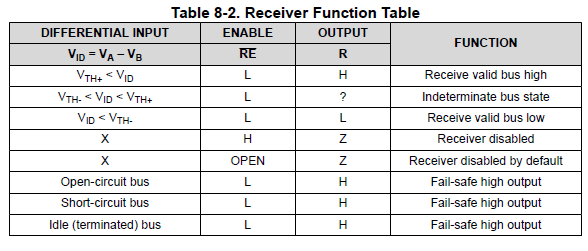
Do I still need a pullup resistor for when the output is "?"

Appreciate your patience helping me with these

Best Regards

Ena

  • Yes, the SMAJ14CA  would protect ±14 V signals against larger voltages.

    The fail-safe receiver has a defined state for most common error states (see the last three lines of the table). The indeterminate state is extremely unlikely to happen; it would requite a driver to force the bus to certain voltage, and then a pull-up would not help.

  • Hi Ena,

    Clemens is correct.

    Do I still need a pullup resistor for when the output is "?"

    There actually isn't a undetermined state in the sense that the device doesn't know what to do. It more like each device is different and may have their thresholds sitting at different areas. Some may treat -100mV as R=high (and will always do this) and others may treat -100mV with R as a low. This due to silicon variation and internal resistor mismatches. 

    You can add external fail safe resistors (a pull up resistor on A and a pull down resistor on B) to add more margin when the bus is idle and the driver on the bus is disabled. 

    Would SMAJ14CA be sufficient to protect the device and the lines from transcient and surge? 

    surge is a whole different beast. ESDs and EFTs are lower in power in terms of duration. Surge events are much larger in power since they hang around the microsecond range. We have a reference design that discusses surge protection here: https://www.ti.com/lit/ug/tiduas1b/tiduas1b.pdf?ts=1744397878399

    -Bobby

  • Hi Clemens and Bobby,

    Thank you guys so much for the help. I will take a look at the fail safe operation.

    I am still very confused with the TVS diode rating. Some source tells me that I should always choose the reverse working voltage to be slighty more than 14V, while I am also looking at the 0.7 derating factor. I also have to factor in the Ipp and Ppp of the diode but I am not sure what to compare this with. Do I look at THVD2450 electrical characteristic or do i look at the signal that is coming into the buses? Thanks!

    Best Regards,

    Ena

  • The working voltage must be high enough so that your actual signals are not clamped. Only the signal voltages that actually happen on the bus matter; I do not know where your ±14 V requirement comes from, but RS-485 drivers output only voltages between 0 V and 5 V, and a wider signal voltage range is caused by ground shifts between the nodes. (For the working voltage, a derating factor is not necessary.) 

    The breakdown voltage (at whatever current you expect) must be low enough so that the transceiver does not get damaged. The THVD2450 tolerates ±70 V, so this is not a problem.

  • Thanks you so much for the clarification. 

    I was reading up on the fail-safe biasing operation when I came across https://e2e.ti.com/support/interface-group/interface/f/interface-forum/1478812/thvd1510-fail-safe-bias-circuits/5679141?tisearch=e2e-sitesearch&keymatch=Bias%20resistor%20for%20the%20external%20fail-safe%20circuit#5679141 

    Can I check if this applies to THVD2450 as well? Thanks!

  • Can I check if this applies to THVD2450 as well? Thanks!

    THVD24XX use a different type of fail safe design. 

    THVD1510 has the Vth+ below GND so if the A/B pins are shorted together or to GND/Vcc then A-B should be 0V. So 0V>-20mV which would force R to be a logic high. 

    THVD24XX is a timer based fail safe. If the A-B pins stay between -40mV and 40mV for longer than 18us, the R output is forced high. During the 18us time, the R output could toggle. 

    The advantage with the THVD24XX is it provides wider Vhysteresis and a more symmetrical Vth which can lower bit distortions (nicer at faster data rates).

    -Bobby