This thread has been locked.

If you have a related question, please click the "Ask a related question" button in the top right corner. The newly created question will be automatically linked to this question.

SN65HVD1782: [Vod] checking

Part Number: SN65HVD1782
Other Parts Discussed in Thread: THVD2410, THVD1400

Tool/software:

Hi team,

 i am checking the Vod setting of RS485 on different device.

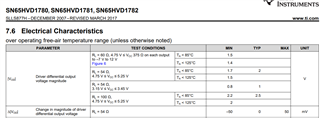
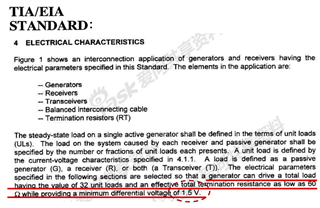
 i see the TIA/EIA standard have demand on Vod on 1.5V min at least. but i am seeing the SN65HVD1782 device have very low Vod than standard.
my question is:

1. why RL = 54 Ω, 3.15 V ≤ VCC ≤ 3.45 V condition will under spec of standard, does it still work as RS485 standard?

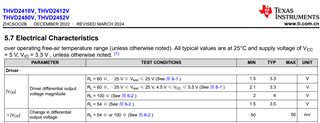
2. why another device doesn't mention the condition of 3.15 V ≤ VCC ≤ 3.45 V like thvd2410

3. what`s the limit and concern when design the Vod range on IC definition ? 

  • The standard assumes that you are using 5 V transceivers. With 3.3 V, Vod is lowered to allow some headroom to the supply.

    This is not a problem in practice because all receivers have a wide common-mode range.

  • Hi Allen,

    I think HVD1782 was designed around 5V Vcc and they spec'd the VoD at 3.3V without regard to the RS485 standard. Basically saying the device could be operational at 3.3V but not compliant to the RS485 standard at 3.3V. 

    1. why RL = 54 Ω, 3.15 V ≤ VCC ≤ 3.45 V condition will under spec of standard, does it still work as RS485 standard?

    RS485 receivers require +/-200mV so as long as this is met, the receivers on the bus should still operate with HVD1782 when its used at 3.3V but the distance and data rate supported at 3.3V likely won't be as good as 5V. 

    2. why another device doesn't mention the condition of 3.15 V ≤ VCC ≤ 3.45 V like thvd2410

    THVD14XX was designed with 3.3V operation in mind with the goal of meeting RS485 standard.

    3. what`s the limit and concern when design the Vod range on IC definition ? 

    If VoD is lower, the distance supported is lower. You can think of the cable as a resistor. If you have termination at the end, then there is a voltage divider.

    A---cable resistance------

                                            |

                                         120 ohm resistor

                                            |

    B---cable resistance-------

    The voltage between the 120 ohm resistor will be smaller because VoD is smaller. So at longer distances, lower VoD will affect the voltage drop across the receiving node.

    -Bobby

  • HI Boddy,

     tks here. it is clear of the HVD1782  VS standard behavior.

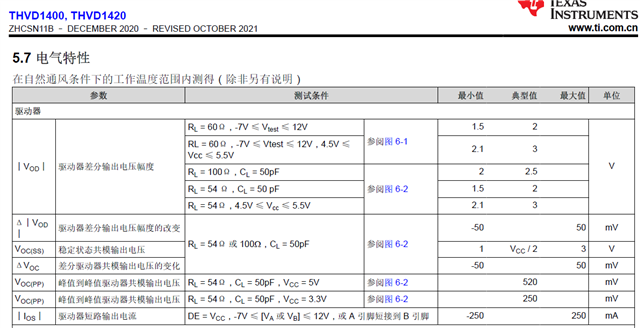
    but we can see the THVD1400 do not mention the Vod on VCC3.3V here.  

    So i purpose if device work with standard , they need to work at 5V to get higher Vod, But we can not guarantee the Vod behavior on 3v3VCC?

  • Allen,

    The top VOD spec uses 3V to 3.6V for the Vcc. So the minimum voltage with 60 ohms is 1.5V which we guarantee. I verified this by looking at the char data for this device. 

    For THVD14xx, it was designed to have 1.5V or high VoD at 3V or higher. The older HVD1782 was not designed around 3V Vcc.

    -Bobby