This thread has been locked.

If you have a related question, please click the "Ask a related question" button in the top right corner. The newly created question will be automatically linked to this question.

TCAN1051HG: Designing with TCAN1051HGVDR

Part Number: TCAN1051HG
Other Parts Discussed in Thread: ISO1044

Tool/software:

Hello Team,
We are using the CAN Transceiver TCAN1051HGVDR in one of our products.
These signals from this transceiver is then fed to another transceiver (TCAN1051HGVDR) at the DUT end through SSR (TLP3147(F).
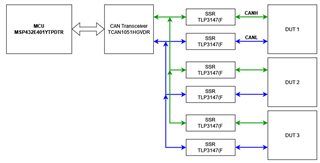
We are using the SSR to MUX the MCU with different DUTs.
Only one pair of SSR will be selected at a time so that only one communication is live between CAN transceivers.
Also, only one DUT will be powered at a time.

Since the SSR has some off state capacitance, the signals will be present at the output of the SSR even when it is off but the device cannot read it because it is powered off and since the signals are not DC biased.

We have termination resistors at all the transceiver sides.

If DUT 2 and 3 are not connected, we have proper communication between MCU and the DUT1.
If DUT2 is connected without termination resistor, then also we have communication between MCU and DUT1 or DUT2.(DUT1 has termination resistor)
If DUT2 is connected with termination resistor, then we are not able to communicate with DUT1 or DUT2.
If DUT3 is connected with the termination resistors, then we are not able to communicate with DUT1 or DUT2 or DUT3

1). What could be the reason for this?
2). Will CAN work with only 1 termination resistor at one end.
3). During off time, no DC current will flow through the SSR, since CAN has pulsating signals, and since AC can pass through the off state capacitance of the SSR, will this load the CAN transmitter?.
4).

Looking for your reply

  • Hi Sv,

    1. It seems the bus is over terminated. When the bus sees proper termination, communication is possible.  However, with more termination included, the total impedance drops and signal reflections should be observed. As more termination is included, the signal eventually collapses. I.e, over termination loads down the bus. And active termination could be used to activate termination resistors as needed. 

    2. CAN bus needs 2 terminations, one at each end of the active bus. Under certain conditions, 1 termination can work. Such as short distances, low speeds, low node count. However, reflections will also increase and may be acceptable depending on the system requirements. 

    3. Yes, the added capacitance can still slow signal edges. Especially with 1 Mbps+ speeds, thanks. 

    Best Regards,

    Michael. 

  • Hello Michael,
    Thank you for your reply.

    1. It seems the bus is over terminated. When the bus sees proper termination, communication is possible.  However, with more termination included, the total impedance drops and signal reflections should be observed. As more termination is included, the signal eventually collapses. I.e, over termination loads down the bus. And active termination could be used to activate termination resistors as needed. 

    In our case, only one node (DUT) will be selected at a time.
    All other set of SSR will be off which means there will be only 2 termination resistors (one at MCU side and other at selected DUT side.)

    And active termination could be used to activate termination resistors as needed. 

    Our SSR is more towards the MCU side. We have a wiring harness between the SSR and DUT.
    We already have a termination resistor at the MCU side. I believe it is better to add a termination at the DUT side and not on the SSR side.
    The DUT already has a termination resistor and we cannot modify it with an active termination resistance.
    1). Since all other SSR are off, will this has any impact on the bus.
    2). Will this load the bus

  • Hi Sv,

    If off, no impact if the off state capacitance is minimal and if the bus still sees the 2 termination resistors, thanks.

    Best Regards,

    Michael.

  • Hello Michael,
    Thank you for your reply.

    The off state capacitance of the SSR is 240pF.

    if the bus still sees the 2 termination resistors

    Did you mean the the bus will see only 2 termination resistors at source and receiver side and not at the off SSR side?.

    Also, what will happen if we have 3* 100E termination resistors in the bus?.

    Also, can you please suggest an isolated CAN transceiver with similar footprint?.

    Looking for your reply

  • Hi Sv,

    240 pF is large. The recommendation is < 100 pF.

    See figure 9-1 of the data sheet recommending only 2 Rterm at the ends of the bus at all times. If more is used, the bus will be too loaded for reflections and the minimum required VOD not met. You may also see ISO1044, ISO CAN Devices or I can further connect you to the ISO team for additional recommendations, thanks.

    Best Regards,

    Michael.